In 1961, three small clay tablets appeared in Tartaria, Romania, sparking an archaeological debate that continues to this day. The symbols incised on their surface, dated by carbon-14 to 5300 BC, could represent the oldest known writing, predating Sumerian writing by millennia. However, their extreme fragility prevents frequent handling, limiting direct study. This is where digital archaeology and photogrammetry offer a revolutionary solution to preserve and analyze this heritage without physical risk.
High-resolution photogrammetry for clay heritage 🏺
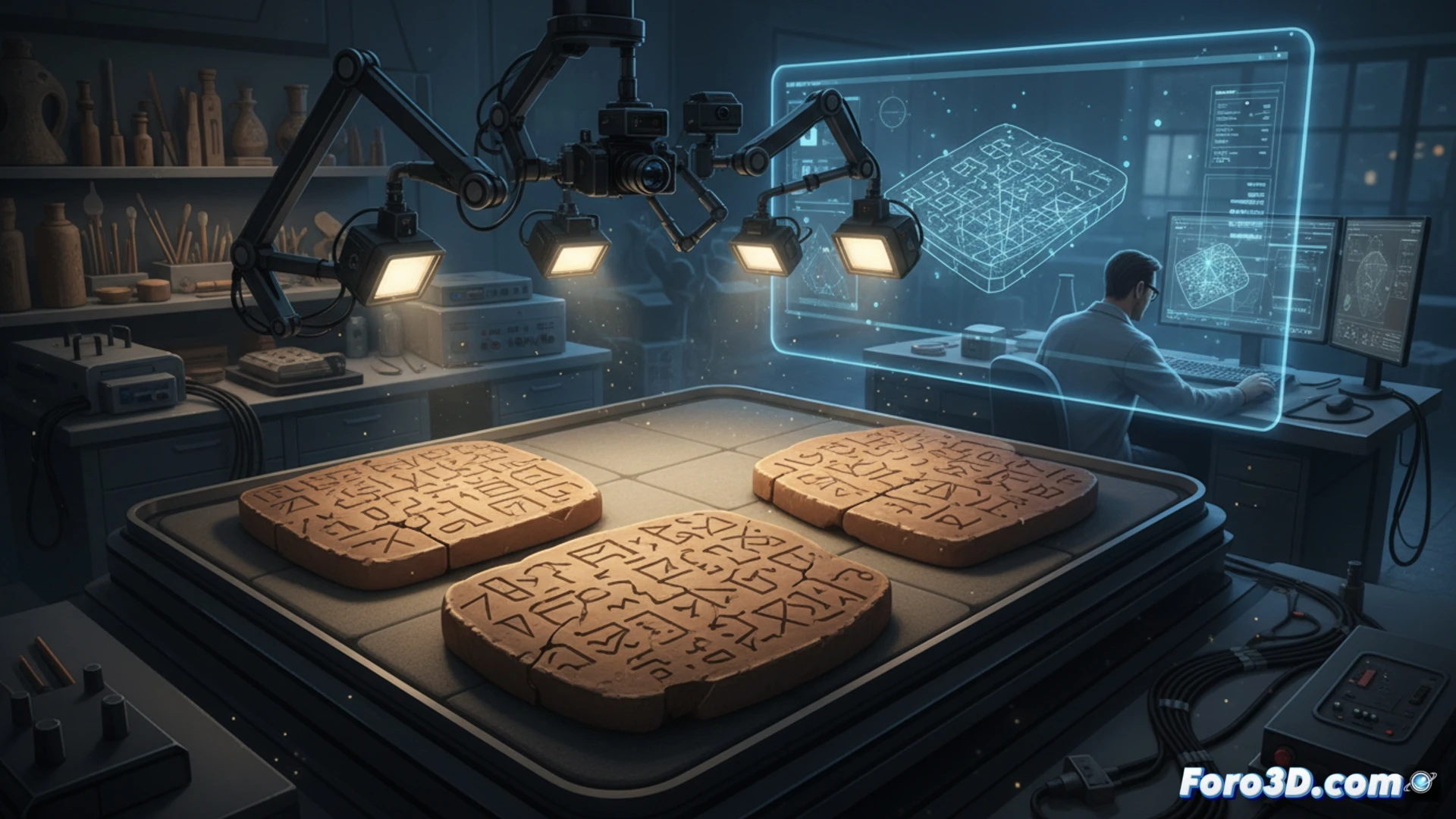
To digitize the Tartaria Tablets, a workflow using a DSLR camera of at least 24 megapixels and a 100 mm macro lens, combined with cross-polarized LED lighting to highlight the grooves of the symbols, is recommended. Between 80 and 120 images per tablet should be captured, rotating the object 360 degrees in 5-degree increments and at two different heights. Processing in software such as Agisoft Metashape or RealityCapture allows generating a dense point cloud and a textured mesh with 0.05 mm resolution. This resulting 3D model allows examining each stroke from any angle, measuring incision depths of up to 0.3 mm, impossible to appreciate with the naked eye. Furthermore, the reflectance of the clay material can be filtered to isolate any original pigments if they existed, although in this case the signs are mere incisions.
Global collaboration to decipher the past 🌍
The true value of this digitization lies not only in preservation, but in the democratization of knowledge. By uploading the 3D models to open repositories like Sketchfab or Zenodo, any researcher in the world can download them and apply pattern recognition algorithms to compare these symbols with contemporary scripts from Mesopotamia or the Balkans. It would even be possible to perform virtual wear analysis to simulate how the signs were engraved with flint tools. The Tartaria Tablets, once confined to display cases and photographs, thus become living data that the global community can interrogate, bringing us closer to confirming whether we are facing the first writing system of humanity.
Could 3D photogrammetry technology and spectral analysis reveal whether the symbols on the Tartaria tablets correspond to an undeciphered primordial writing system or to simple decorative marks, and how would this change our understanding of the origin of writing in human civilization?
(PS: and remember: if you can't find a bone, you can always model it yourself)