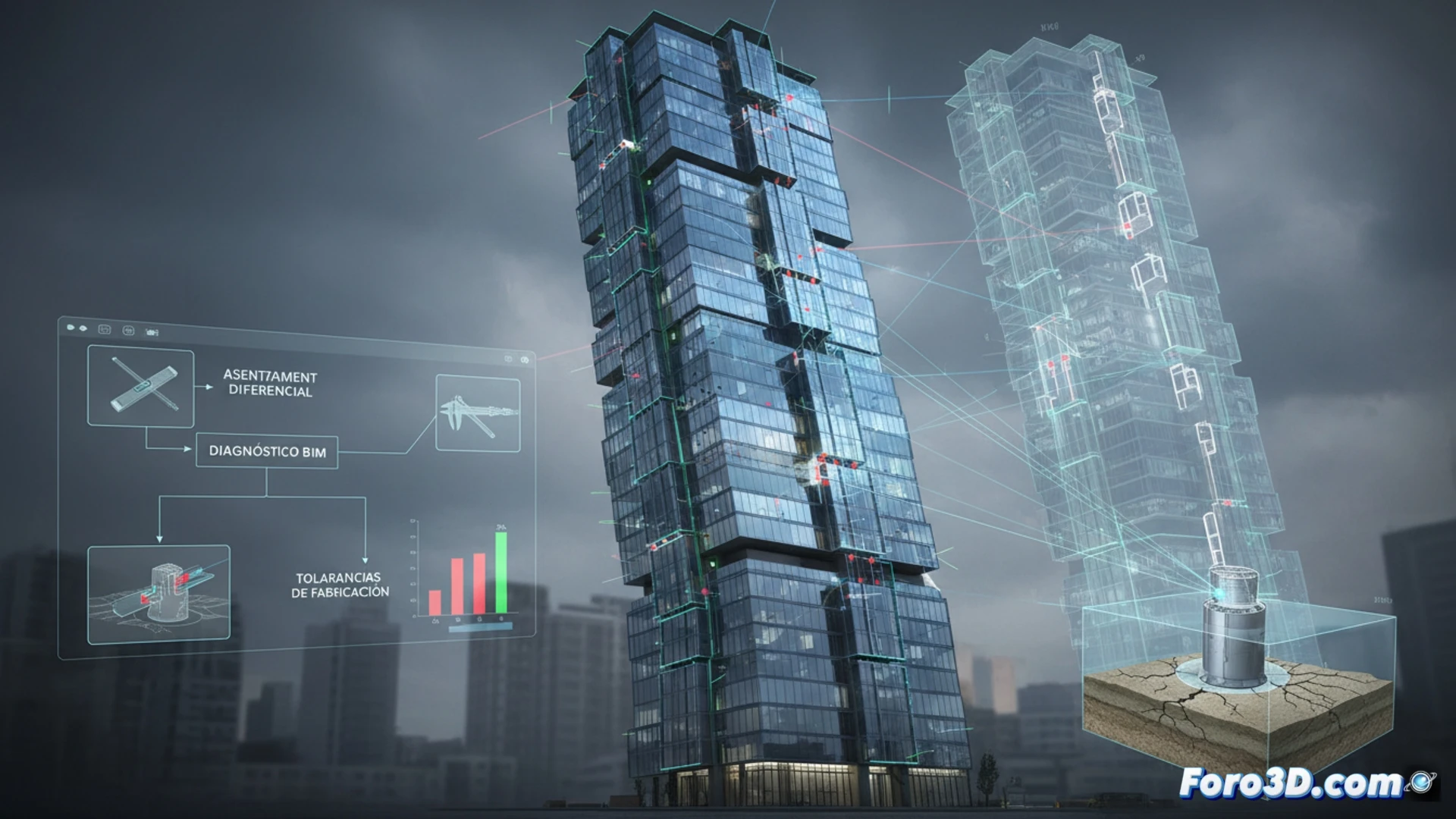
A skyscraper built with prefabricated modules shows a progressive tilt that threatens its structural integrity. To determine whether the origin of the failure lies in the manufacturing tolerances of the joints or in differential settlement of the core, a workflow based on comparing real point clouds against the original BIM model has been implemented. This 3D analysis allows for the identification of millimeter deviations and precise diagnosis of the pathology.
Geometric verification pipeline with Leica Cyclone and Navisworks 🏗️
The process begins with capturing the point cloud of the real structure using laser scanning, processed in Leica Cyclone to clean noise and register coordinates. Subsequently, it is imported into Autodesk Navisworks along with the BIM design model. The Clash Detection tool is configured to look for deviations greater than 5 mm between both sets. Results show that in the joints of the modules on the south facade, the misalignment is uniform and increases with height, indicating a systematic manufacturing error. In contrast, the columns of the central core show irregular vertical displacement, pointing to differential ground settlement. Trimble Business Center is used to calculate the global tilt vector and confirm the hypothesis.
Lessons for quality management in modular construction 📐
This case demonstrates that geometric verification using BIM not only serves to control execution but also to diagnose complex pathologies. The combination of point clouds and as-built models allows for differentiating between prefabrication errors and foundation failures, avoiding costly assumptions. For the industry, the lesson is clear: integrate clash detection not as a final construction step, but as a continuous monitoring tool during the construction of modular skyscrapers.
How can the BIM model of a modular skyscraper integrate IoT sensors and digital twins to detect and correct millimeter deviations in structural alignment in real-time before they compromise the building's integrity?
(PS: BIM is like having a building in Excel, but with nice windows.)