During a test firing, a liquid fuel engine made of Inconel via 3D printing failed catastrophically. The explosion was not a random accident, but the culmination of an accelerated fatigue process. Subsequent analysis, using 3D micro-CT, revealed the root cause: internal delamination. Lack of fusion between adjacent layers generated microcracks that, under thermal cycling and extreme combustion pressure, turned into localized hot spots, pushing the chamber wall to its strength limit.
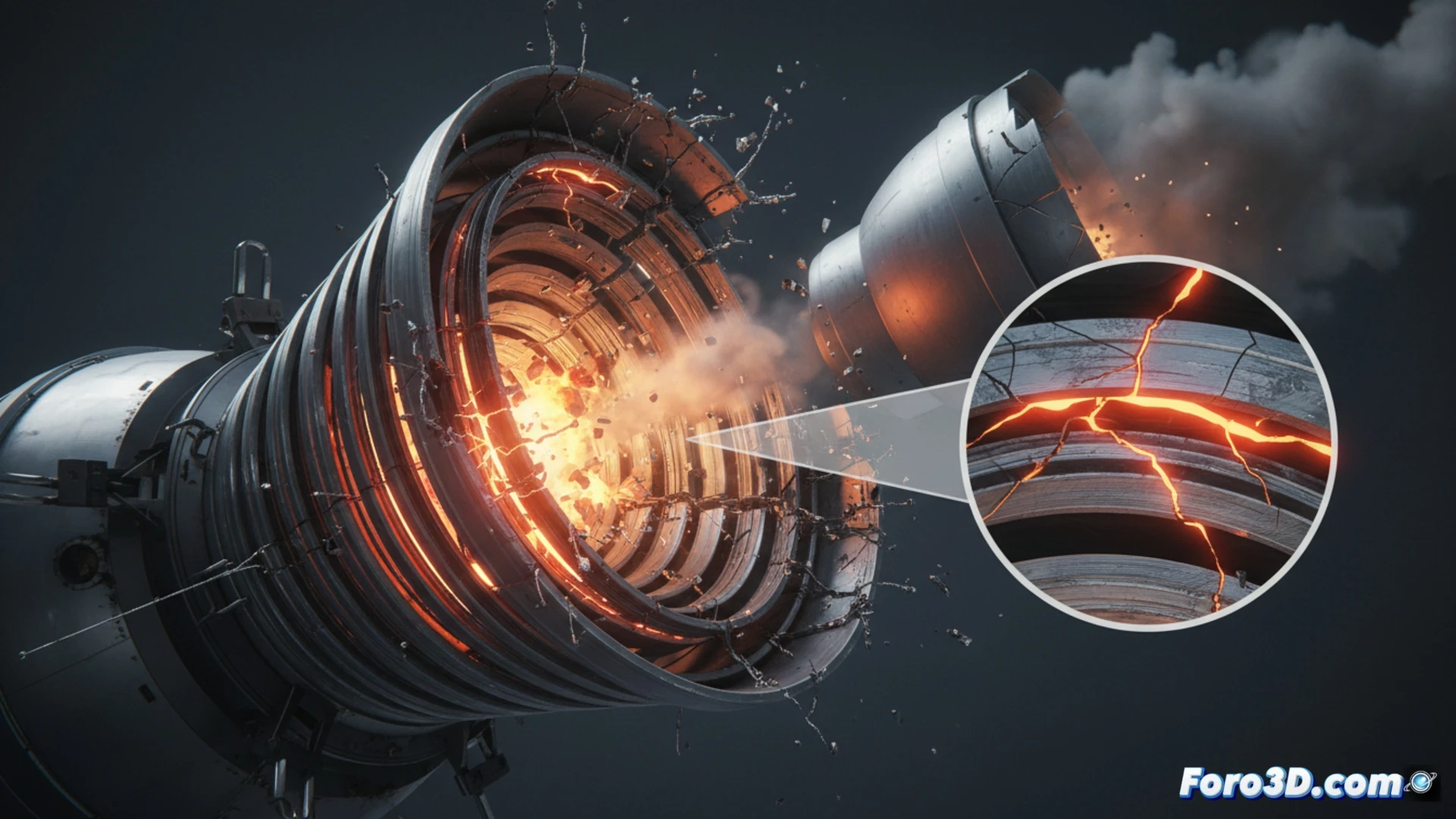
Failure reconstruction: Micro-CT, simulation, and thermal fatigue in Inconel 🔥
The investigation process began with a high-resolution 3D computed tomography scan in VGSTUDIO MAX. This software allowed segmenting the chamber volume and isolating internal discontinuities, precisely identifying the geometry of the lack of fusion between layers. With this data, the point cloud was imported into Ansys Discovery to perform a finite element analysis. The simulation coupled the heat transfer from the combustion gas with the mechanical stresses induced by pressure. The results showed that, around the delaminated defects, the thermal stress concentration exceeded the yield strength of Inconel at high temperature. This cycle of differential expansion and contraction acted like constant hammering, propagating the crack until the wall suddenly lost its structural integrity.
Lessons for the industry: Validate the process before the part ⚙️
This case demonstrates that material fatigue in additively manufactured parts depends not only on the base material but on the homogeneity of the process. A theoretically perfect Inconel can fail if a layer does not fuse correctly. Micro-CT technology, combined with multiphysics simulation in Ansys, allows anticipating these failures before reaching the test bench. For the engineer, the lesson is clear: validation of the printing process is as critical as the geometry design. The part must not only look good; it must be free of delaminations that, under cyclic fatigue, become time bombs.
What advanced nonlinear fatigue simulation techniques allow accurately predicting delamination in Inconel manufactured by 3D printing, considering residual stresses and anisotropic microstructures of the process?
(PS: Material fatigue is like yours after 10 hours of simulation.)