The recent mooring line failure in a floating offshore wind farm has brought attention to a phenomenon that materials engineers know well but is often underestimated in lifespan calculations: galvanic corrosion. This electrochemical process, accelerated by the saline environment and cyclic wave loads, not only reduces the steel's load-bearing cross-section but also generates pits that act as stress concentrators. The result is premature fatigue failure that can occur years earlier than predicted in design manuals.
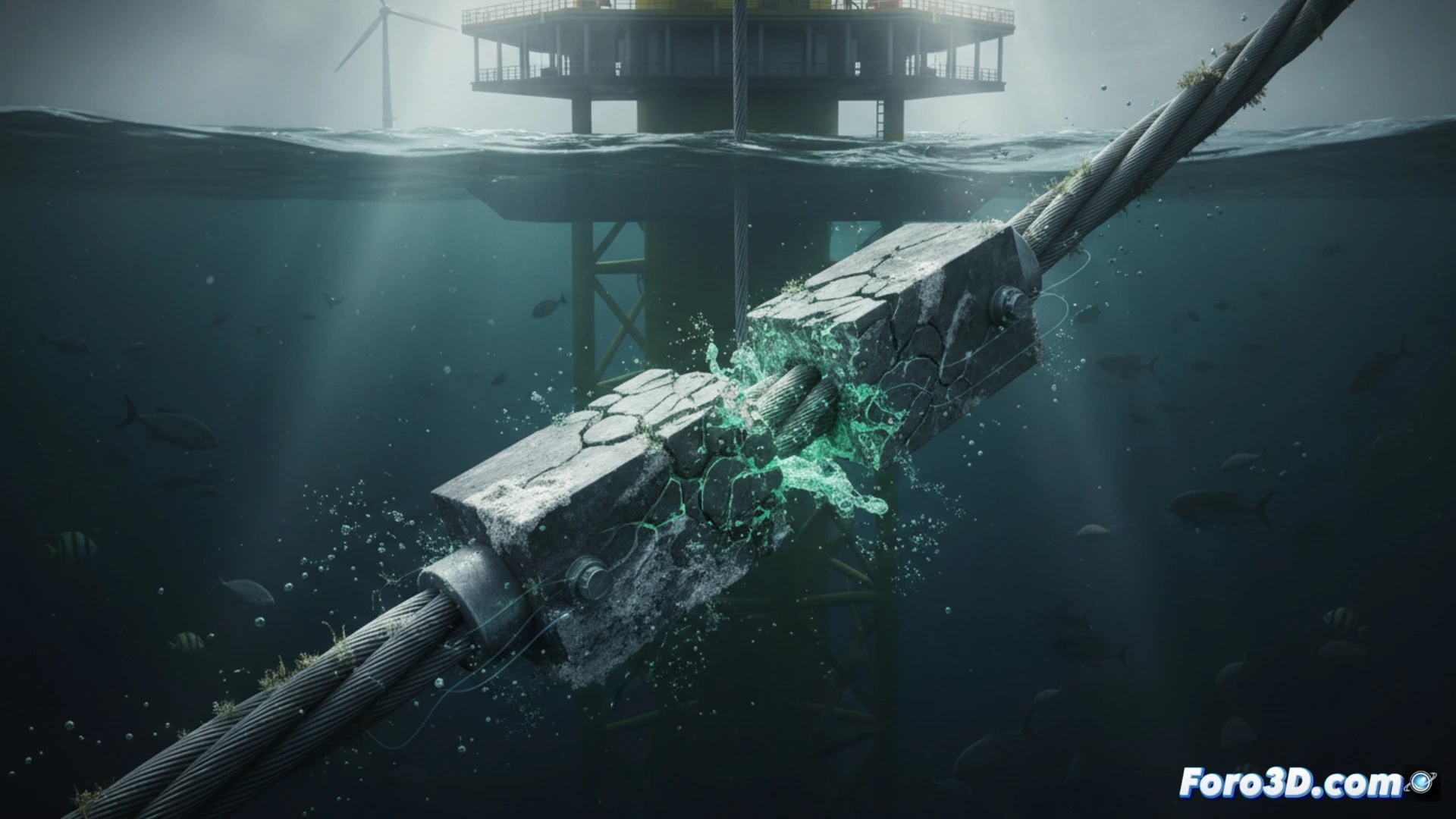
Dynamic load modeling and deformation analysis with OrcaFlex and GOM Inspect 🛠️
To understand how galvanic corrosion accelerates fatigue, it is necessary to simulate the real environment. OrcaFlex allows modeling the dynamic loads to which the anchor is subjected: axial tensions, bending induced by platform motion, and high-frequency vibrations. These load data are cross-referenced with the corrosion map obtained through 3D scanning. This is where GOM Inspect comes in, analyzing the accumulated plastic deformations in the corroded areas. The combination reveals that a pit just 0.5 mm deep can reduce the material's fatigue life by more than 40%. The next step is to document the actual failure geometry with Leica Cyclone, generating a point cloud that serves as a digital twin of the damaged component.
Service life prediction: from digital twin to smart inspection 🔍
The lesson is clear: visual monitoring is not enough. With data from OrcaFlex, GOM Inspect, and Leica Cyclone, we can build a predictive model that indicates when a mooring line will reach its fatigue limit considering actual galvanic corrosion. This allows scheduling inspections at critical points and replacing components before failure, avoiding production downtime and environmental risks. The industry needs to move from reactive maintenance to one based on material fatigue simulation, integrating corrosion as an additional load variable in structural analysis.
How can the interaction between galvanic corrosion and fatigue crack nucleation in steel-aluminum joints of floating anchors be numerically modeled to predict their residual service life?
(PS: Material fatigue is like yours after 10 hours of simulation.)