The rupture of a supersonic wind tunnel during a Mach 3 test is not a simple mechanical accident; it is a warning about material fatigue under extreme conditions. When a section collapsed inward, the engineering team turned to Siemens NX, Autodesk CFD, and RealityCapture to perform a digital autopsy of the failure. The 3D reconstruction revealed that moisture from the test air had triggered stress corrosion cracking in the anchor bolts, weakening the structure to the point of implosion.
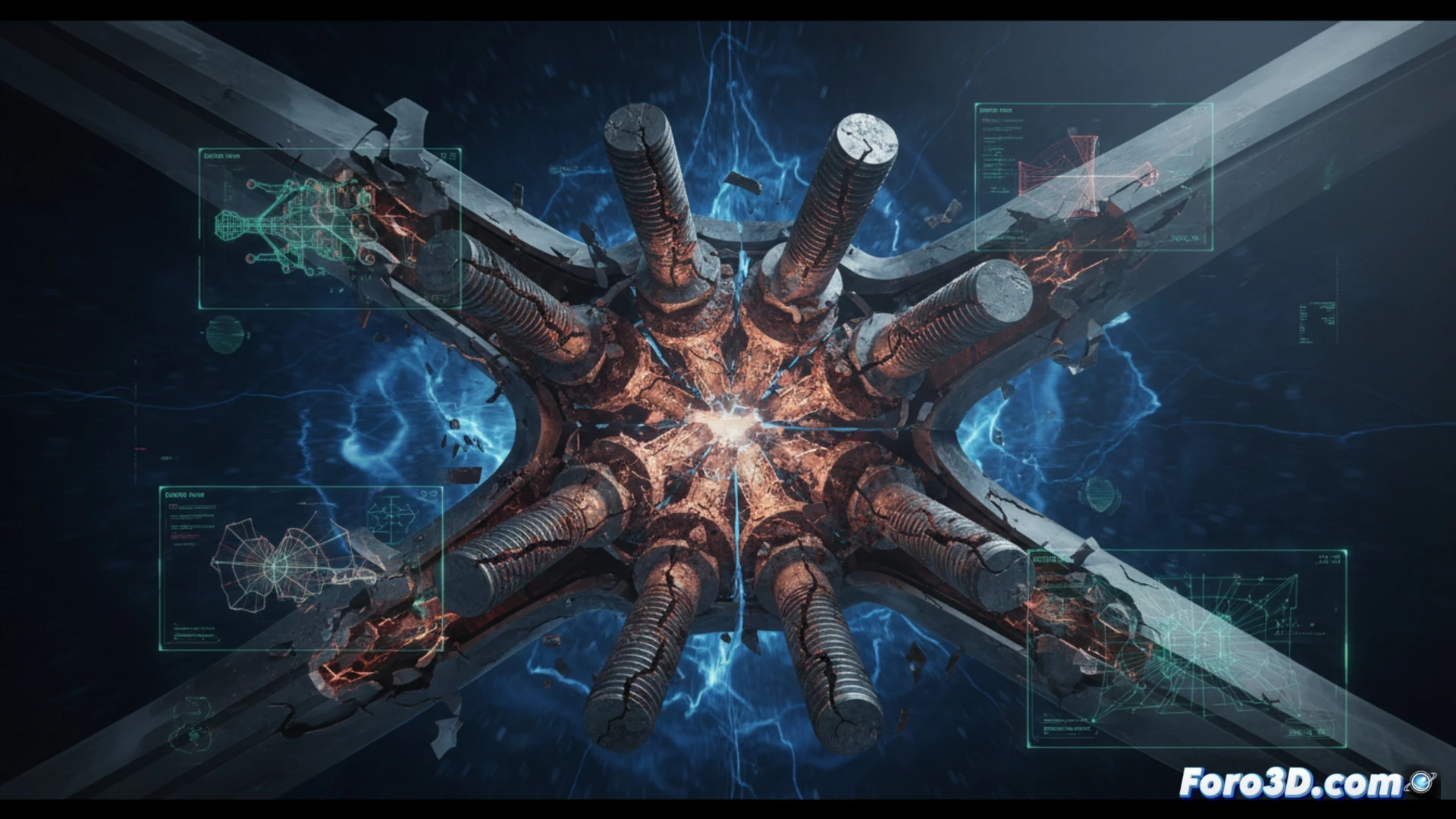
Forensic reconstruction: from physical collapse to digital model 🔍
The process began with RealityCapture, which digitized the implosion marks on the metal panels, generating a high-precision point cloud. This model was imported into Siemens NX to recreate the original assembly and analyze bolt tolerances. In parallel, Autodesk CFD simulated the aerodynamic loads at Mach 3, calculating the cyclic stresses endured by the joints. The correlation between the actual marks and the simulated high-stress zones confirmed that corrosion-induced microcracking, accelerated by moisture, had reduced the effective cross-section of the bolts until fatigue failure occurred.
Lessons for fatigue simulation in aggressive environments ⚙️
This case demonstrates that fatigue simulation cannot be limited to pure mechanical loads. The combination of fluid dynamics, structural modeling, and forensic 3D scanning allows for the identification of environmental factors such as moisture, which, though negligible under normal conditions, become critical in supersonic regimes. Integrating this data into simulation loops prevents hidden failures, such as stress corrosion cracking, from compromising high-cost, high-risk infrastructure.
What finite element simulation parameters would allow for more accurate modeling of the initiation and propagation of stress corrosion cracking in high-strength steel bolts, replicating the extreme conditions of a Mach 3 wind tunnel?
(PS: Material fatigue is like yours after 10 hours of simulation.)