Chilla's Art has perfected a unique formula within indie horror: combining the technical nostalgia of 2000s digital cameras with oppressive, claustrophobic lighting. Their new title, Parasocial, not only continues this tradition but also exposes an accessible technical workflow for any indie developer. We analyze how they achieve this aesthetic with Unity and Blender, from post-processing to low-resolution modeling.
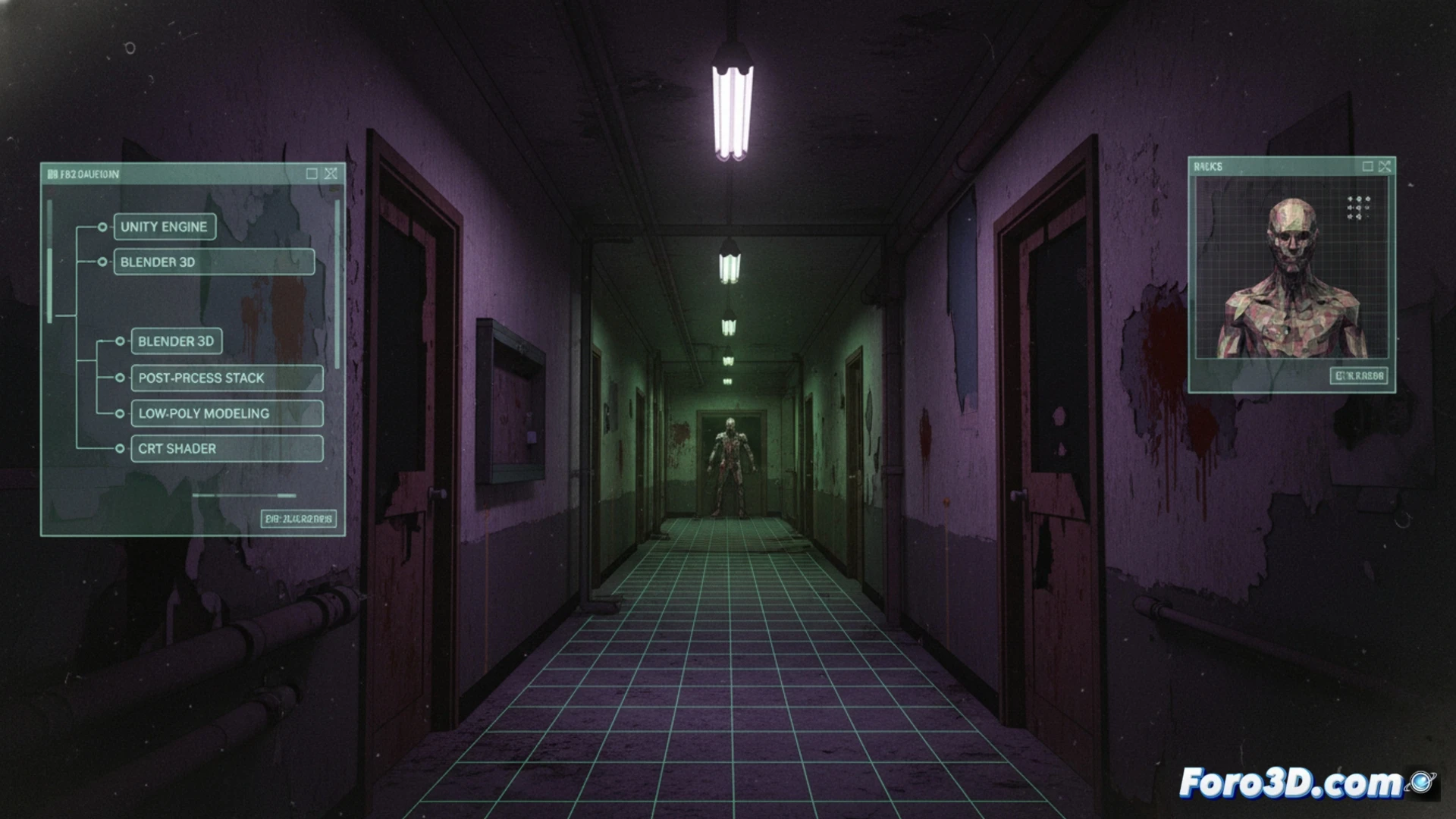
Claustrophobic lighting and retro post-processing in Unity 🎮
Chilla's Art's main trick lies in real-time lighting and the absence of direct light sources. In Unity, they use a directional light system with soft shadows, but drastically reduce the ambient light range (Ambient Intensity below 0.3) and apply a bluish/greenish tone in the Color Space. For the 2000s camera effect, they use a custom Image Effect that simulates chromatic aberration, analog noise (grain), and Gaussian blur at the edges. The key is the color profile: they use a LUT (Look Up Table) that compresses blacks and slightly saturates whites to mimic the compression of codecs from that era. For the claustrophobic feel, they recommend using a Fog volume with high density and an almost black color, limiting the view distance to 10-15 meters.
Low-poly modeling and dirty texturing in Blender 🛠️
In Blender, the studio avoids hyper-realistic models. They work with simple geometry (low-poly) and 256x256 or 512x512 pixel textures, hand-painted with dirty brushes and stains. The secret lies in the Roughness node: they raise it to values between 0.8 and 1.0 to eliminate any clean specular reflections. Additionally, they apply a Decimate modifier to assets so they look like they were rendered by an old GPU. To replicate this style, a practical tip is to use the Eevee render engine instead of Cycles, as its flat, bounce-free lighting perfectly matches the digital camera aesthetic. Finally, they export the models as FBX files with smooth normals, but in Unity they disable Generate Lightmap UVs to prevent the engine from calculating global illumination, thus forcing flatter, retro-style shading.
How does Chilla's Art manage to replicate the visual limitations of 1990s digital cameras in Unity and Blender to enhance the horror atmosphere without sacrificing technical performance?
(PS: game jams are like weddings: everyone is happy, no one sleeps, and you end up crying)