A fleet of autonomous robots (AGVs) collided in a deadlock within a smart warehouse, triggering a fire that paralyzed operations for 48 hours. This incident, recorded in sensor logs, poses a technical challenge: determining whether the error was due to route planning or external interference with the LiDAR sensors. Using the 3D pipeline with Navisworks, CloudCompare, and Unreal Engine 5, it is possible to reconstruct every millimeter of the trajectories and isolate the root cause of the accident. 🔥
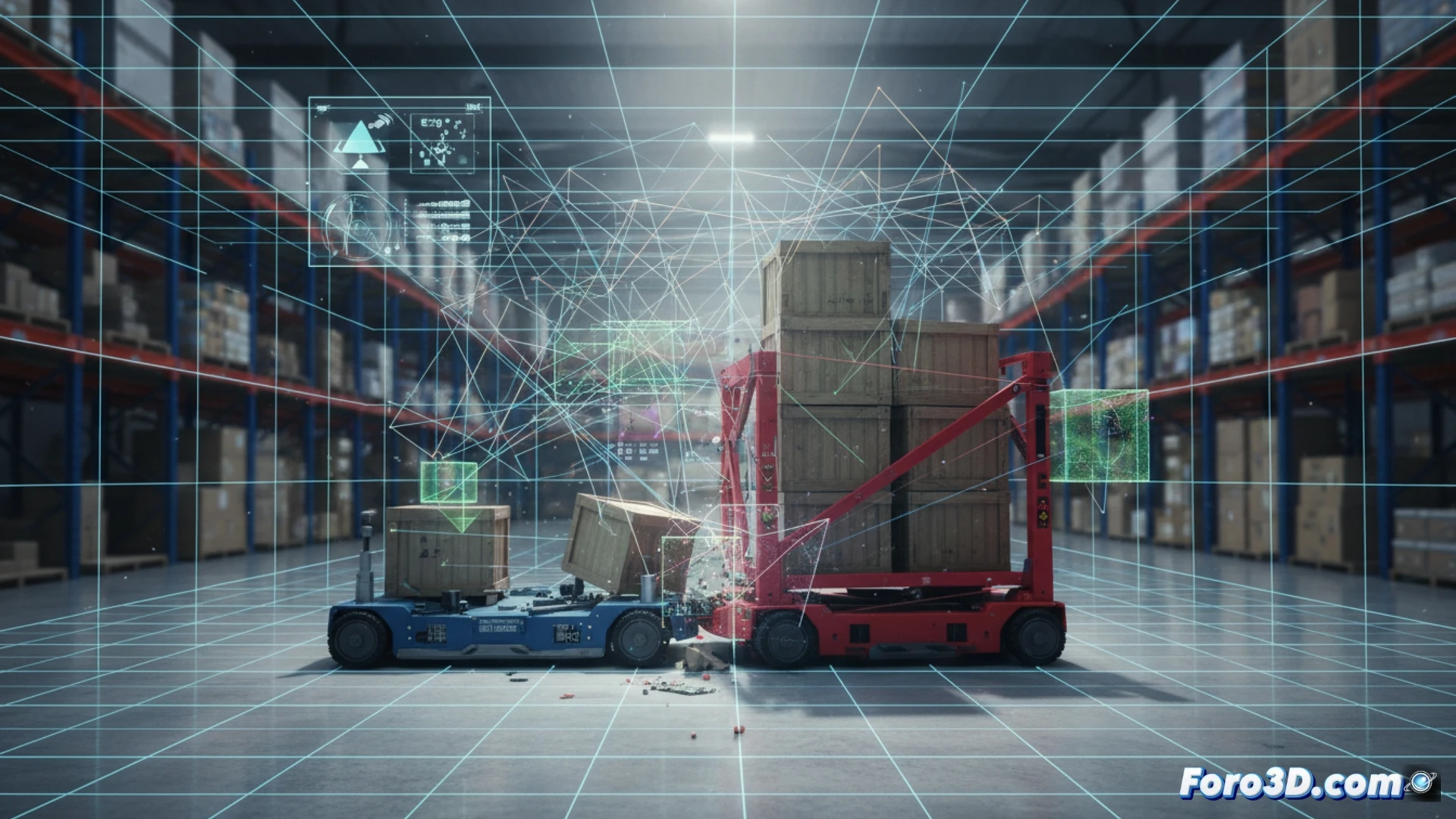
Trajectory reconstruction and deadlock detection with Navisworks and CloudCompare 🚧
The first step of the forensic analysis was to import the position logs of the 12 AGVs into Navisworks to visualize the warehouse layout and assigned routes. The simulation revealed a bottleneck in aisle 7, where four robots converged simultaneously. Subsequently, in CloudCompare, the LiDAR point clouds from each robot were aligned with the warehouse's digital twin. The calibration showed an angular deviation of 2.3 degrees in robot R-04 just before the impact. It was suspected that the high-frequency LED lights on the ceiling, operating at 120 Hz, could have generated an interference pattern on the sensor, falsifying obstacle detection. To verify this, the light spectrum was modeled in SolidWorks, simulating the sensor's behavior under that illumination, confirming that optical noise caused a braking delay of 0.4 seconds.
Lessons for industrial logistics flow simulation 💡
This case demonstrates that logistics flow simulation cannot be limited to route optimization. It is crucial to integrate environmental variables, such as industrial lighting, into collision models. Unreal Engine 5 allowed recreating the event in real-time, visualizing how the LED interference altered the LiDAR's perception. The proposed solution includes redesigning the layout of aisle 7 with a larger turning radius and adding frequency filters to the sensors. In 3D environments, every detail of the physical environment matters; ignoring ceiling lights can cost millions in damages and production downtime.
How can 3D reconstruction of the logistics failure identify flaws in the AGV collision avoidance system and improve safety in smart warehouses?
(PS: simulating an industrial plant is like playing The Sims, but without pools to remove the ladder)