The collapse of a suspended glass-bottom pool represents a critical scenario in infrastructure engineering. To unravel the causes, a technical team combined three key tools: Agisoft Metashape for photogrammetry of the debris, Abaqus for finite element simulation, and Rhino 3D for parametric modeling. The analysis revealed that the failure was not solely structural but originated from a combination of progressive glass fracture and a perimeter seal failure induced by differential thermal expansion between the steel support and the glass panel.
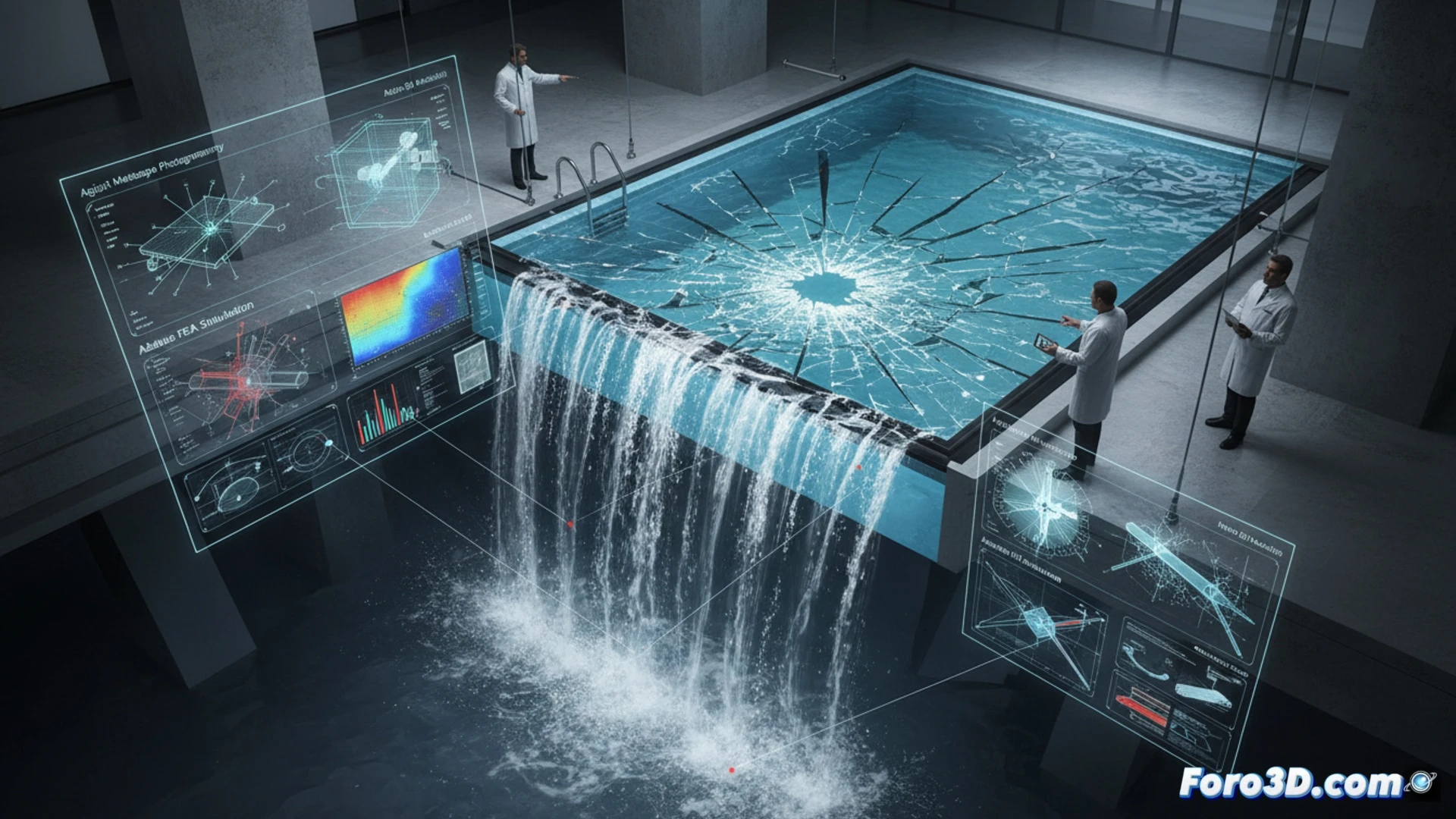
Virtual Reconstruction of the Incident with Metashape and Abaqus 🛠️
The process began with photogrammetric capture of the fragments using Agisoft Metashape, generating a dense point cloud that allowed each piece of broken glass and deformed metal profiles to be georeferenced. This digital model was imported into Abaqus, where hydrostatic pressure loads and thermal stresses were applied. The simulation identified that the structural silicone seal failed first at the corners, where the difference in thermal expansion coefficient between the glass and stainless steel reached a critical displacement value of 2.3 mm. Once the seal was broken, water seeped toward the edges, causing tensile stress fracture in the tempered glass, which collapsed within seconds.
Parametric Lessons for Future Safety 📐
The use of Rhino 3D for parametric modeling of the joints allowed recreating dozens of thermal expansion scenarios, demonstrating that a design with 15 mm wide expansion joints would have absorbed the deformation without compromising the seal. The technical conclusion is clear: current regulations for glass-bottom pools must mandate mandatory differential thermal analyses and seal fatigue tests. This case becomes a precedent to prevent aesthetics from taking precedence over safety in high-risk infrastructure.
Considering the collapse due to differential thermal expansion, what real-time structural monitoring methodology could predict the propagation of microcracks in a laminated glass panel before they reach a critical fracture point?
(PS: Simulating catastrophes is fun until the computer crashes and you are the catastrophe.)