A competition e-foil skimming across the water at 50 km/h disintegrated in seconds, leaving the rider in the water with no apparent explanation. 3D forensic analysis has identified cavitation as the root cause of the disaster. When water boils on the surface of the carbon wing due to local low pressure, bubbles form that implode violently, eroding the fiber until catastrophic loss of lift occurs. This article breaks down the technical process of the failure, from CFD simulation to industrial tomography.
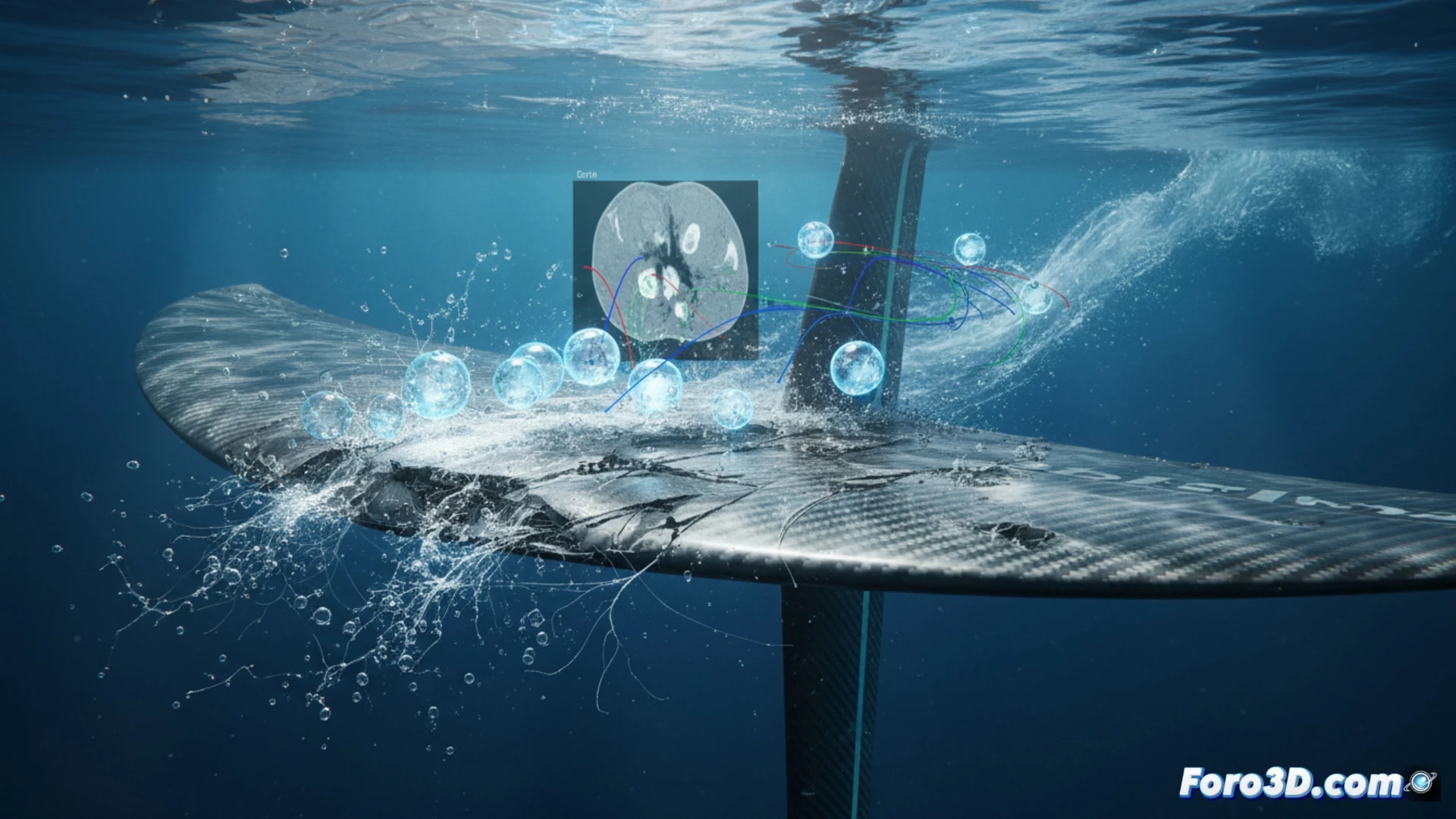
Forensic Analysis: CFD in SolidWorks and Tomography in Volume Graphics 🛠️
The first step of the investigation was to reproduce the hydrofoil's flight conditions using SolidWorks Flow Simulation. The CFD model revealed zones of negative pressure at the wing's leading edge, precisely where the airfoil profile generates maximum lift. In these regions, pressure drops below the vapor pressure of water, initiating the cavitation phenomenon. The bubbles collapse at high frequency, generating micro-jets of water that impact the carbon surface. To verify internal damage, Volume Graphics with industrial computed tomography was used, scanning the wing in 3D. Cross-sections showed dendritic microcracks advancing from the surface into the laminate interior, weakening the resin matrix and separating the fibers. This pattern is identical to that observed in hydraulic turbine blades and marine propellers subjected to prolonged cavitation, confirming that the failure was not an isolated manufacturing defect, but a fatigue process accelerated by high speed.
Visualizing the Wear: From Fracture to Collapse in Blender 🎬
The reconstruction of progressive wear was carried out in Blender, where pressure maps from the CFD and crack volumes from the tomography were imported. The animation shows how, after hundreds of implosion cycles, the microcracks coalesce into a main fissure that runs across the wing from the leading edge to the central support. At the critical moment, the loss of lifting area generates a torsional moment that breaks the carbon into multiple fragments. The visualization not only serves the expert report but also allows engineers to redesign the airfoil profile with curvatures that prevent pressure drop, hardening the surface with elastomeric coatings. The lesson is clear: cavitation is not just noise; it is a silent killer that turns carbon fiber into dust.
Which finite element simulation parameters should have been prioritized in the carbon hydrofoil design to predict cavitation-induced fatigue at 50 km/h and prevent its catastrophic failure?
(PS: Material fatigue is like yours after 10 hours of simulation.)