Cavitation is one of the most aggressive silent enemies in hydroelectric power plants. When a turbine fails, the first step is not to blindly disassemble it, but to digitize the disaster. In this case, the damaged blades are scanned with a GOM ATOS system to capture the exact topography of the erosion. The objective: to determine whether the failure is due to natural fatigue or operation outside design parameters.
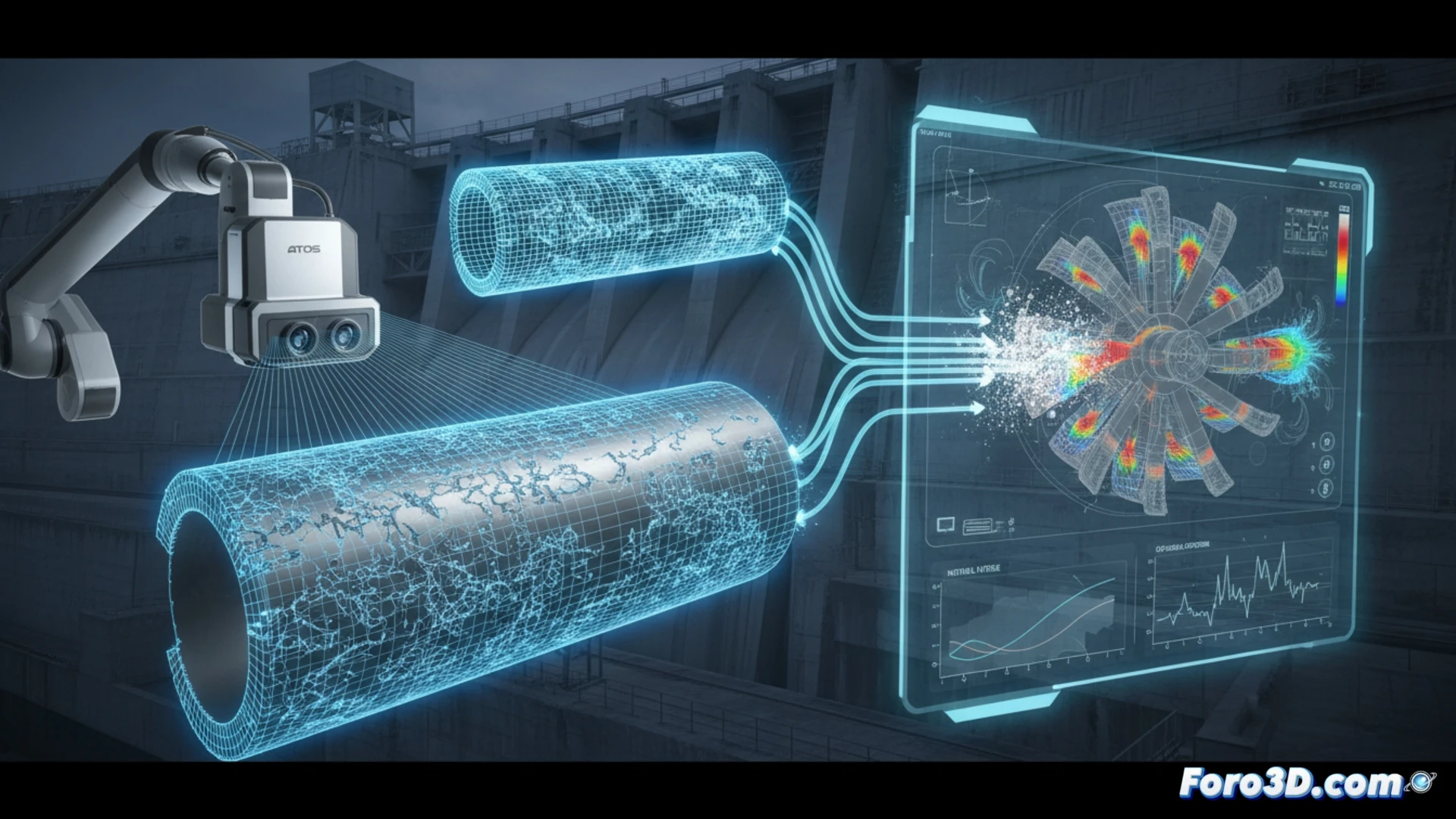
Workflow: from point cloud to CFD simulation 🔧
The process begins with digitizing the blades using GOM ATOS, generating a high-precision point cloud that reflects every crater and indentation caused by cavitation. This real model is imported into SolidWorks to reconstruct the damaged geometry and subsequently transferred to Ansys Fluent. There, a CFD simulation is run that reproduces real flow conditions. The results reveal low-pressure zones and bubble collapse that exactly match the scanned erosion patterns. The surprise comes when comparing the original CAD model with the scanned one using CloudCompare: the geometric differences indicate that the turbine operated at a flow rate and speed much higher than specified, causing severe cavitation on the leading edges.
Lessons for material fatigue simulation ⚙️
This case demonstrates that fatigue simulation cannot be based solely on ideal models. The combination of 3D scanning of real damage and CFD allows failure hypotheses to be validated with concrete data. For simulation engineers, the message is clear: if your model does not reflect the post-damage geometry, your lifespan predictions will be unrealistic. CloudCompare acts as the final judge, showing where and how much the actual operation deviated from the theoretical design. Cavitation is not just a hydraulic problem; it is a fatigue sentence written on the material's surface.
Is it possible to quantitatively correlate the cavitation erosion zones detected in a 3D scan of a blade with the pressure and flow maps obtained from CFD to predict the remaining useful life of the component?
(PS: Material fatigue is like yours after 10 hours of simulation.)