Volumetric bioprinting has taken a qualitative leap: solidifying three-dimensional structures in seconds, not hours. The Levato lab in Utrecht has created trabecular bone models in 12.5 seconds, a liver-on-a-chip that filters ammonia, and a functional pancreas. Everything is advancing rapidly, except for one detail: vascularization remains a dead end for achieving thick, functional tissues.
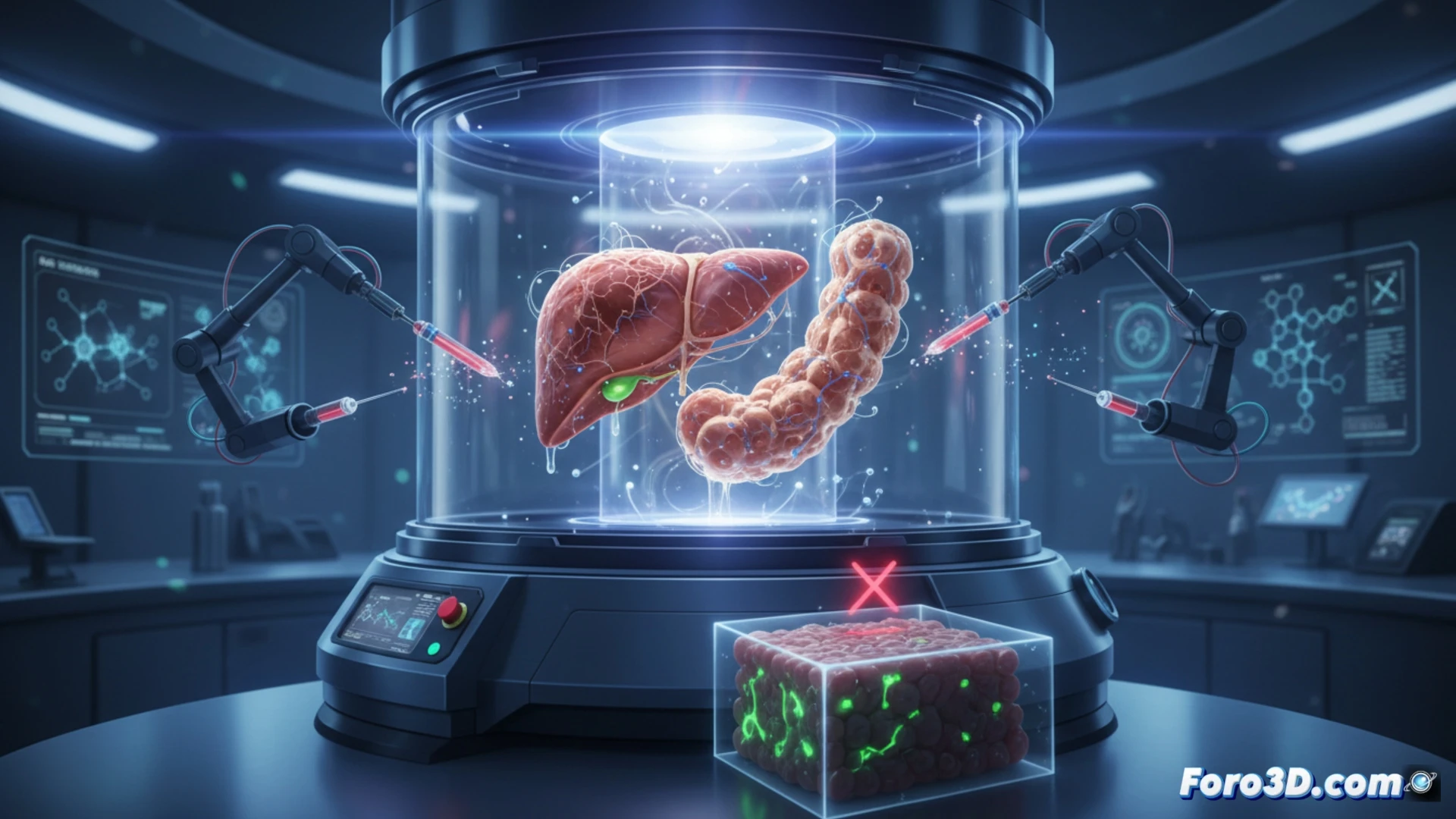
Light, resin, and cells: the recipe for printing in record time 🧪
The technique uses a light beam that polymerizes a gel with living cells in a complete volume, avoiding the slow layer-by-layer stacking. Levato's team achieved a trabecular bone in 12.5 seconds and a miniaturized liver capable of eliminating ammonia. They also fabricated a pancreas with insulin-producing beta cells. The problem is that, without a hierarchical network of vessels, nutrients cannot reach the interior, limiting the size and viability of the tissue.
The fastest liver in the West, but without plumbing 🚰
You have a liver that cleans ammonia on a chip, a pancreas that produces insulin, and a bone ready in 12 seconds. It all sounds like science fiction. But when you look inside, you realize it's like a luxury building without plumbing: the cells in the center starve because there are no pipes to bring them food. Vascularization is the plumber everyone needs and no one has hired yet.