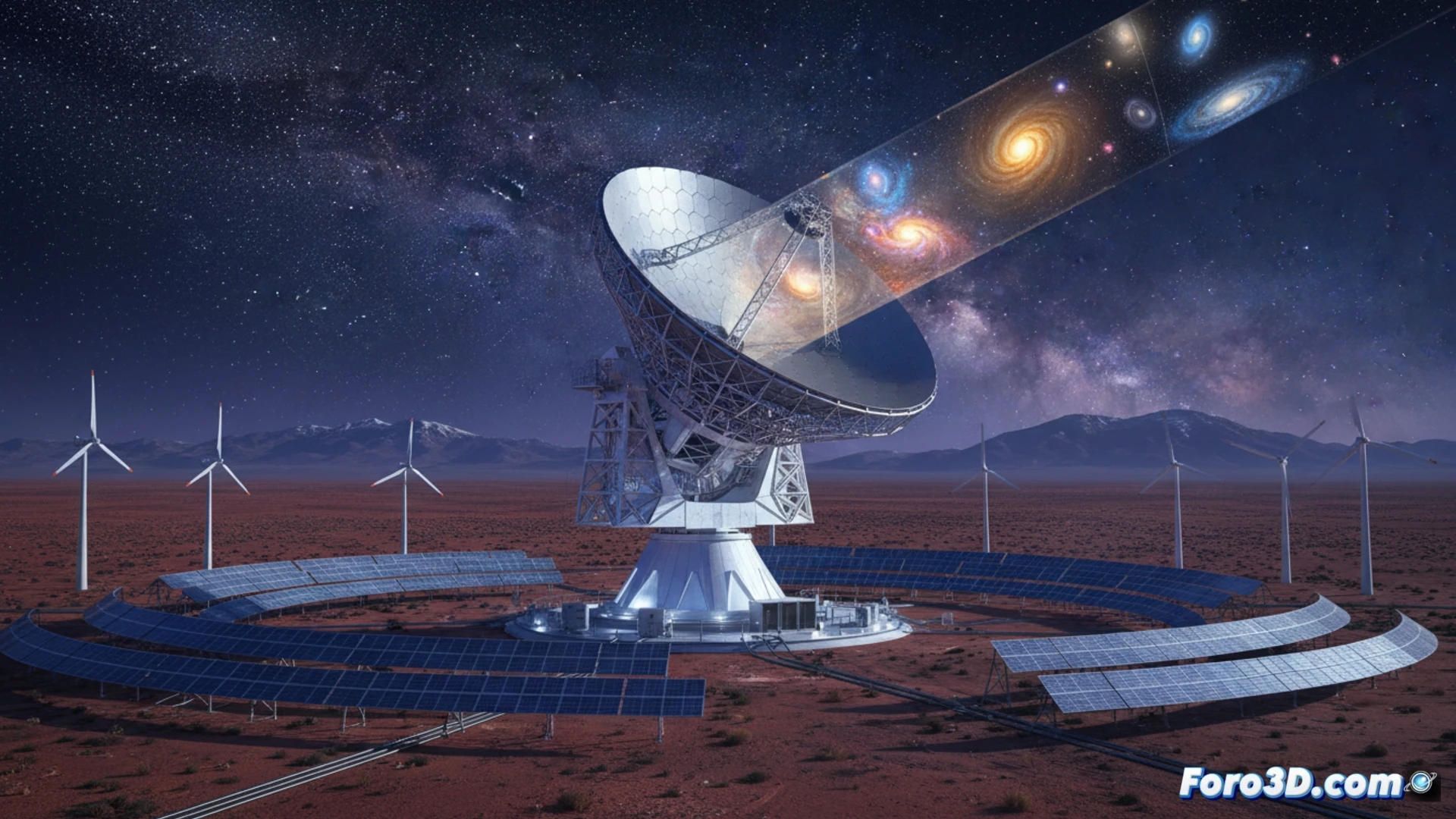
An international consortium, led from Europe, has begun construction of AtLAST in the Atacama Desert. This telescope will feature a 50-meter antenna and will operate exclusively on renewable energy. Its large field of view sets it apart from others like ALMA, which observe very small areas. AtLAST will capture submillimeter radiation, the same radiation emitted by interstellar dust that blocks visible light. This will allow it to detect hidden galaxies, star-forming regions, and black hole activity that go unnoticed by other instruments.
A Giant Antenna That Sees Through Cosmic Dust 🔭
AtLAST will operate at submillimeter wavelengths, a band of the spectrum that passes through interstellar dust without issue. While the James Webb focuses on near and mid-infrared, this new telescope complements its observations by revealing cold, dense regions of the universe. Its 50-meter antenna and advanced optical design will allow it to map large areas of the sky in less time. Furthermore, by using solar and wind energy, it reduces its carbon footprint in a place where the sky is extremely dry and stable, ideal conditions for submillimeter astronomy.
AtLAST, the Telescope That Will Make ALMA Feel Nearsighted 🌌
While ALMA spends hours staring at a tiny point like someone examining a speck of dust on a carpet, AtLAST will come to sweep the entire room in a flash. Astronomers, accustomed to waiting for turns to observe a single grain of cosmic sand, will now be able to ask to see the entire desert. And all this without generating emissions, because besides seeing far, it aims to be eco-friendly. So, if you are interstellar dust, get ready: you will no longer have anywhere to hide.