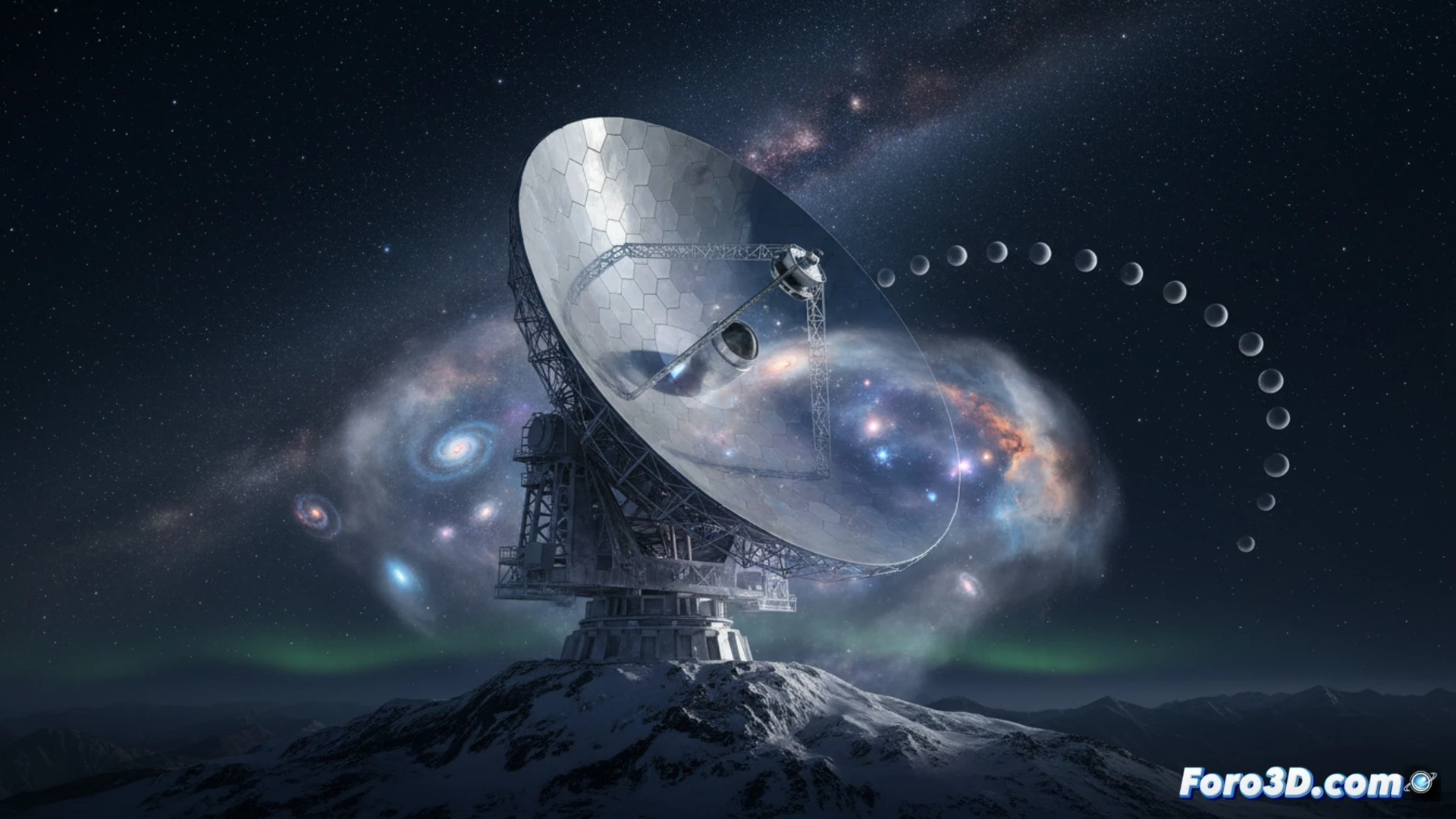
An international team led by Europe has launched the AtLAST telescope, designed to explore regions of the universe hidden beneath dense layers of cosmic dust. With a 50-meter parabolic dish and a 12-meter secondary mirror, this instrument acts like a wide-angle lens, analyzing broad areas equivalent to 16 moons at once, something its predecessor ALMA cannot do.
Massive coverage and unprecedented submillimeter vision 🔭
Unlike telescopes such as ALMA, which only focus on very small areas of the sky, AtLAST offers a panoramic view of the submillimeter universe. Its design allows it to sweep across vast expanses in less time, capturing radiation escaping from dense dust clouds. This will facilitate the study of star formation, active galactic nuclei, and the edges of the early universe, providing data that previously required multiple fragmented observations.
The telescope that looks where ALMA could only peek 🌌
While ALMA struggles to focus on a speck of dust for hours, AtLAST arrives like that friend at a party who takes in the whole room at a glance. With its ability to cover 16 moons at once, astronomers can now say goodbye to obsessions over minute details and welcome a big-picture view. But let's not get too excited: the telescope is big, but it still can't find the keys lost in the sofa.