The atmospheric reentry of a CubeSat culminated in premature disintegration, leaving only scarce carbonized remains. The 3D forensic analysis focuses on the phenolic resin of the heat shield, suspected of having suffered delamination due to an incorrect mixture of catalysts. This failure, typical in material fatigue studies, is investigated through computed tomography and multiphysics simulation to understand how a process error drastically reduces the composite's lifespan under extreme thermal stress.
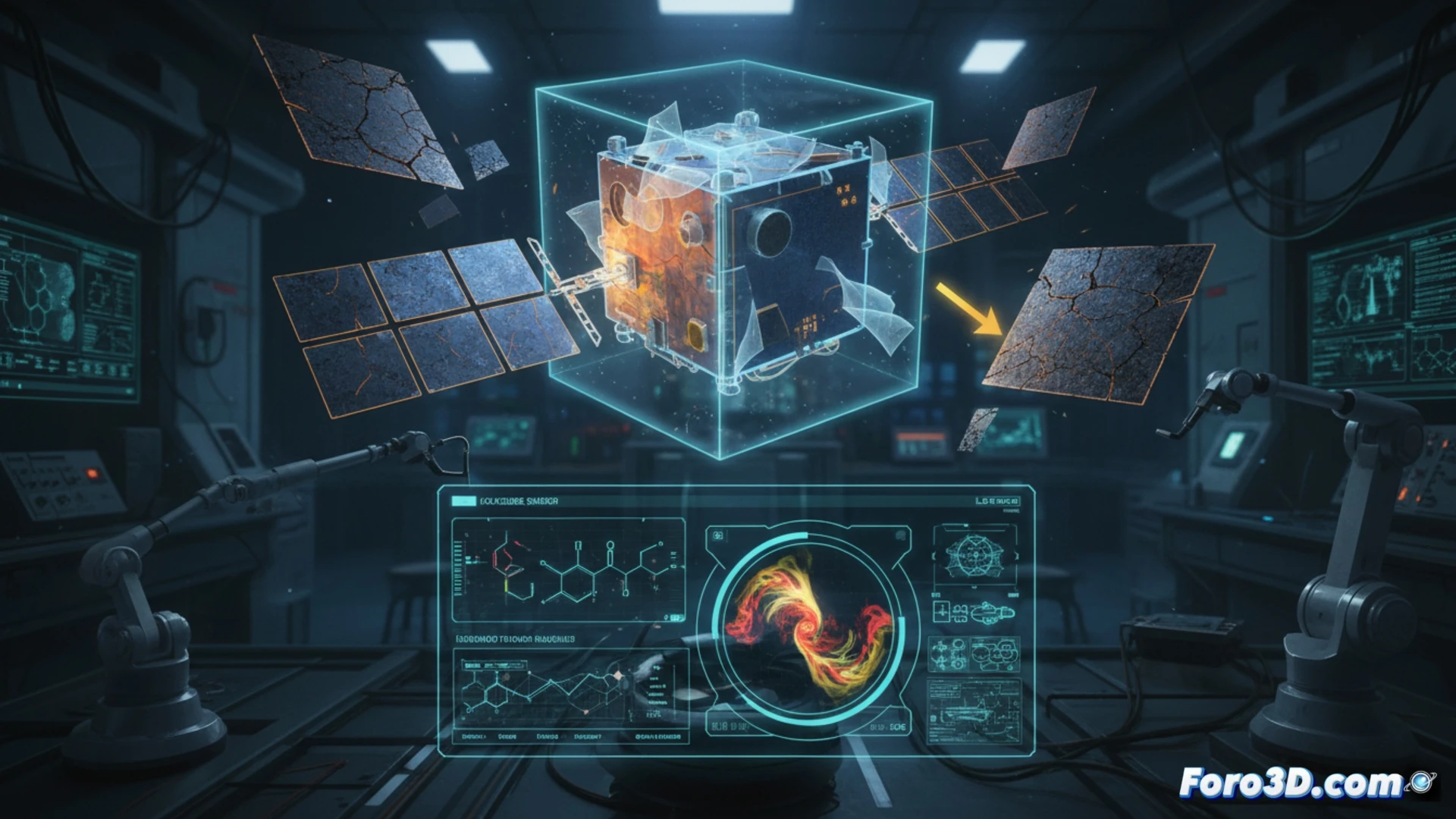
Modeling degradation in phenolic resin with Siemens NX and LS-DYNA 🔥
To replicate the failure, the heat shield is modeled in Siemens NX, defining a phenolic resin with anisotropic properties and an altered curing stoichiometry. The incorrect mixture of catalysts reduces the polymer's glass transition temperature (Tg), resulting in a loss of stiffness at reentry temperatures exceeding 1500 degrees Celsius. In LS-DYNA, the reentry profile is simulated with coupled thermal and aerodynamic loads, using a progressive damage model that activates delamination when interfacial stress exceeds cohesive strength. The results show that a 5% variation in catalyst concentration accelerates the cyclic fatigue of the material, causing premature delaminations at the fiber-resin interface.
Lessons for fatigue simulation in composite materials 🛰️
This case demonstrates that fatigue simulation depends not only on external loads but also on the integrity of the manufacturing process. Volume Graphics allows analyzing the tomographies of the remains, revealing microcracks and debonding zones that validate the LS-DYNA models. The lesson is clear: in high-demand environments, such as atmospheric reentry, a small error in the catalyst mixture can be catastrophic. Predictive simulation must incorporate process tolerances to anticipate these failure modes and ensure the reliability of micro-satellites.
What critical lessons about catalyst homogeneity in polymer matrix composites did the 3D forensic analysis of the CubeSat reveal to prevent delamination in future space missions?
(PS: Material fatigue is like yours after 10 hours of simulation.)