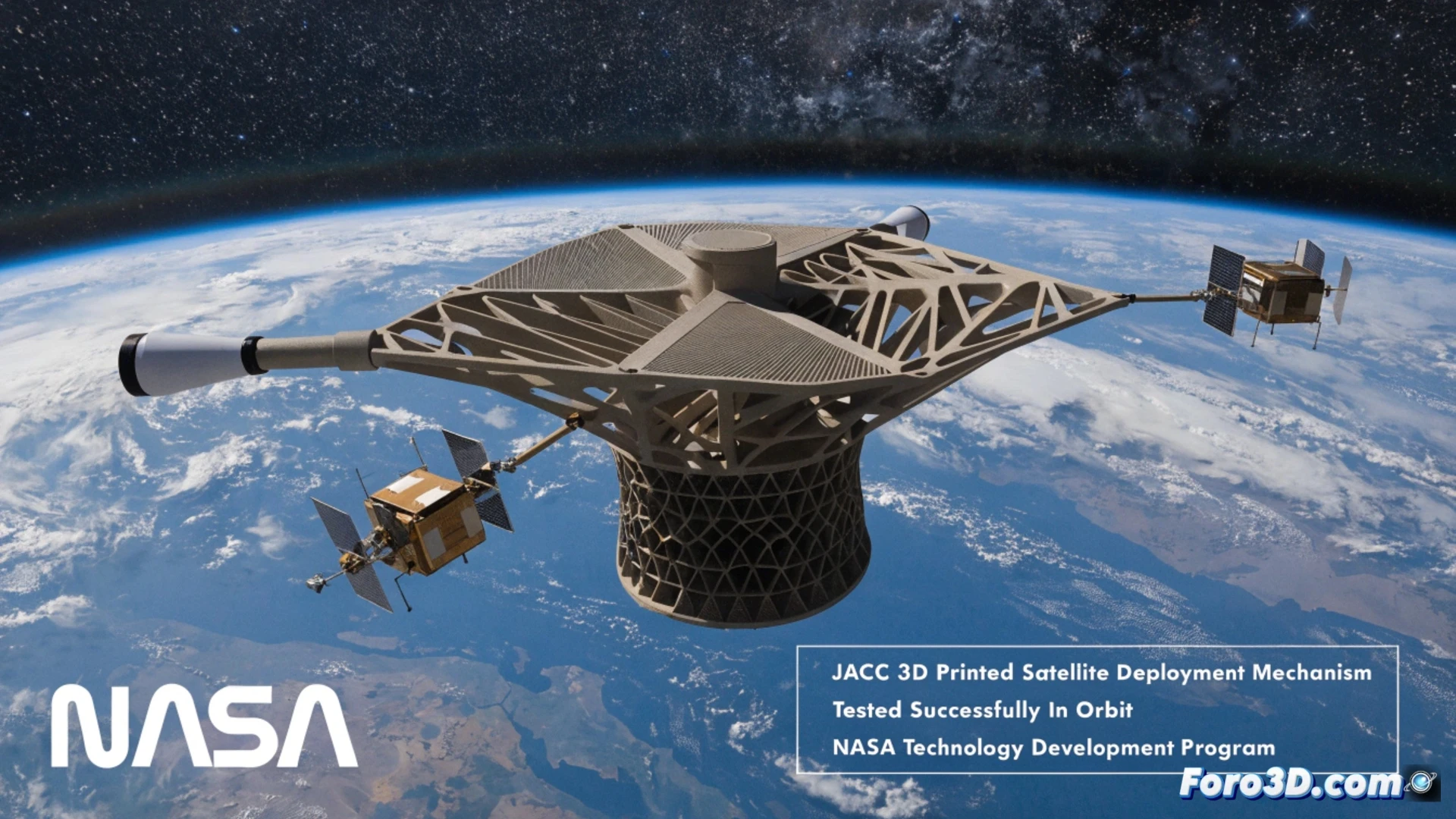
NASA has validated a new concept for satellite hardware in space. Onboard the Mercury One satellite, the JPL Additive Compliant Canister (JACC) was activated, a deployment mechanism manufactured using 3D printing. This test in low Earth orbit confirms that additive manufacturing can simplify designs and reduce costs in space components, an advancement for future missions.
JACC Design and Validation in the Space Environment 🛰️
The JACC device, developed at the Jet Propulsion Laboratory, is a compact canister that houses and deploys structures such as antennas. Its design leverages the inherent flexibility of printed material to create mechanisms without complex assemblies. Activation on February 3 demonstrated its reliability in vacuum and extreme temperatures. This approach reduces the number of parts and assembly steps, resulting in lighter hardware with fewer failure points.
From the Hot Bed to the Cold Vacuum: The Printer That Reached Space 🚀
It seems that the same technology we use to print keychains and chess pieces is now approved for space. All it was missing was for the mechanism to jam and display a bed leveling error message at 400 km altitude. Jokes aside, it's a remarkable achievement to see how such an earthly and sometimes capricious process passes the toughest tests. Who would have thought that do-it-yourself would end up becoming do it for NASA.