Milan Bergamo Airport has reached a milestone by putting into service its first building constructed using 3D printing. This structure, which will function as an information and welcome center, is the result of a collaboration with the Bauhaus University of Weimar. The project embodies the fusion of the most advanced technological innovation with the functional needs of key infrastructure, demonstrating the real viability of additive manufacturing in architecture at full scale.
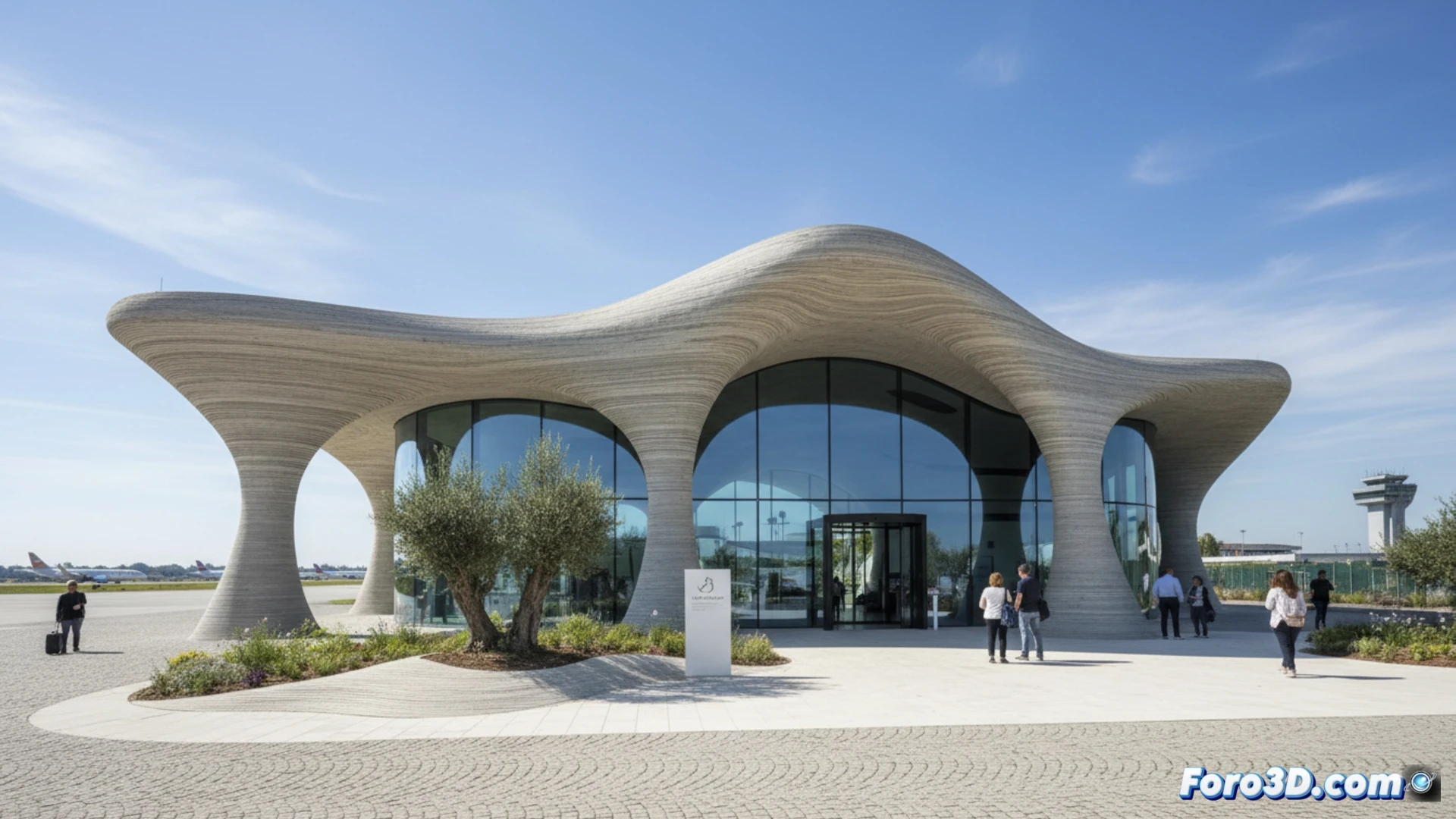
Technology and construction process: robotic arm and extruded concrete 🏗️
The construction was carried out using an industrial robotic arm that deposited layer by layer a special concrete designed for extrusion. This method allows unprecedented formal freedom for concrete, facilitating the creation of curved and organic shapes that would be very costly or unfeasible with traditional formwork. The process not only significantly accelerates construction times but also minimizes waste generation by depositing the material only where it is strictly necessary. This precision turns digital design into the direct mold, eliminating intermediate steps and reducing the margin of error.
A case study for the future of architectural construction 📚
This project transcends its practical function to become a vital case study. It validates 3D printing as a disruptive tool within the integral workflow of architecture and construction, from the BIM model to physical execution. Its success in such a demanding environment as an airport underscores its potential to create more efficient and sustainable infrastructures, paving the way for these technologies to be integrated into industry standards.
How can 3D printing of buildings, like the one inaugurated at Milan Bergamo Airport, integrate and optimize BIM workflows in complex architectural projects?
(P.S.: BIM is like having a building in Excel, but with pretty windows.)