This week marks eight decades since the public presentation of the ENIAC, a machine that defined a path. Conceived for ballistic calculations at the University of Pennsylvania, this artifact is recognized as the first general-purpose digital computer. Its ability to be reprogrammed marked a difference from previous calculators. This anniversary invites reflection on the starting point of the revolution that transformed technology, science, and our daily life.
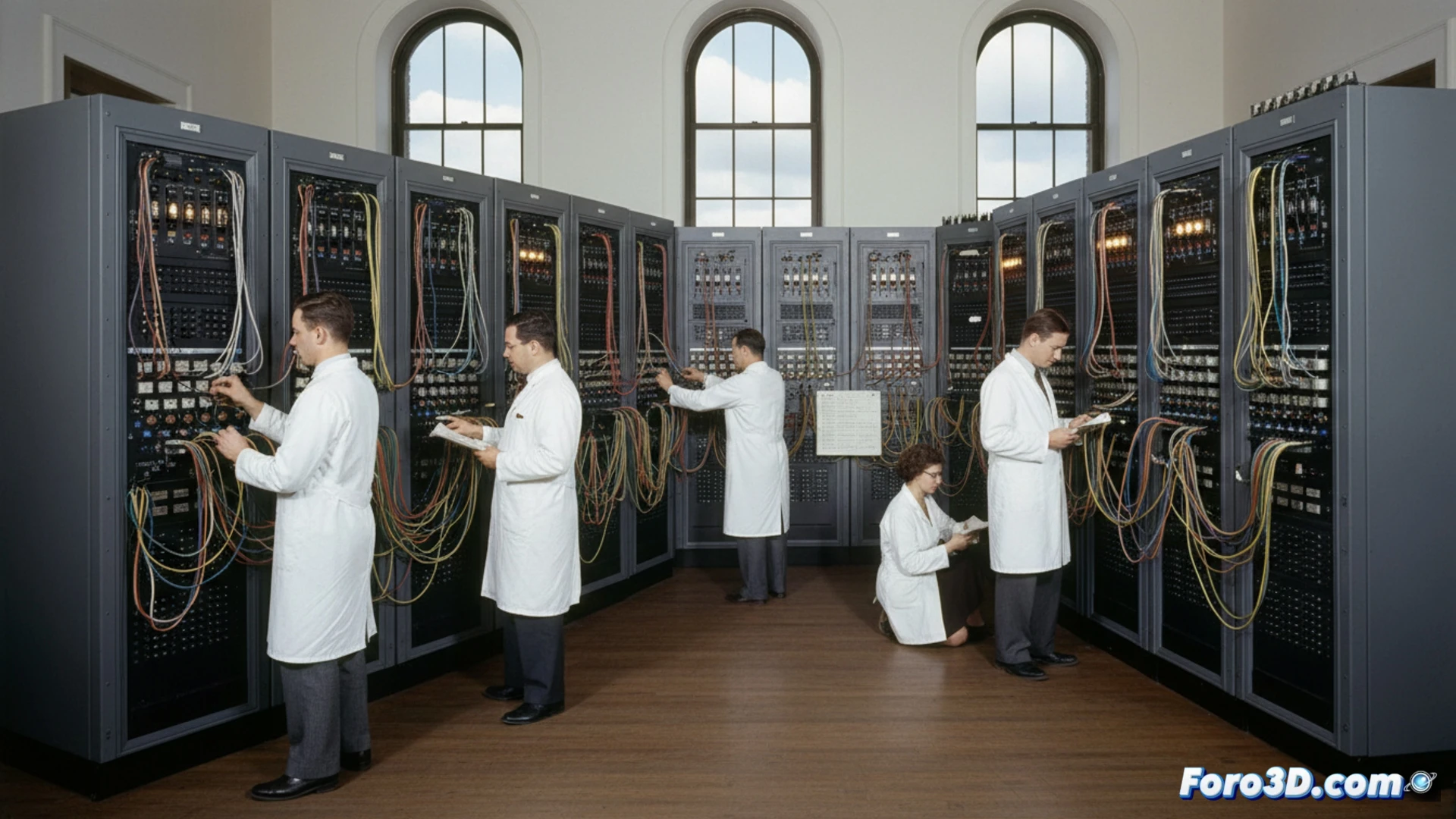
Vacuum Tube Architecture and Manual Programming 🧠
The ENIAC's architecture was physical and tangible. It occupied more than 160 square meters and its operation depended on around 18,000 vacuum tubes, components that generated great heat and consumed 150 kilowatts. Programming was not done with languages, but by manually reconnecting cables and setting switches on panels. This laborious task, which could take days, established the principle of a configurable machine for multiple problems, a central concept in later computing.
The first gaming rig that could heat an entire apple 🔥
Let's imagine for a moment the ENIAC user's setup. There was no need to worry about liquid cooling: the air conditioning system was several industrial fans to prevent the tubes from melting the floor. Its electricity consumption was equivalent to that of a small neighborhood, just to run calculations that a digital watch does today. Programming it required a team of people walking between racks, connecting cables like in a 1940s telephone exchange. A clear example that, sometimes, progress begins with a bunch of switches and sweat.