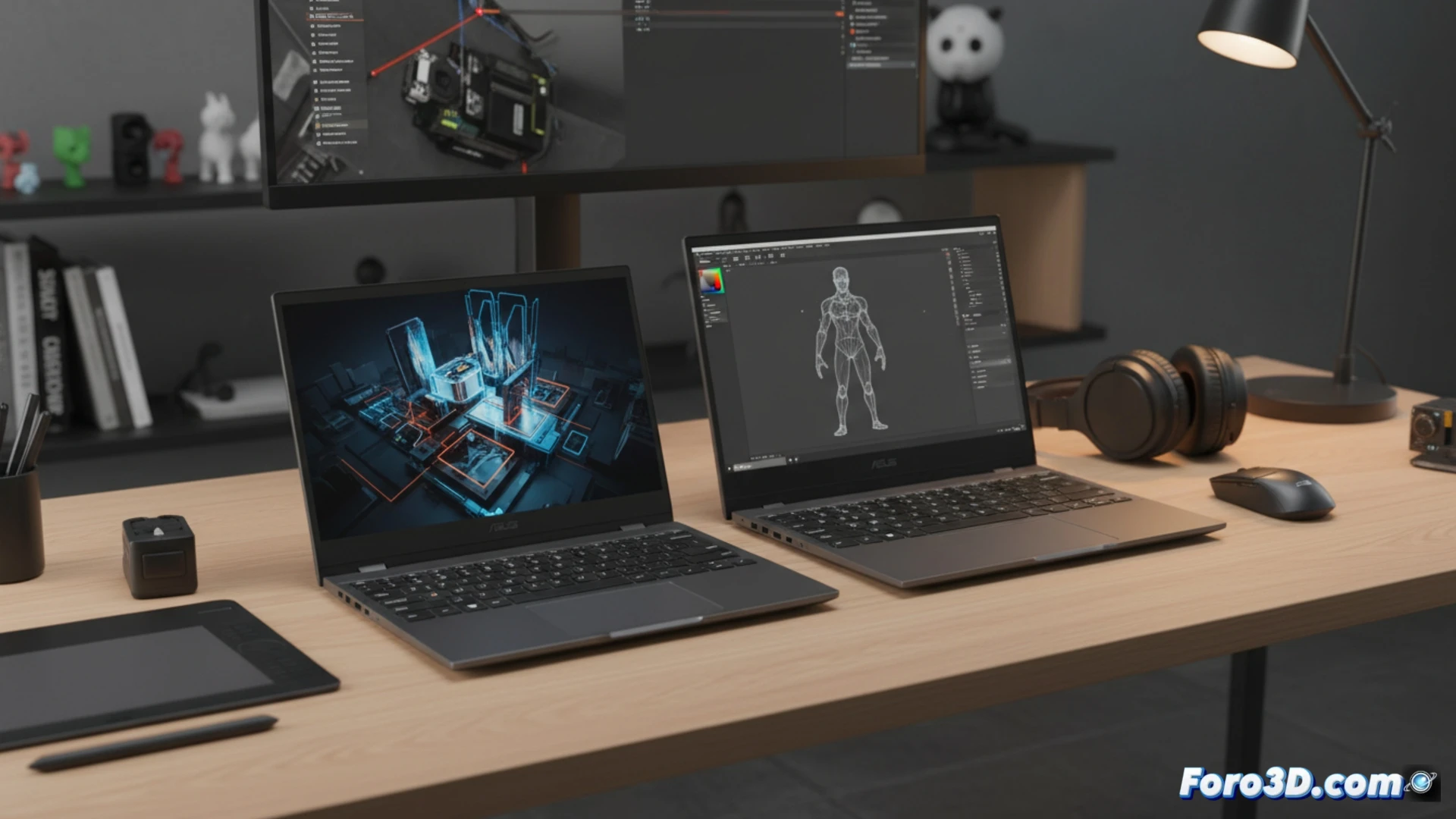
ASUS has launched in Russia its new professional ProArt PX13 and ProArt P16 laptops, with prices around 300,000 rubles. Aimed at the demanding creator, they promise to take productivity to another level. But, do they really live up to the demands of a 3D artist or VFX technician? We analyze their key specifications to determine if they are serious contenders in the niche of mobile workstations.
Technical specifications focused on the creative workflow 🔍
The ProArt P16 presents itself as the most powerful option for 3D, with an interesting combination: the new AMD Ryzen AI 9 HX 370 processor and an Nvidia GeForce RTX 5060 GPU with 8 GB. This graphics card, from the RTX 50 series, should offer solid performance in viewport and GPU rendering in applications like Blender, Maya, or Unreal Engine. The 32 GB of RAM is the minimum recommended today for complex scenes, and the 2 TB SSD is spot on. The PX13, with its Ryzen AI Max+ 395 and 64 GB of RAM, is a multitasking and CPU rendering beast, but its lack of a discrete graphics card limits it for simulations and GPU rendering, making it suitable for modeling and less demanding 2D/3D tasks.
Value and position in the professional mobile market 💼
The key question is its competitiveness. At its price, the P16 competes with high-end gaming laptops and other mobile workstations. The RTX 5060 is a point to verify, as it must clearly outperform a mobile RTX 4070 to justify the investment. The big advantage is its factory-calibrated 3K OLED screen. In conclusion, the P16 is an interesting proposal for the mobile 3D artist who prioritizes screen and a modern CPU/GPU balance, while the PX13 is more niche for those who need maximum RAM and CPU without such high graphical demands.
Do the new Asus ProArt PX13 and P16 really justify their high price for mobile 3D artists and professionals compared to other portable workstations on the market?
(PS: Your CPU heats up more than the debate between Blender and Maya)