The summer heat turns any walk into a challenge, but a 3D-printed mechanical solution can make a difference. This tutorial breaks down the design of a self-ventilating sun visor with an 8-centimeter brim, whose secret lies in internal ducts with a worm gear geometry. By correctly modeling this internal helix, we achieve a natural draft effect that extracts hot air from the forehead, keeping the head cool without the need for fans or batteries.
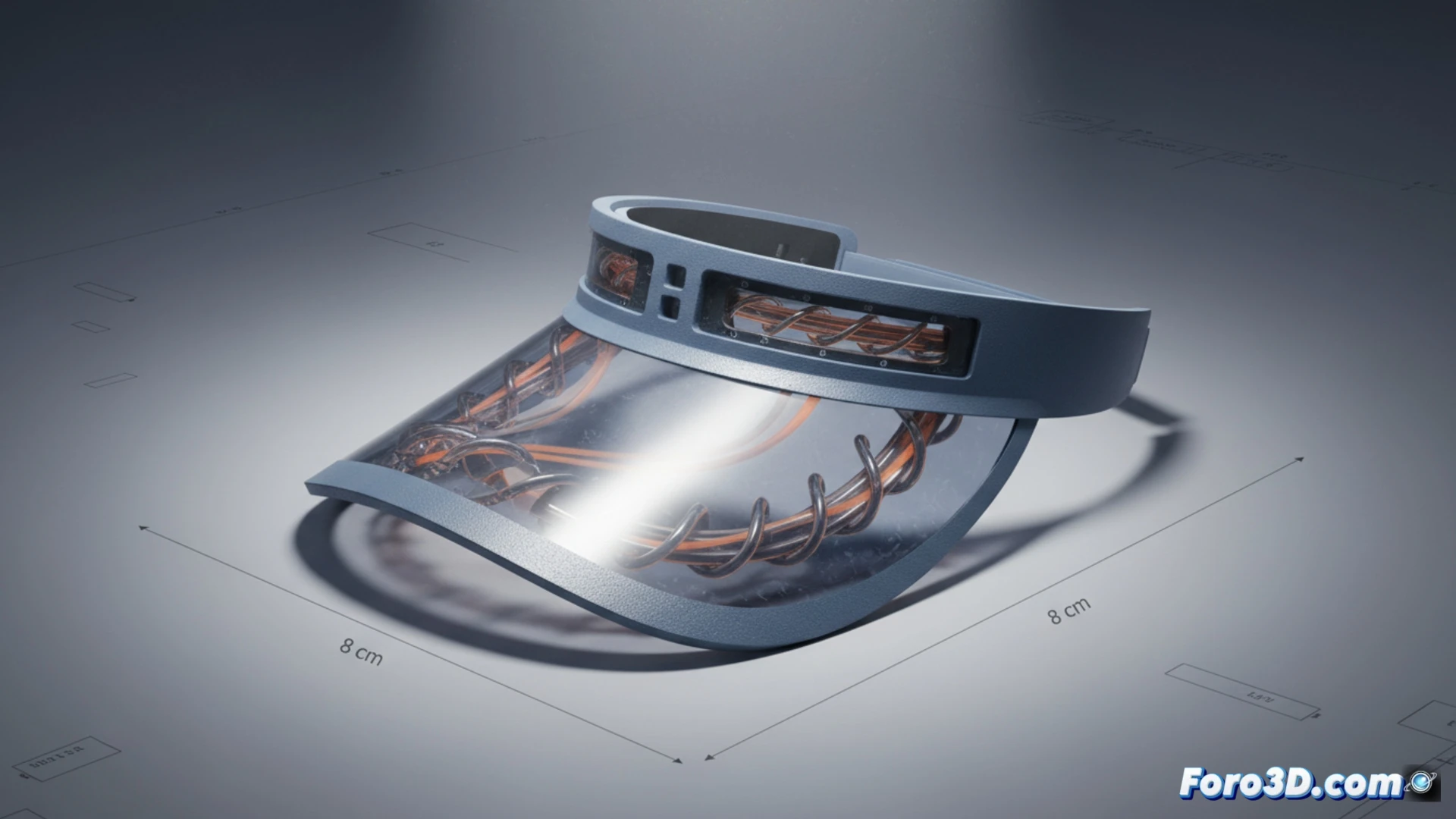
Worm Gear Geometry: CAD Modeling and Internal Ducts 🌀
The technical core of this part lies in the internal channels with a helical profile. In Fusion 360, it is recommended to create a sketch of the 80 mm wide brim and extrude a base body 5 mm thick. Subsequently, a helical duct is designed using the Sweep operation with a 4 mm diameter circular profile along a variable pitch helix. This worm gear geometry, oriented from the front towards the nape, generates a pressure difference that draws in hot air. For Blender, the Screw modifier can be used on a square profile, followed by applying a Boolean Difference on the visor solid. The printing orientation should be with the brim facing up and the forehead contact surface towards the heated bed, using tree supports to clear the ducts. Recommended materials are PLA+ for occasional use or PETG for UV and thermal resistance outdoors, with a layer height of 0.16 mm to preserve helical precision.
Optimizing Natural Draft in the Slicer 🔥
Once modeled, the success of the airflow depends on slicing. In Cura or PrusaSlicer, it is vital to disable infill inside the helical ducts to avoid obstructions. It is recommended to use an extra perimeter on the channel walls and a reduced print speed of 60% for curved areas. If the natural draft seems insufficient, the duct diameter can be scaled to 5 mm in the original CAD model, or a small additional ventilation slot can be added to the back of the brim. This passive design demonstrates how 3D printing can transform basic thermodynamics into portable comfort.
How does the helical geometry of the ducts in a 3D-printed sun visor affect airflow and temperature reduction on the surface of the 8 cm brim during a summer day?
PS: don't forget to level your bed, or your print will look like abstract art