Continuous vibration in electrical wiring is not just a noise or surface wear issue; it is a mechanical fatigue phenomenon that degrades the integrity of conductors and their insulation. Each oscillation cycle generates micro-deformations in the material, accumulating stress at critical points such as terminals, bends, or splices. Over time, these cyclic stresses exceed the elastic limit of copper or aluminum, initiating micro-cracks that, without intervention, lead to catastrophic breakage.
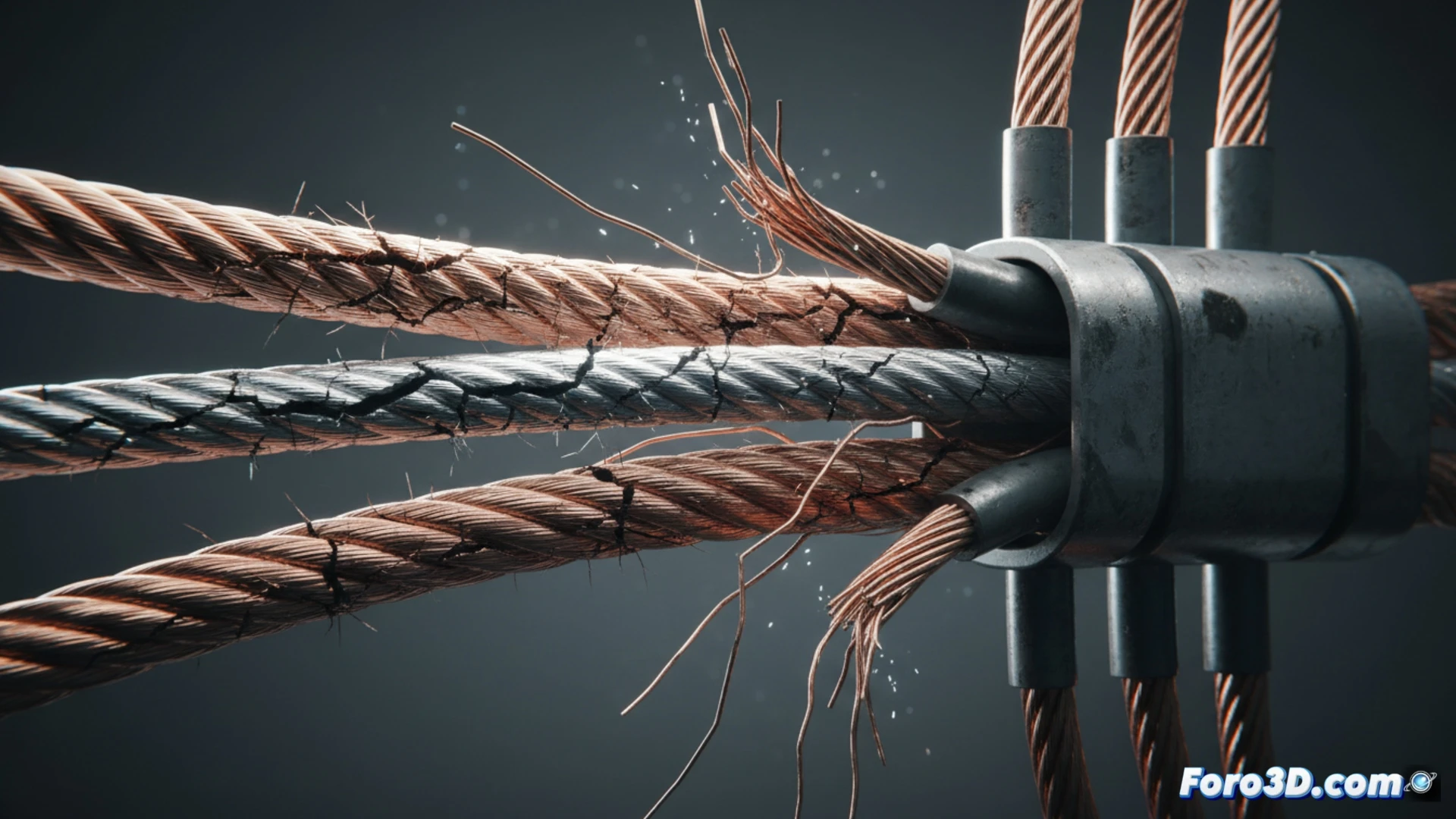
3D simulation of wave propagation and stress points 🔬
3D modeling allows for precise visualization of how a vibration wave propagates along a cable, identifying high-amplitude nodes and stress concentration zones. In a finite element simulation environment, a specific excitation frequency can be applied, and the distribution of Von Mises stress can be observed in real time. This reveals that failures do not occur randomly: they appear at points where the cable geometry changes abruptly or where the insulation has discontinuities. Progressive degradation is represented through heat maps showing the advance of micro-cracks from the surface toward the conductive core, a process that under real conditions can take months but is accelerated in the simulation for analysis.
Predicting failures before they occur in critical infrastructure ⚡
In wind turbines, suspension bridges, and railway systems, cables are subjected to constant vibrations from wind, traffic, or machinery. An electrical failure in these environments not only interrupts service but can also cause fires or structural collapses. 3D fatigue simulation allows engineers to predict the remaining service life of wiring and schedule preventive maintenance. By inputting real frequency and amplitude data, the model anticipates where and when failure will occur, transforming passive safety into an active prediction strategy.
How can the progression of fatigue in electrical cables subjected to continuous vibration be modeled and visualized in 3D to predict structural failure points before visible fracture occurs?
(PS: Material fatigue is like yours after 10 hours of simulation.)