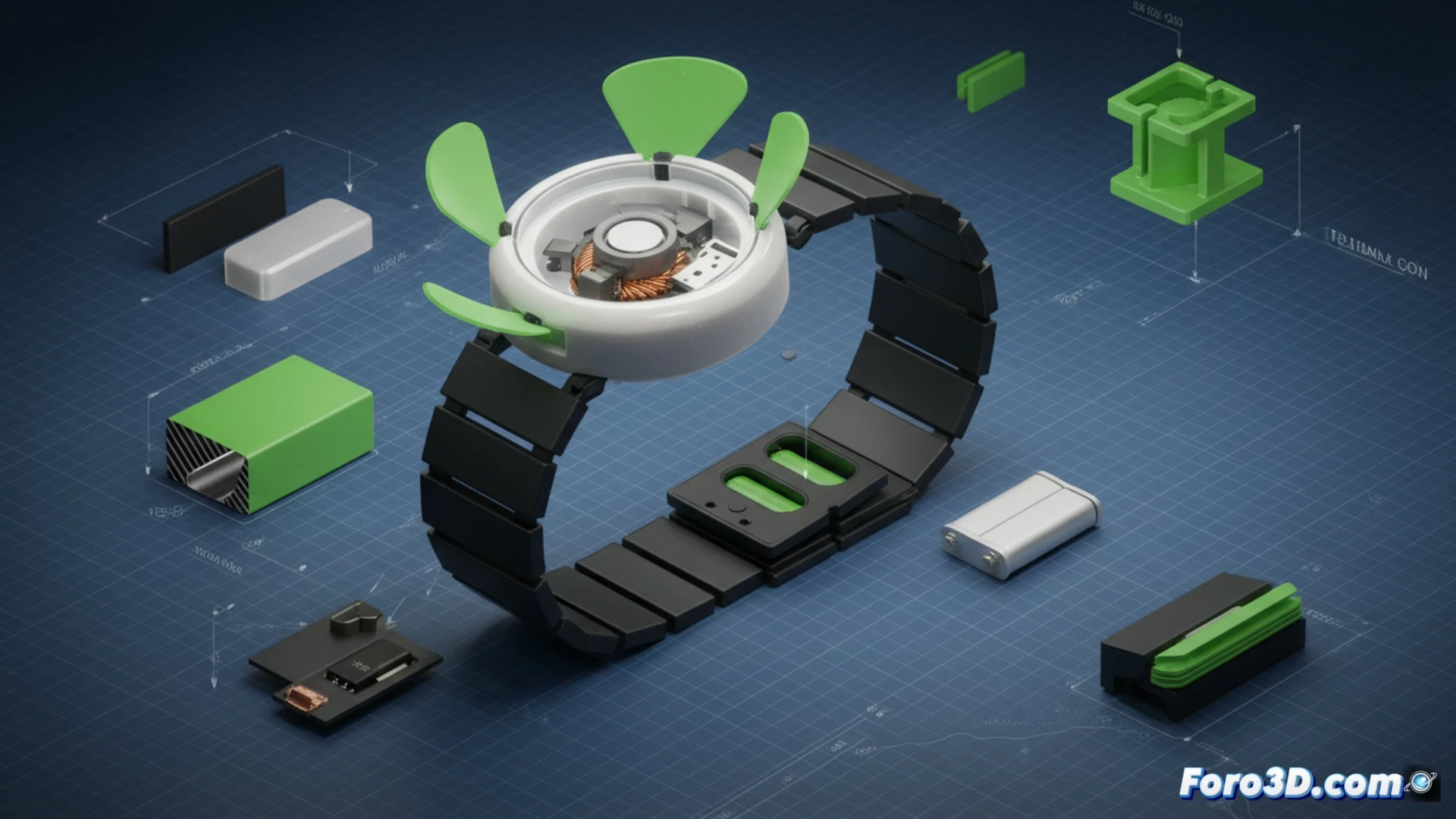
The design of a wrist fan with foldable TPU blades represents a fascinating case study in optimizing 3D printable models. This device combines the flexibility of TPU to create blades that fold for storage, a low-profile coreless motor, and a rechargeable button cell battery offering 6 hours of autonomy. We analyze the technical keys to replicate this design, from material selection to printing tolerances, providing a guide for makers looking to integrate electronics into flexible parts.
Component integration and printing strategies 🛠️
The choice of TPU for the blades is no coincidence: its elasticity allows the blades to bend without fracturing, enabling a foldable design that reduces the fan's volume when not in use. To achieve quiet operation, the coreless motor must be mounted with slight clearance in its housing, avoiding vibrations that amplify noise. Print orientation is critical: the blades should be printed horizontally with minimal supports to preserve the smooth surface that reduces air friction. A tolerance of 0.2 mm between the motor shaft and the propeller hub is recommended for a smooth fit. The rechargeable button cell battery is integrated into the wristband via a compartment sealed with a snap-on lid, also in TPU, allowing battery changes without tools.
Reflection on foldable design and autonomy 🔋
This fan challenges the notion that 3D printing only produces rigid objects. By using TPU for the foldable blades, it demonstrates that additive manufacturing can create dynamic mechanisms that enhance portability. The 6-hour autonomy with a button cell battery is an achievement in energy efficiency, made possible by the low consumption of the coreless motor and the optimization of the blades' aerodynamic profile. To adapt this design to different printers, it is essential to calibrate TPU retraction to avoid stringing and adjust the printing speed to 20-30 mm/s. Post-processing is limited to carefully removing supports and verifying that the blades rotate freely before final assembly.
What specific advantages does TPU offer over other flexible filaments to achieve an optimal balance between the flexibility of the foldable blades and the structural rigidity needed in the wrist support of a 3D fan?
(PS: A good printable model is like a good friend: it doesn't need supports.)