3D product design allows us to explore thermal comfort solutions that transcend aesthetics. The concept of a hat with a flexible solar panel and an extractor fan at the nape represents a challenge in mechanical and ergonomic integration. Modeling this device involves not only representing the exterior geometry but also simulating the internal path of hot air that accumulates under the brim, a common problem in caps and hats exposed to the sun for long periods.
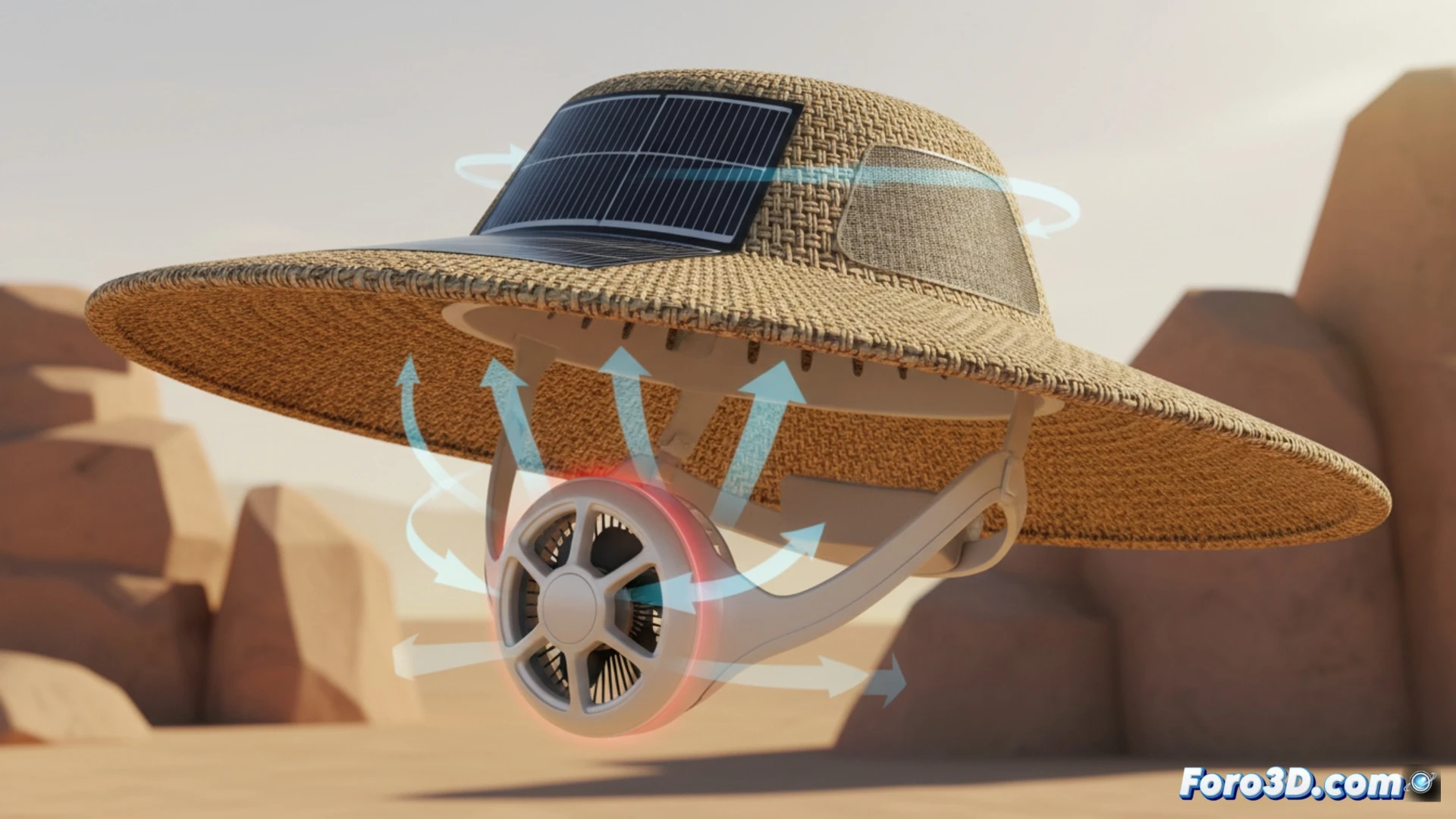
Parametric modeling of the forced ventilation system 🌬️
To approach 3D modeling, we start from a classic bucket hat base, to which an internal cavity at the nape is added to house a 30 mm axial micro-fan. The flexible solar panel, made of amorphous silicon, is integrated into the upper curvature of the brim, connected to a lithium polymer battery hidden in the inner band. CFD (computational fluid dynamics) simulation reveals that the extractor must generate a negative pressure of at least 15 Pa to suck in the hot air (which tends to stratify in the parietal area) and expel it through an upper grille at the crown. The design of the internal ducts must avoid right angles to minimize pressure drops; a curvature radius of 8 mm at the transitions proves optimal for maintaining laminar flow. The cross-section render clearly shows the air path: it enters through micro-perforations on the forehead, circulates over the scalp, and is drawn towards the rear extractor.
Additive manufacturing feasibility and comparison with solar wearables 🧢
Additive manufacturing (FDM or SLS) allows creating the hat's internal skeleton in a single piece, integrating the air channels and motor supports without the need for secondary assembly. Compared to existing solar wearables, such as the EcoGear hat or the SolAire visor, this design solves the blind spot of passive ventilation: none of them actively extract hot air from the nape. The main challenge lies in waterproofing the extractor and the durability of the flexible panel against repeated bending. A prototype printed in TPU (thermoplastic polyurethane) for the brim and PETG for the internal structure offers an optimal balance between flexibility and structural rigidity.
How can an active ventilation system inside a solar hat be modeled in 3D to ensure efficient airflow without compromising the structure or ergonomics of the design?
(PS: Designing a product in 3D is like being an architect, but without having to worry about the bricks.)