Breakage of solar panels due to wind action is an increasingly documented phenomenon in photovoltaic parks. Although tempered glass withstands high static loads, turbulent gusts generate differential pressure patterns that exceed the material's fatigue limits. This article analyzes, through CFD simulation and 3D modeling, how these fractures originate, offering a technical guide to improve the structural resistance of installations.
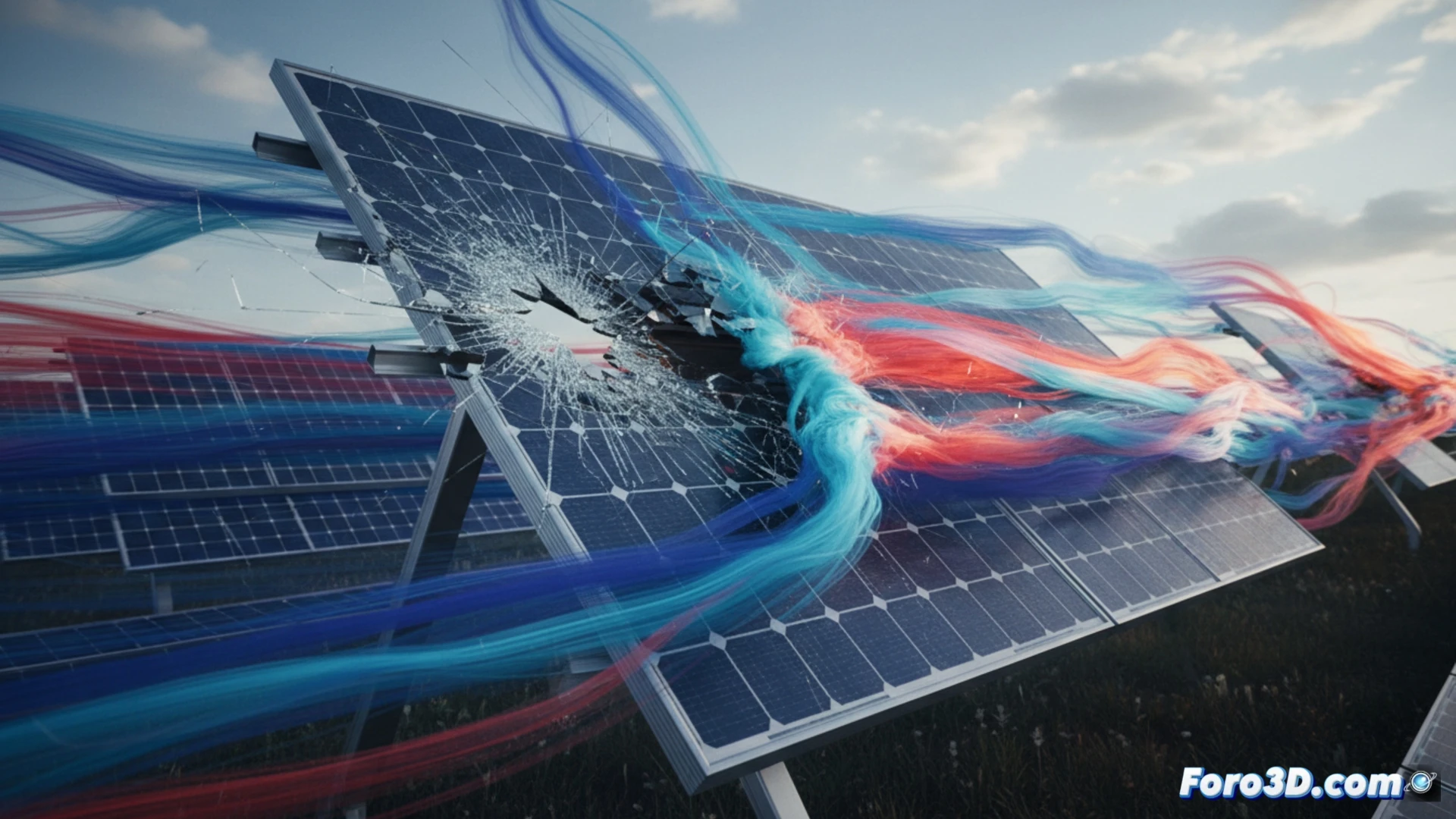
Stress analysis using computational fluid dynamics 🌪️
To model the failure, a 3D domain was built with a photovoltaic panel tilted at 30 degrees, exposed to a turbulent wind profile of 120 km/h. The CFD simulation revealed that the front face withstands positive pressures of up to 1.8 kPa, while the back face experiences negative suction of -2.3 kPa. This difference generates a bending moment that concentrates stresses at the frame corners and anchor points. The pressure map shows vortices at the leading edge that amplify dynamic loads. Cyclic fatigue, modeled with finite elements, indicates that microcracks in the glass propagate rapidly when the differential pressure exceeds 3 kPa, causing catastrophic panel breakage.
Lessons for photovoltaic structure design 🔧
The simulation demonstrates that the tilt angle and frame rigidity are critical factors. Reducing the tilt to 15 degrees decreases suction by 40%, while adding diagonal reinforcements at the corners better distributes stresses. It is recommended to install wind deflectors at the edges to break vortices and use tempered glass with a PVB layer to retain fragments in case of breakage. These changes, validated through 3D simulation, can increase the lifespan of installations against extreme weather events.
Can CFD modeling accurately predict the exact point of structural failure in a solar panel subjected to extreme wind gusts, considering fluid-structure interaction and microcracking of tempered glass?
(PS: Simulating catastrophes is fun until the computer melts down and you are the catastrophe.)