The electric arc in a vehicular battery connector is not only a catastrophic failure but also a complex physical phenomenon that can be modeled in 3D for preventive analysis. This article details the technical process for designing a parametric connector in CAD software, assigning conductivity and insulation properties to its terminals, and simulating the disruptive discharge using particle systems and volumetric light emitters in real-time rendering engines.
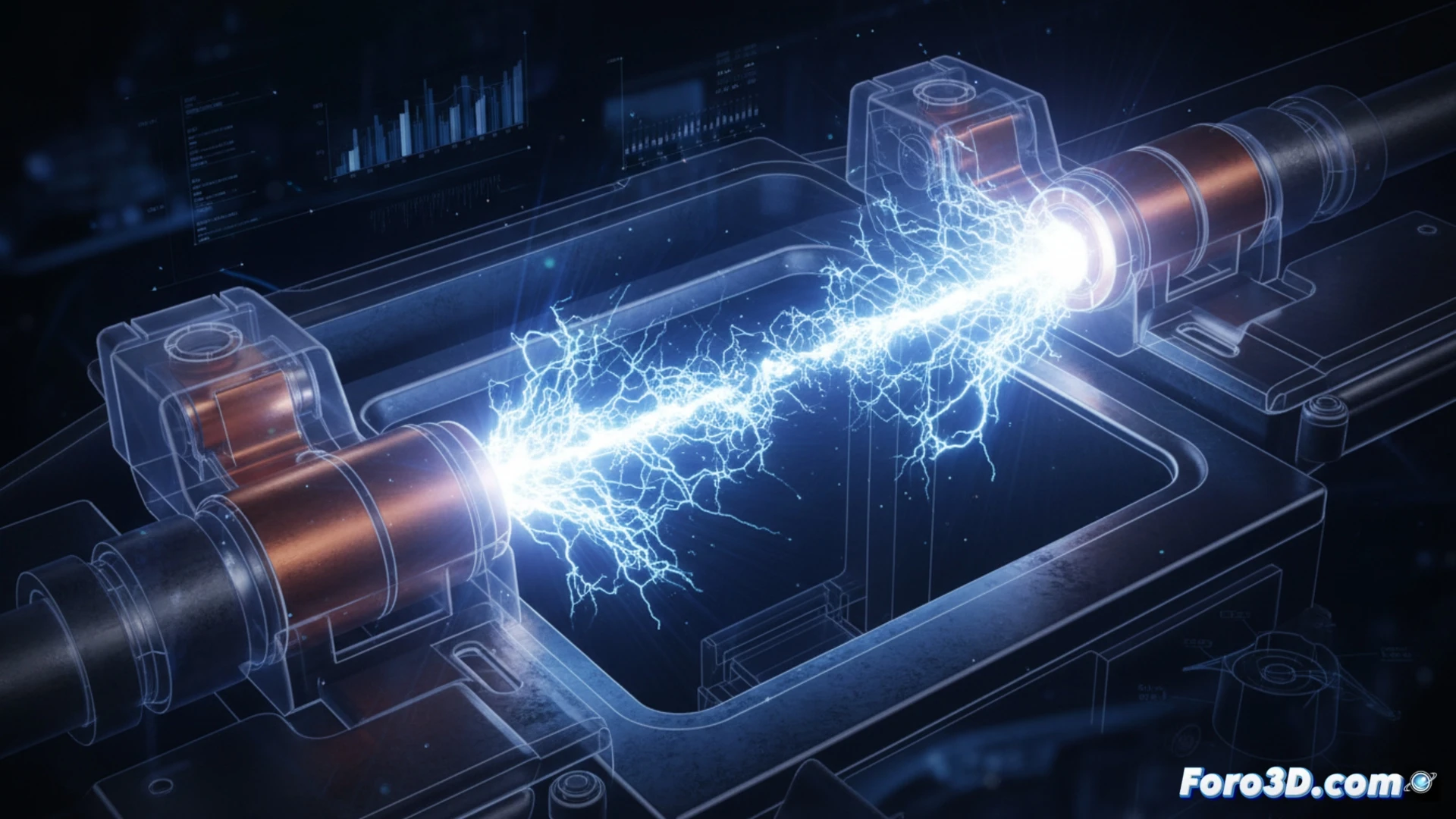
Parametric modeling and discharge simulation ⚡
To replicate the arc, the Anderson or SAE type connector is modeled with clearance tolerances between terminals. PBR materials are assigned: oxidized copper for terminals with increased resistivity and PA66 plastic with dielectric properties for the insulator. The arc simulation is achieved through a particle system with curved trajectories that ionize the air, combined with a flash effect synchronized to intermittent contact. Breakdown voltage parameters (12V to 48V) and short-circuit current are adjusted to visualize the plasma energy. Thermal stress analysis on the mesh reveals melting points due to Joule heating, key to understanding failures caused by corrosion or vibration.
Preventive design and risk visualization 🔧
3D simulation allows automotive engineers to visualize how a poor connection or galvanic corrosion generates a low-impedance path that triggers the arc. By rendering the phenomenon, critical zones are identified to redesign contact geometries, add dielectric seals, or incorporate quick-disconnect systems. This approach reduces physical prototypes and accelerates the certification of safer connectors for electric and hybrid vehicles, where currents exceed 400A.
Can the plasma dynamics and contact erosion in an electric arc of a vehicular battery connector be accurately simulated using 3D tools like COMSOL or Ansys, and what practical limitations do these models present compared to real short-circuit tests?
(PS: modeling a car is easy, the hard part is making sure it doesn't turn into a cube with wheels)