The fracture of a delivery chassis is not an isolated accident, but the consequence of a predictable phenomenon: material fatigue. Every pothole, brake, and curve generates micro-stresses that accumulate at critical points. As digital forensic engineers, we can model this chassis in 3D, replicate real cyclic loads, and visualize exactly where and why the fracture occurs. This article breaks down the technical process to anticipate failure before it happens on the road.
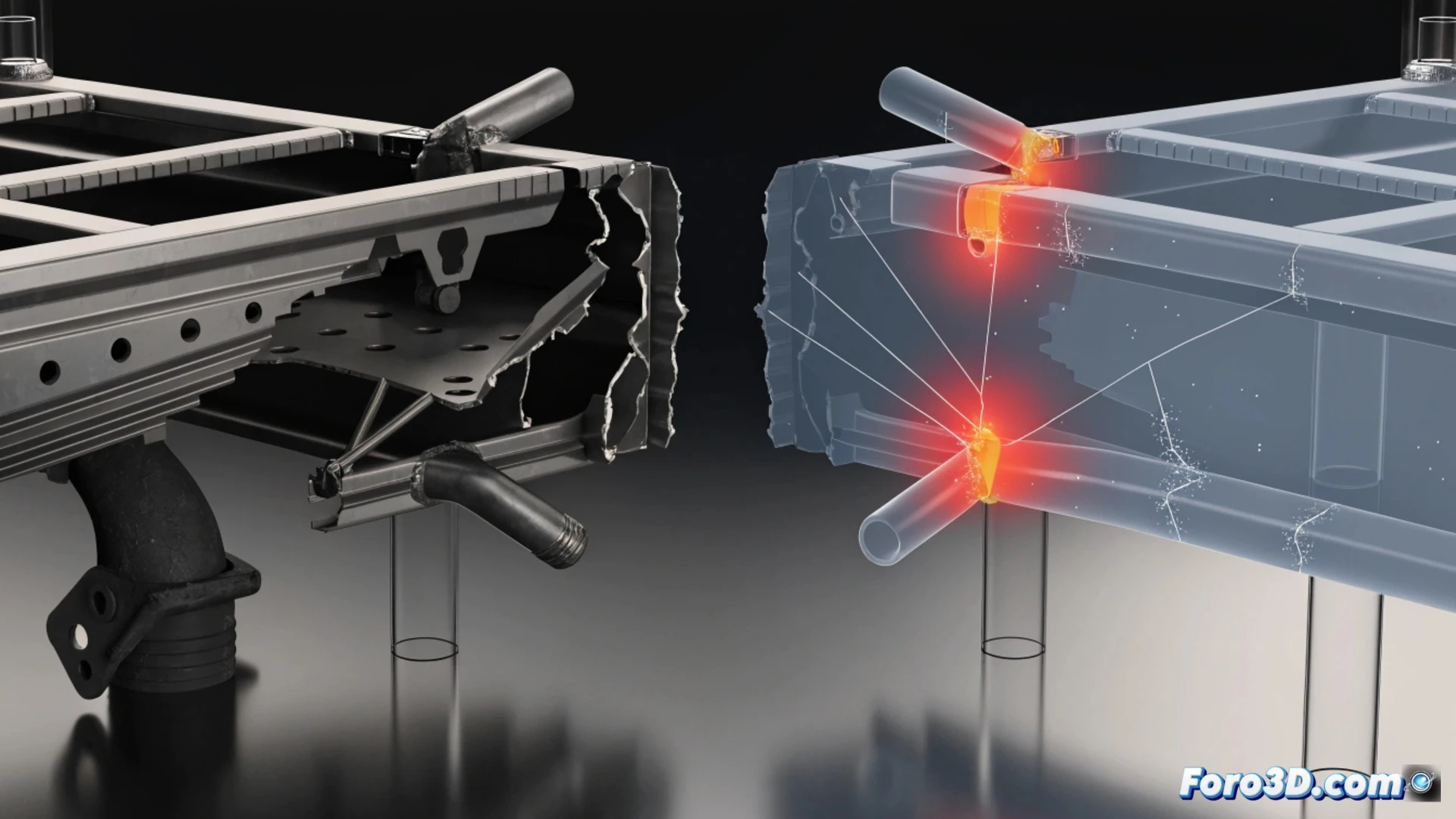
3D Modeling and Cyclic Stress Mapping 🔧
The first step is to digitally reconstruct the chassis with millimeter precision, including welded joints and suspension anchor points. We apply a high-density finite element mesh in critical areas such as the rear side member and the engine mount. The simulation introduces variable load cycles: 10,000 repetitions of maximum load (full vehicle in a turn), followed by 50,000 cycles of average load (urban driving). The results reveal a stress hot spot precisely in the area where forensic reports indicate the actual fracture occurred. 3D simulation allows us to see the microscopic propagation of the crack cycle by cycle, something impossible to detect with a traditional visual inspection.
Why Did It Fail? The Lesson of Materials ⚙️
By changing the chassis material in the simulation, the failure shifts or disappears. Carbon steel shows a lifespan of 150,000 cycles before cracking. Aluminum 6061 reduces that lifespan to 90,000 cycles but adds lightness. Carbon fiber, although strong in tension, fails catastrophically without prior deformation. The actual fracture of the delivery chassis was due to a fatal combination: a design that concentrated stress on a poor weld and a material (low-cost steel) that could not withstand the cyclic loads of urban delivery. 3D simulation not only predicts the failure but also forces a redesign of the chassis with larger curvature radii and materials with a better fatigue limit.
What specific factors of the load cycle in a delivery chassis, such as the frequency of stops and starts or the asymmetric distribution of the load, are revealed by fatigue simulation as critical for predicting the exact point of fracture rather than a generalized failure?
(PS: Material fatigue is like yours after 10 hours of simulation.)