Recovering hidden writing in notepads is a classic challenge in forensic science. Indented impressions, generated by the pressure of a pen on upper sheets, are often invisible to the naked eye. Traditionally, the Electrostatic Detection Apparatus (ESDA) is used, but this method has limitations: it does not preserve the original topography and can damage the support. Photogrammetry and 3D scanning with structured light offer a non-destructive and digitally enduring alternative. 🔍
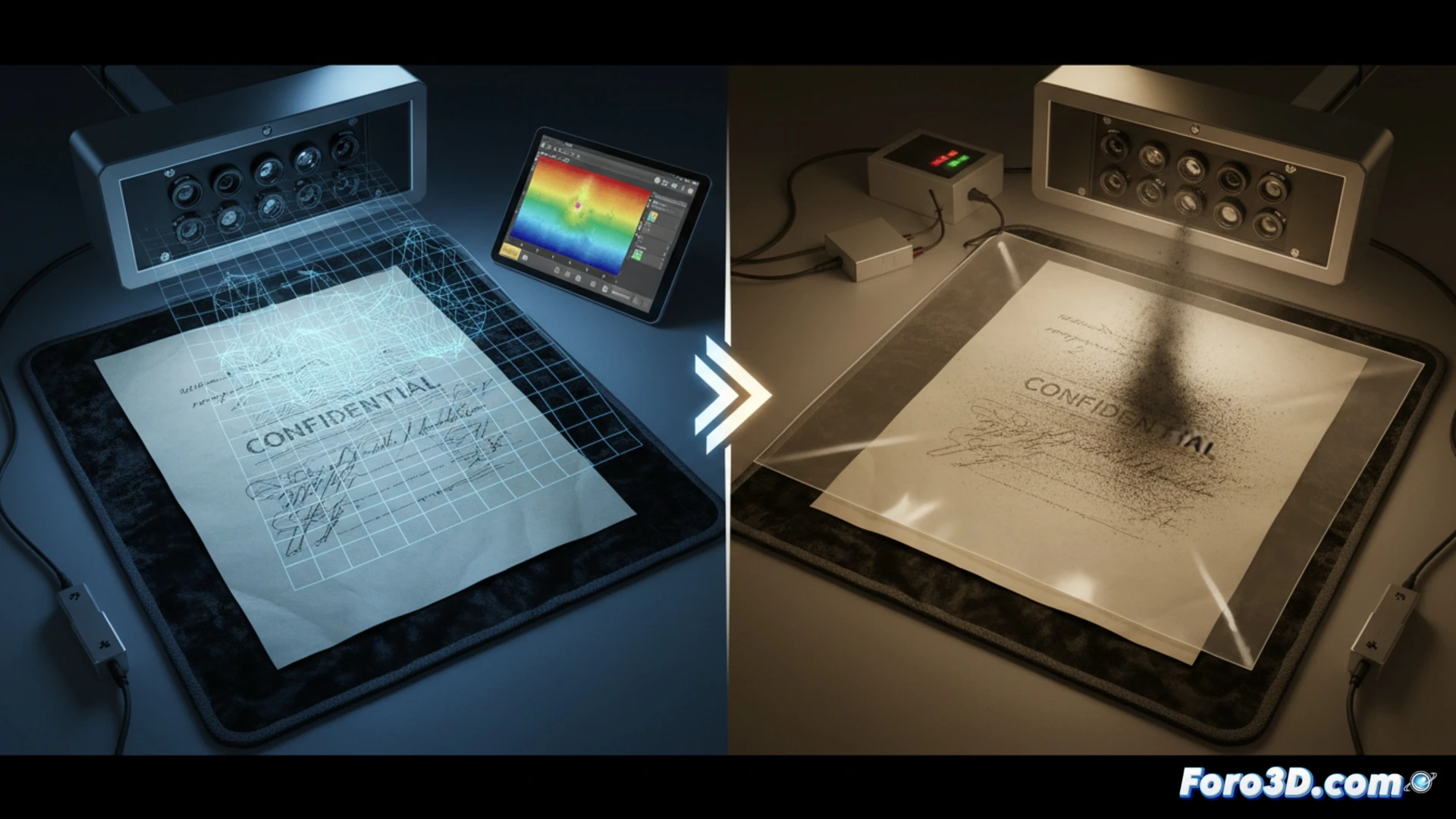
Technical Workflow with Structured Light ⚙️
The process begins with a high-resolution structured light scanner, such as a blue fringe system. The equipment is calibrated to capture microtopographies with sub-micron precision. The paper sheet is placed on a flat, anti-reflective surface. The scanner projects a light pattern that deforms upon hitting the indentations. A synchronized camera records these deformations. The processing software calculates the three-dimensional point cloud, generating a digital model of the surface. This model can be virtually illuminated from different angles to enhance the grooves, revealing the text without physical contact.
Forensic Advantages and Digital Preservation 🛡️
Unlike ESDA, which requires applying an electrostatic charge and chemical developer, 3D scanning is completely non-invasive. The obtained model is a durable file that can be reanalyzed years later without degrading the evidence. The expert can manipulate synthetic lighting, measure the exact depth of the strokes, and generate cross-sections. This methodology not only reveals the text but also quantifies the applied force, offering a more robust and reproducible forensic analysis in any jurisdiction.
What advantages does 3D scanning offer over forensic ESDA for detecting indented impressions on different types of paper and notepad thicknesses?
(PS: In scene analysis, every scale witness is a small anonymous hero.)