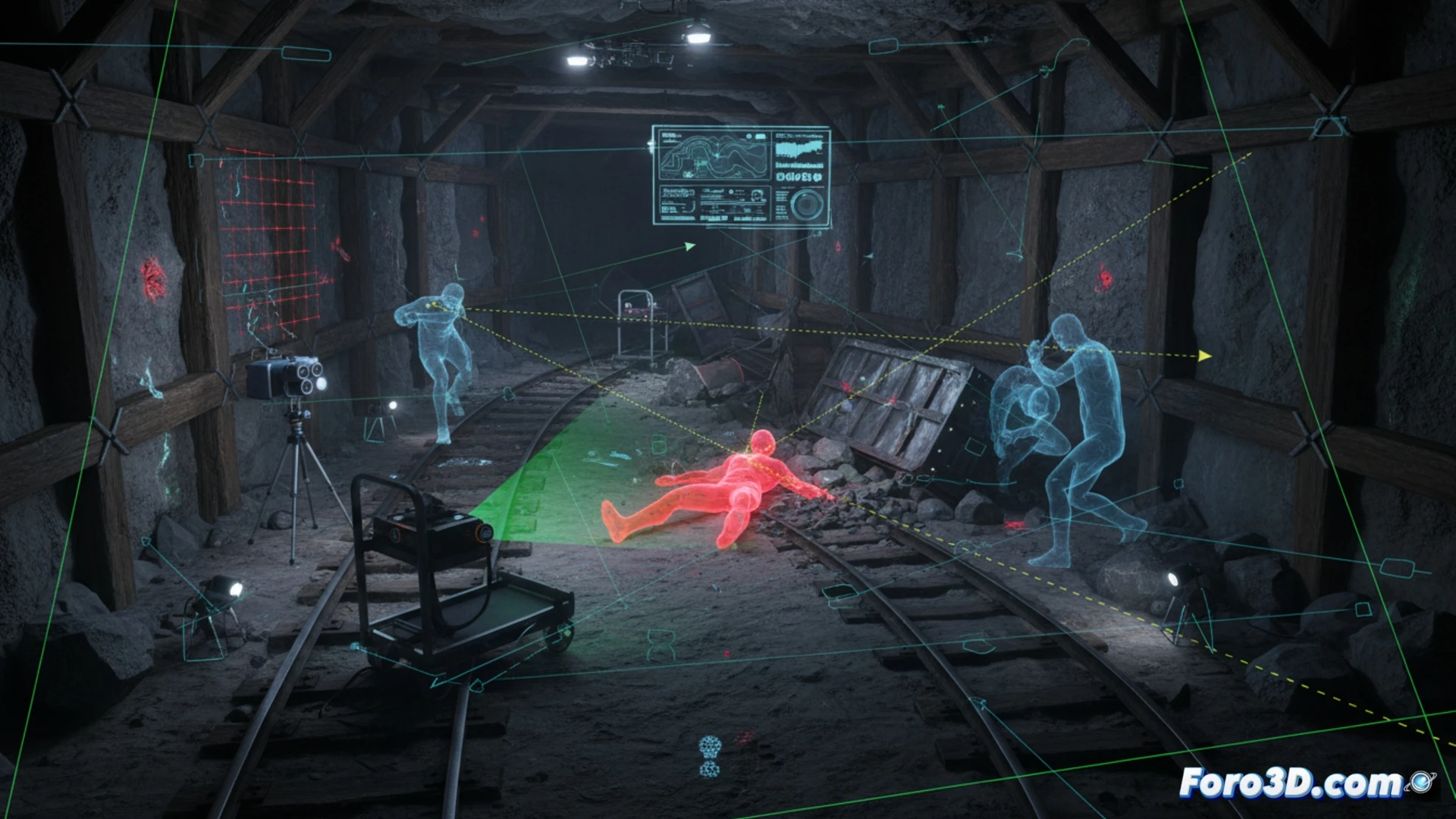
Documenting a crime scene in a mine presents extreme challenges: total darkness, suspended dust, and irregular geometries. In this technical article, we detail the forensic workflow for recreating a violent incident that occurred 200 meters deep. We combine photogrammetry with controlled lighting, terrestrial LiDAR scanning, and game engines to generate a digital replica that allows investigators to analyze ballistic trajectories and movements of those involved without altering the real scene. 🎯
Data capture in low-light conditions and complex geometry 🛠️
The first step involves deploying a long-range LiDAR scanner (Faro Focus or Leica RTC360) at strategic points in the gallery. To compensate for the lack of natural light, full-spectrum LED panels mounted on tripods are used, minimizing harsh shadows that could distort the point cloud. Simultaneously, a photogrammetric capture is performed with a high-ISO DSLR camera and wide-angle lens, synchronizing the shot with a ring flash to avoid vignetting. Each scanning station is georeferenced using coded targets, allowing the data to be merged into a unified model. Vegetation and fine dust are filtered in software such as RealityCapture or Agisoft Metashape, obtaining a textured mesh with submillimeter precision in areas of interest, such as impact marks or gunshot residue.
Trajectory simulation and judicial validation ⚖️
Once the digital twin of the mine is generated, it is imported into Unreal Engine 5 or Unity. There, ballistic trajectories calculated through impact analysis and the positions of the victim and aggressor based on bloodstain distribution are integrated. The simulation allows varying parameters such as movement speed or shooting angle, generating animations that experts can present in court. This approach not only streamlines the investigation but also offers an irrefutable visual narrative for the trial, overcoming the limitations of traditional 2D reports.
What is the most effective strategy for filtering suspended dust from the point cloud generated by the LiDAR scanner during the 3D reconstruction of a crime scene in an underground mine?
(PS: don't forget to calibrate the laser scanner before documenting the scene... or you might be modeling a ghost)