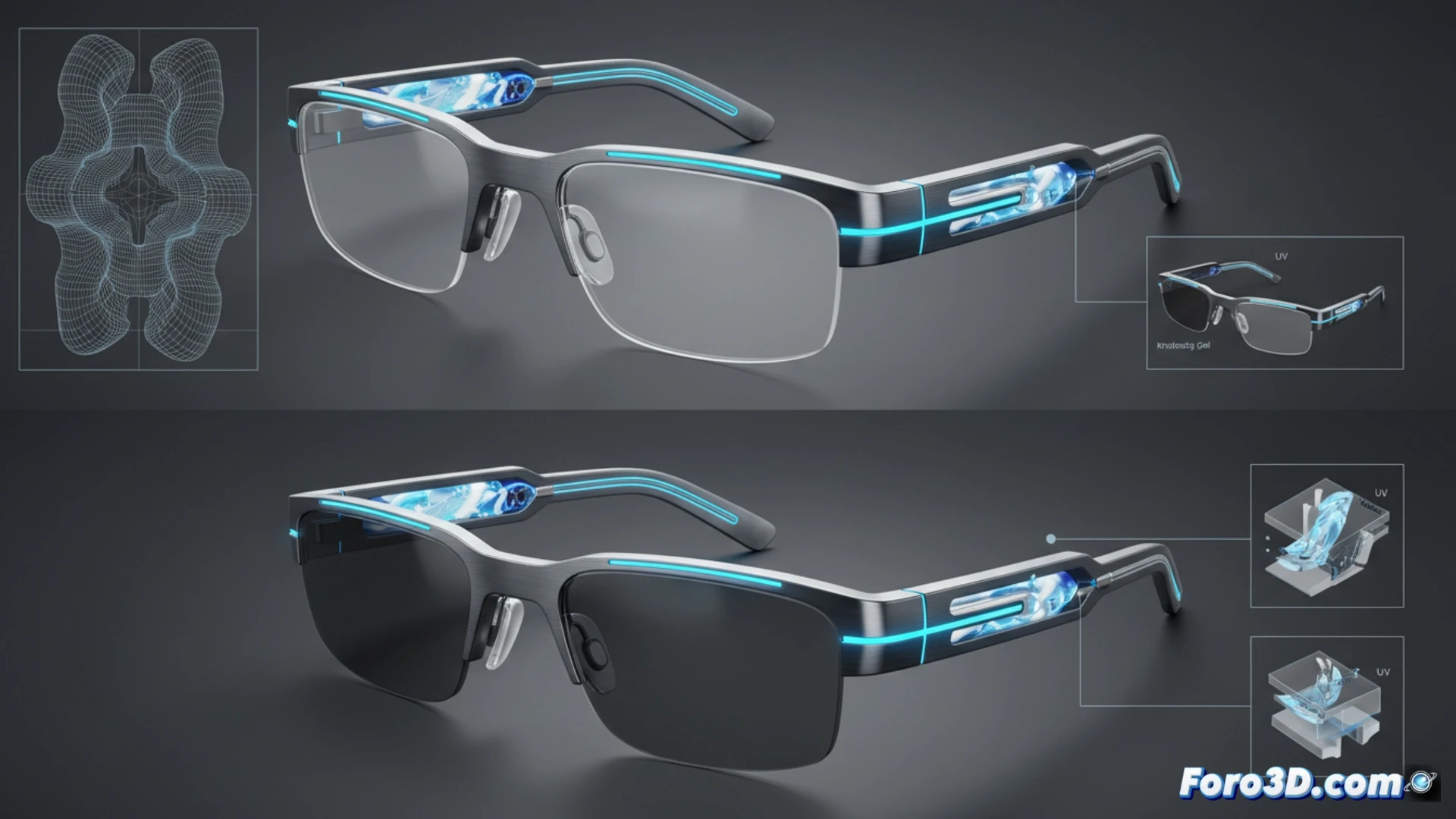
We address the design of a conceptual product that merges smart optics with physical thermoregulation. The glasses feature electrochromic lenses that respond to UV radiation, transitioning from a transparent state to a dark tint. The technical challenge lies in the temples, which house a refrigerator-rechargeable cooling gel. This article details the workflow in 3D modeling of complex surfaces, the integration of internal mechanisms, and rendering techniques to simulate the product's dynamic states.
Integration of Mechanisms in Nurbs Surfaces 🛠️
Modeling begins with creating the frame using Class A curves in software like Rhino or SolidWorks. The complexity arises when designing the housing for the electrical contacts of the electrochromic lenses within a profile barely 2mm thick. For the temples, a sealed internal cavity with a precise volume for the gel is modeled. It is crucial to define a wall thickness that allows thermal conduction without compromising ergonomics. The surface finish requires a reflectance analysis to simulate matte plastic and brushed metal. The gel's transparency is achieved with a dielectric material with a refractive index of 1.33, similar to water, but with a bluish tint to suggest a cooling effect.
Rendering and Dynamic State Configurator 🎨
For visualization, dual materials are configured for the lenses. A blend node controls the transition between transparent glass and dark polarized glass, linked to a slider in the 3D configurator. The cooling gel is rendered with a subsurface scattering (SSS) effect to simulate its density. The studio lighting is adjusted with an HDRI sun to show the progressive darkening of the lenses. The final configurator allows the user to toggle between frame colors and tint level, presenting the product as a functional piece ready for additive manufacturing.
How can the geometry of the heat sink integrated into the frame be optimized to ensure efficient dissipation without compromising the weight and ergonomics of the electro-optical glasses with active cooling?
(PS: Designing a product in 3D is like being an architect, but without having to worry about the bricks.)