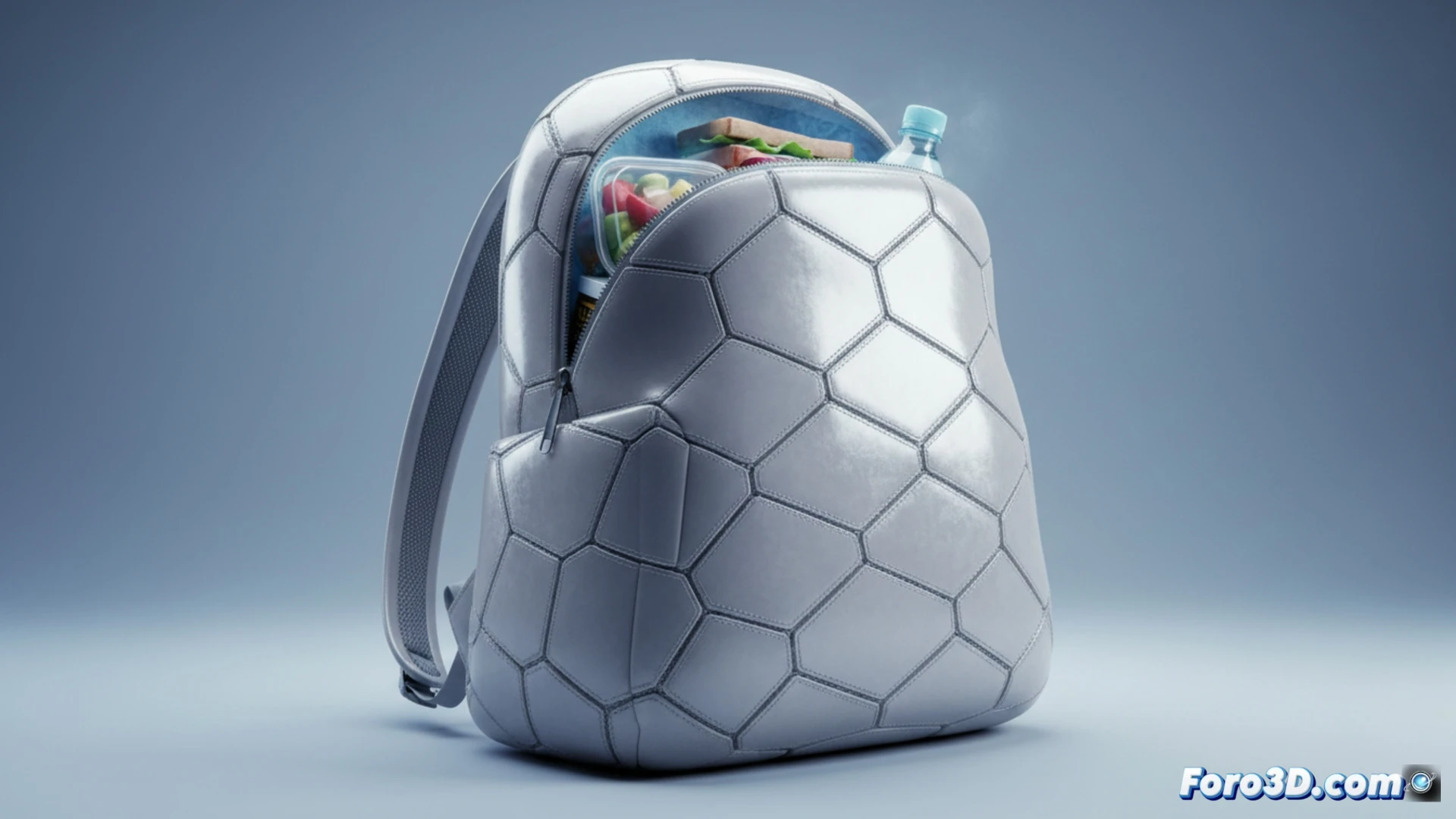
The additive manufacturing community has received a design that redefines the concept of passive cooling. It is a thermal backpack that eliminates the need for ice or cooling gels. Its secret lies in an air chamber structure separated by 3D-printed seams, combined with a reflective external ceramic layer. The result is a system capable of keeping food and drinks cold for eight continuous hours, using only the physics of convection and thermal reflection.
Technical analysis of the 3D model and printing parameters 🧊
The STL file of this backpack is optimized for flexible filaments such as TPU with Shore hardness 85A or higher. The printed seams are not mere decorative lines; they act as structural separators that generate a dead air chamber between the inner and outer layers. To achieve the passive effect, a layer height of 0.16 mm and 40% infill with a gyroid pattern in the side walls are recommended. The reflective ceramic layer is applied through post-processing with high-emissivity ceramic paint on the printed outer surface. It is crucial to print the seams with a material flow of 105% to ensure the air chamber is airtight. The recommended wall thickness is 1.6 mm to balance flexibility and insulation.
Implications for printable model design 🔧
This development demonstrates that 3D printing can replace traditional composite materials in thermal applications. For the modeler, the challenge lies in designing seams that act as airtight seals without losing the flexibility of TPU. The passive, ice-free approach opens the door to lighter and more sustainable backpacks. 3D model designers must prioritize the geometry of the air chambers and the integration of the ceramic layer into the file itself, either as a textured surface or as a guide for post-processing.
Considering that the backpack uses printed seams for its structure and ceramic as a passive cooling material, how are these components integrated to ensure the design is fully 3D printable without compromising thermal efficiency during the 8 hours of cold?
(PS: A good printable model is like a good friend: it doesn't need supports.)