The James Webb telescope has located a previously unseen theoretical object: a black hole star. It is a black hole residing inside a star without completely destroying it. The detection was achieved by analyzing a distant red dot emitting 40 spectral lines, thus expanding knowledge about the early universe.
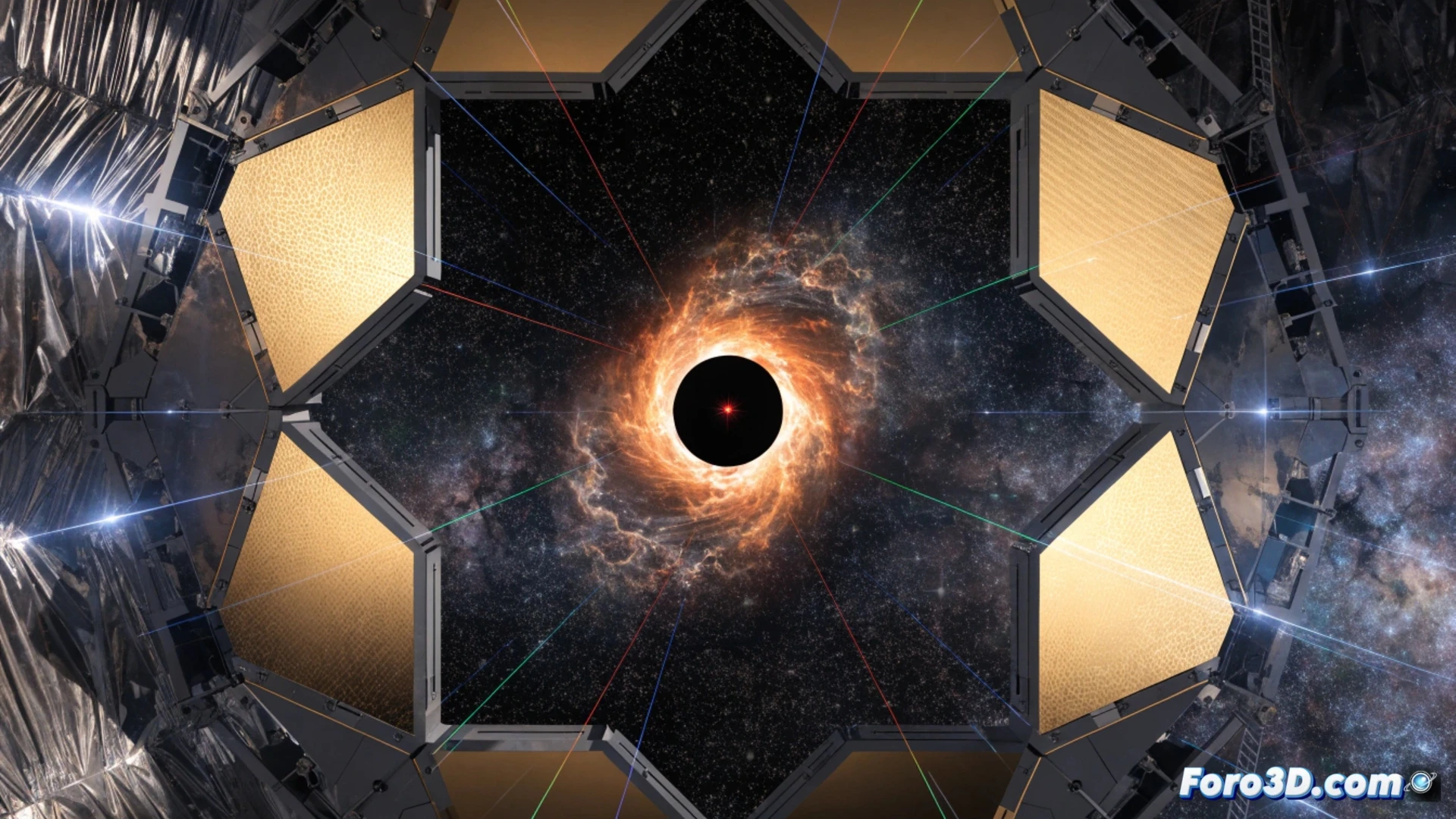
How the theory was confirmed with 40 spectral lines 🔭
The discovery is based on studying the light of a distant object. Astronomers identified 40 distinct spectral lines, whose signature matches models predicting the existence of black holes inside massive stars. This phenomenon, known as a quasi-star, would have formed in the early universe. Confirming this key astronomical theory allows for a better understanding of galaxy evolution and dark matter.
The black hole that dares not devour its own home 🛸
Imagine having a neighbor so dense that he lives in your living room and doesn't eat your couch. Well, that's this star: a black hole that, instead of devouring it, coexists with it. Kind of like a roommate who never orders pizza but also leaves no space in the fridge. Good thing it's not one of those hungry black holes, because then there would be no article to write.