Artist Louise Vo Tan has brought back to life the French crown jewels that were stolen from the Louvre in 1831. But she did not find them in any dusty basement. She has recreated them as holograms from historical images and engravings made before the theft. The exhibition is located in the old Port-Coton lighthouse building, a place that combines the light of the sea with the light of projectors.
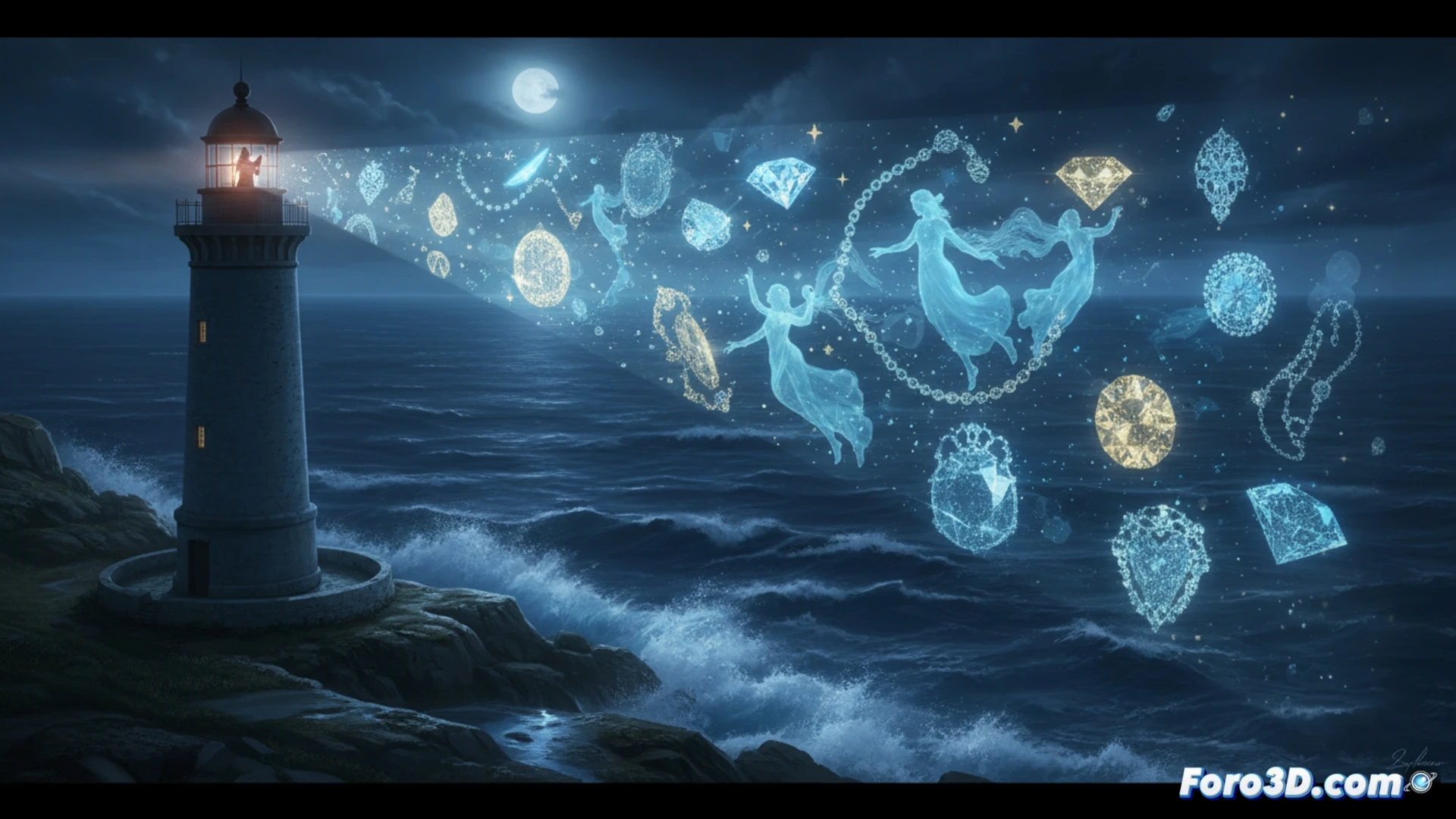
How technique turns old engravings into light 💡
To achieve the effect, Vo Tan used 3D modeling software based on drawings and archival descriptions. Each gem, setting, and filigree detail was digitally reconstructed. Then, a projection system with lasers and fine mesh screens generates the holograms in the empty space of the lighthouse. The result is pieces that float without physical support, visible from multiple angles. No special glasses are needed, just look towards the light.
At least no one will take these away 🔒
The advantage of exhibiting jewels made of light is that no one can put them in a pocket. If someone tried to steal them, they would only manage to take away a beam of photons. And if a projector burns out, you can always restart the computer. Something the Louvre guards could not do in 1831, when the thieves took the original pieces without leaving a single sparkle. Now the light is indeed guarded.