The recent thermal runaway incident in an eVTOL air taxi has brought the safety of high-density battery systems into focus. Although there were no casualties, the event reveals the need to understand how heat propagates within a cell pack. In this article, we analyze the incident from the perspective of 3D modeling and embedded systems simulation, key to preventing catastrophic failures in urban air mobility.
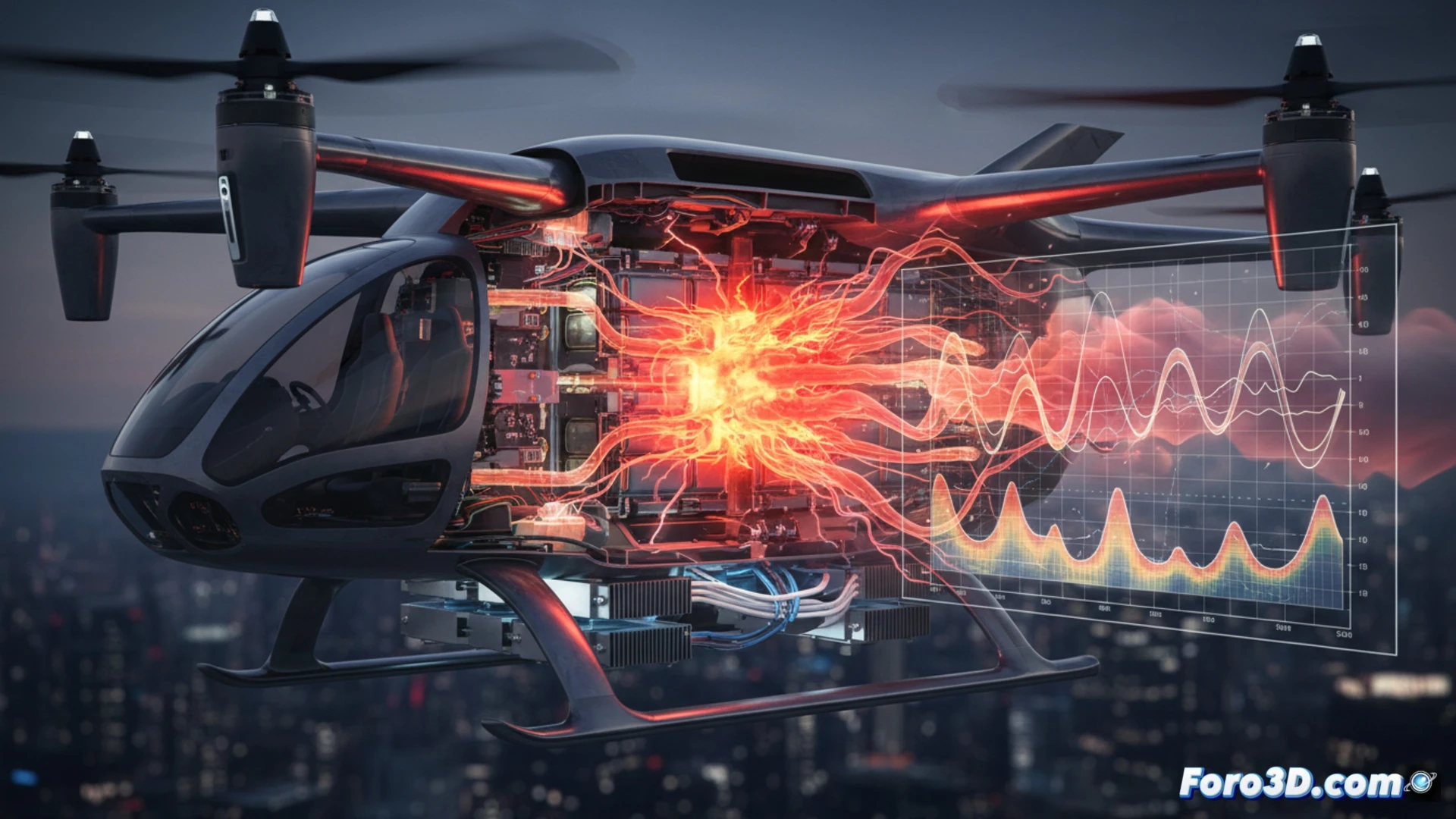
3D modeling of thermal propagation in lithium cells 🔥
To recreate the incident, a generic eVTOL battery pack was modeled in 3D, including 21700 cylindrical cells, connection busbars, and the liquid cooling system. Finite element method (FEM) simulation allowed visualizing the thermal runaway sequence: a defective cell reaches 180 degrees Celsius, triggering a chain reaction. The model shows how heat concentrates in areas of lower dissipation, precisely where temperature sensors failed in the real case. This graphical representation is vital for redesigning ceramic separators and cooling channels.
Lessons for active safety system design ⚙️
3D simulation not only confirms the failure but also allows testing solutions without building physical prototypes. For example, by adding a phase change material (PCM) between cells, the model predicts a 40% reduction in thermal propagation speed. For the automotive and 3D systems niche, this case demonstrates that integrating thermal simulation into the design phase is as critical as the vehicle chassis itself. The air taxi leak is not a failure, but invaluable data for the next generation of safe eVTOLs.
What 3D simulation parameters allow for more accurate prediction of thermal runaway propagation in high-density batteries of an eVTOL air taxi, and how do these models validate data from the recent incident?
(PS: modeling a car is easy, the hard part is making sure it doesn't become a box on wheels)