Railway wheel deformation is not a sudden failure, but the cumulative consequence of millions of load cycles. Each train pass over the rail generates contact stresses that, combined with thermal braking, initiate plasticization processes in the tread. This article breaks down how 3D simulation allows visualizing the evolution of cracks and the loss of the original profile before a catastrophic failure occurs.
Parametric modeling of cyclic and thermomechanical stresses 🔧
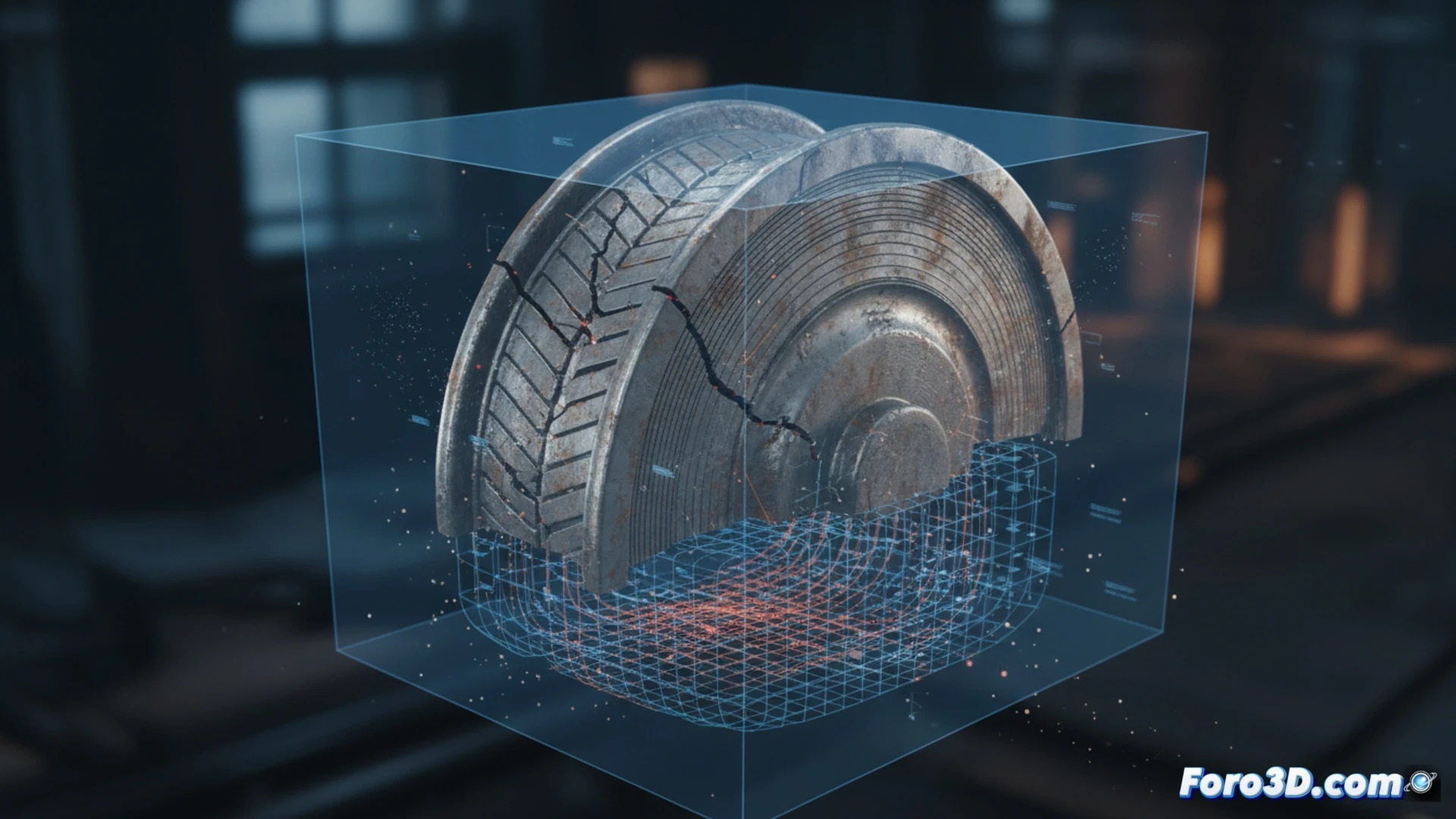
To analyze fatigue, a parametric model is built in which the wheel geometry (S1002 profile or similar) is subjected to repetitive loads of up to 100 kN and thermal gradients of 300 degrees Celsius generated by braking. Finite element simulation reveals two critical zones: the contact surface, where Hertzian stresses exceed the elastic limit of the steel, and the subsurface layer at 5-10 mm depth, where cyclic shear nucleates microcracks. By varying the friction coefficient and material hardness (R7 steel vs. R8T steel), the model shows how the plastic strain rate doubles in softer steels, accelerating the formation of rolling contact fatigue (RCF) cracks. 3D visualization allows isolating the exact point where the Von Mises equivalent stress exceeds the yield strength, marking the onset of irregular wear known as false brinelling.
From simulation to predictive railway maintenance 🚆
Beyond academic analysis, these simulations allow predicting the remaining useful life of a wheel with millimeter precision. By comparing the evolution of the simulated tread profile with real measurements from laser profilometers, selective reprofiling can be scheduled in workshops, avoiding the premature replacement of entire wheels. The true technical value lies in translating the fatigue visible in the 3D model into data-driven maintenance decisions, reducing operational costs and increasing safety in railway infrastructure.
What are the main challenges when 3D modeling the transition between low-cycle and high-cycle fatigue in railway wheel wear?
(PS: Material fatigue is like yours after 10 hours of simulation.)