The recent explosion of a solid-state battery in a testing laboratory has reopened the debate on the safety of these promising technologies. Although they are considered more stable than liquid lithium batteries, this event demonstrates that no system is risk-free. At Foro3D, we analyze this case as a technological catastrophe, using three-dimensional models to break down the progression of thermal runaway and the dynamics of the shockwave.
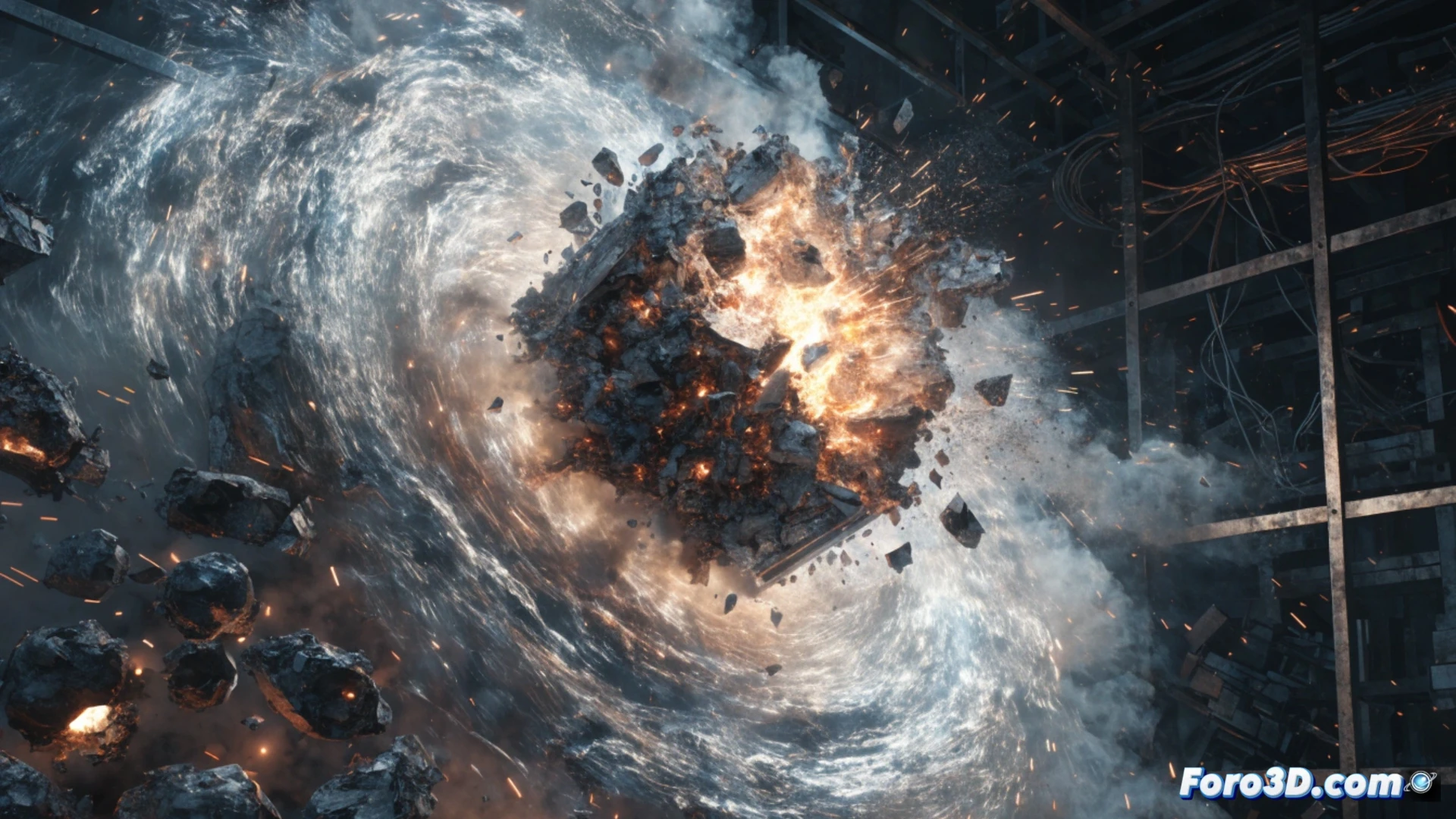
Mechanics of thermal runaway and deflagration modeling 🔥
Our 3D simulation reconstructs the incident from its origin: a lithium dendrite pierces the solid electrolyte, creating an internal short circuit. The model, based on calorimetry data and computational fluid dynamics (CFD), shows how the local temperature exceeds 400 degrees Celsius in milliseconds. The release of gases, primarily oxygen and vaporized electrolyte, generates overpressure that fractures the metal casing. The animation reveals that the shockwave, although less intense than in liquid batteries, is sufficient to propel fragments at high speed—a critical risk in domestic storage systems or electric vehicles.
Lessons for pack design and emergency protocols ⚠️
The 3D visualization of the incident allows us to identify blind spots in current safety measures. The failure did not cascade to adjacent cells, but it did generate an aerosol of incandescent particles. This suggests that conventional extinguishing systems, such as water spray, may not be effective. We propose redesigning the separators between cells with ablative materials and updating emergency protocols to include evacuation distances based on particle dispersion, not just radiant heat. 3D forensic analysis is, once again, the key tool to prevent the next catastrophe.
What critical parameters of the 3D simulation need to be adjusted to accurately predict the propagation of thermal runaway in a solid-state battery before a catastrophic explosion occurs?
(PS: Simulating catastrophes is fun until your computer melts down and you become the catastrophe.)