Sweat on the forehead is a recurring problem during summer, especially for those who wear caps or hats. The traditional solution is disposable absorbent bands, but they generate waste and don't always fit well. This technical tutorial explains how to design and print a reusable sweatband separator in ultra-low-density flexible foam, optimized to fit the inner curvature of any cap and manufactured without the need for supports.
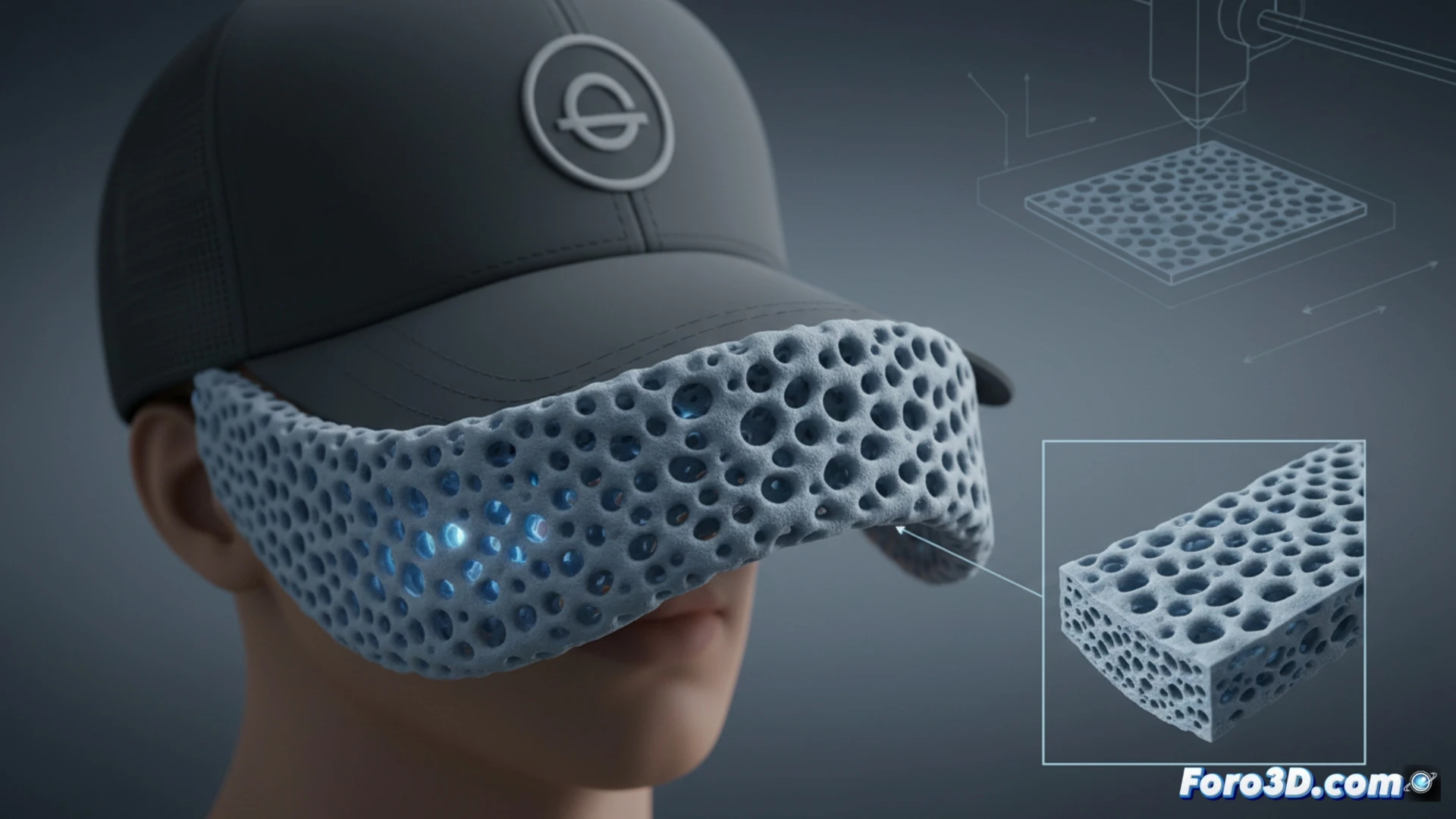
Parameterization and Print Settings for Flexibility 🧵
The separator design must be parametric to fit different head sizes. The first step is to model a 3D arc that matches the inside of the cap, with a thickness between 2 and 3 millimeters and a height of 3 to 4 centimeters. The key is the material: a TPU filament with a hardness of 85A or lower (such as NinjaFlex or Recreus FilaFlex). To achieve the low-density foam texture, configure an extrusion with 30% flow and a temperature of 210 degrees Celsius. The print speed should be reduced to 20 mm/s and retraction must be disabled to avoid internal gaps. The infill should be gyroid type at 5% to maintain lightness and the ability to absorb moisture through capillary action.
Curvature and STL File Optimization 🔧
For the separator to work on different types of hats, the arc must be designed with a variable curvature radius between 80 and 120 millimeters. This allows the piece to deform without breaking when inserted into the inner band. STL optimization involves removing any protrusions or right angles; all edges must have a 1-millimeter chamfer to avoid stress points. Additionally, it is recommended to orient the piece horizontally on the print bed, with an initial layer of 0.3 mm to improve adhesion. This results in a functional, breathable separator ready for use in less than 45 minutes of printing.
What design parameters and flexible foam materials are critical to ensure that a 3D printed sweat separator is effective, breathable, and comfortable to wear under a cap during long periods of physical activity?
(PS: don't forget to level your bed, or your print will look like abstract art)