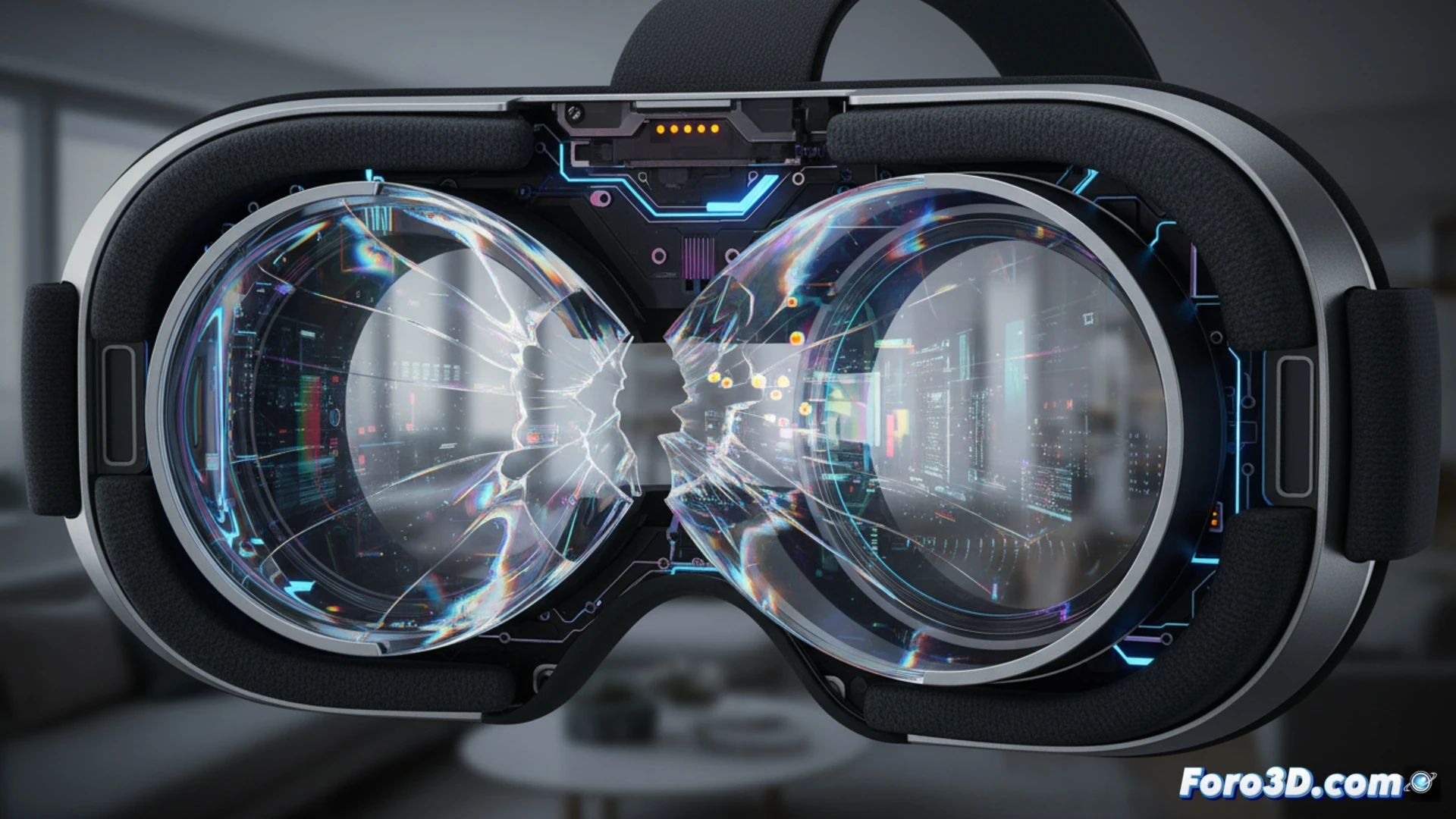
Delamination in Mixed Reality headsets is a technical phenomenon that occurs when the internal optical layers of the device separate, generating irreversible visual distortions. Unlike a simple scratch, this defect compromises the structural integrity of the visor, affecting the sharpness of video passthrough and spatial calibration. In devices like Apple Vision Pro or Meta Quest 3, where millimeter precision is critical, delamination becomes an invisible barrier to immersion.
Technical causes and detection via 3D scanning 🔍
The main causes of delamination are divided into three fronts. First, differential thermal stress between the optical adhesive and the plastic or glass lenses, accelerated by charge cycles and heat generated by XR processors. Second, exposure to ambient humidity, which degrades anti-reflective coatings and causes internal bubbles. Third, manufacturing defects in vacuum lamination. To detect it objectively, repair workshops use structured light 3D scanning or optical coherence tomography (OCT), capable of mapping sub-millimeter layer separation without disassembling the headset. This technique reveals delamination patterns in the form of concentric rings or radial cracks.
Impact on experience and design solutions 🛠️
Delamination not only generates visual artifacts like halos or blurry areas, but also breaks mixed reality calibration by altering the perceived interpupillary distance. Documented cases in technical forums show that the problem usually appears after 6-12 months of intensive use, especially in humid climates. As a solution, manufacturers are adopting adhesives with more stable thermal expansion coefficients and hydrophobic coatings on the lens interface. For the user, prevention involves avoiding sudden temperature changes and using desiccant cases during storage.
What specific factors of the optical design of Mixed Reality headsets, such as layer adhesion or the materials used, contribute to the onset of delamination, and how can this failure be predicted before it becomes visible to the user?
(PS: With extended reality, you can see dragons in your living room. The problem is when the dragon sits on your couch and there's no room.)