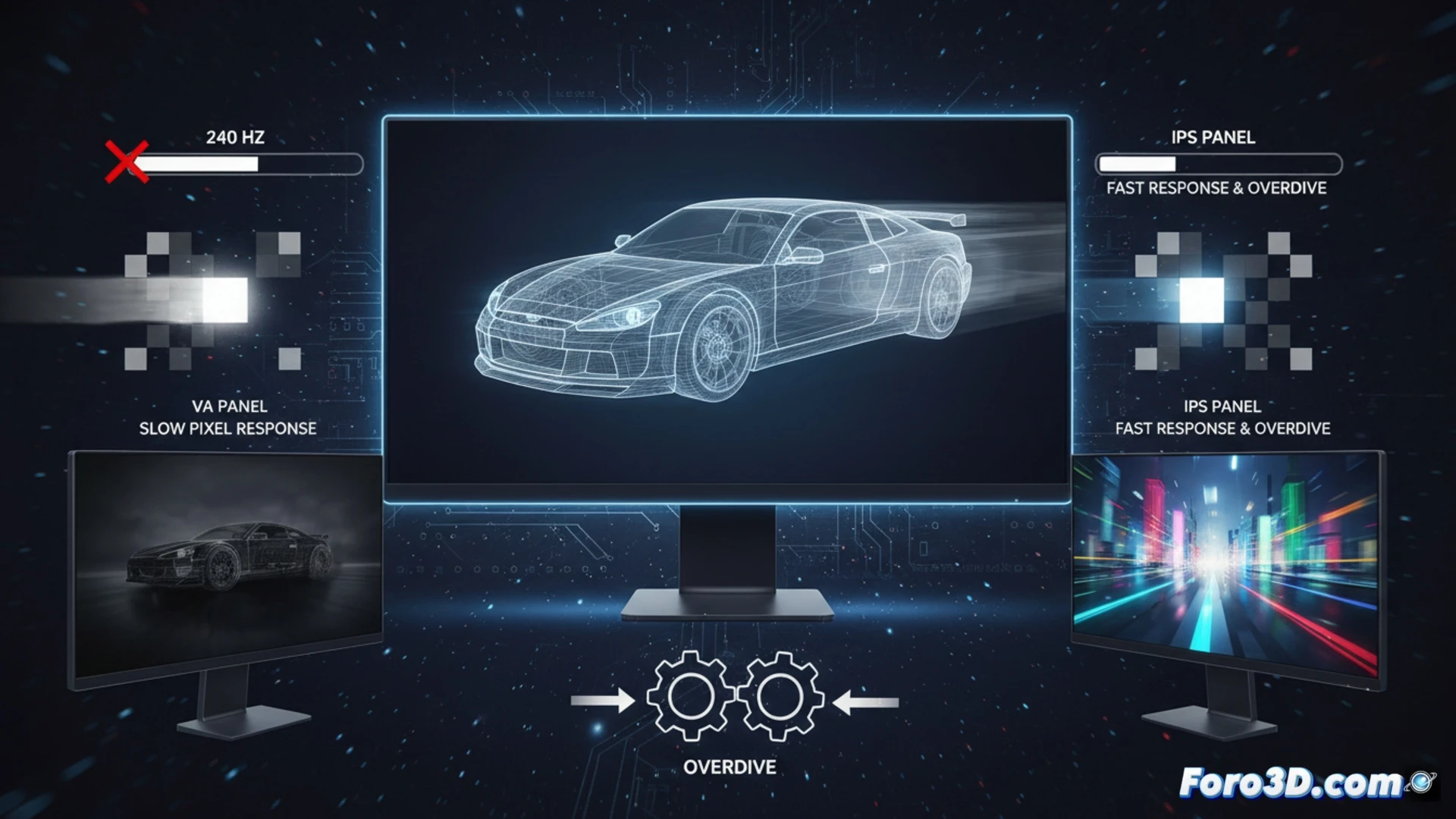
In the world of 3D modeling and simulation, visual fluidity is key. However, many professionals fall into the error of thinking that a 240 Hz monitor guarantees zero trails or ghosting. The technical reality is more complex: the refresh rate only indicates how many times the image is updated per second, but it does not control the speed at which a pixel changes color. If the response time is slow, especially on VA panels with dark scenes, you will see trails even if your monitor reaches 240 Hz. Here we break down why this matters for your 3D workflow.
GtG response time and overdrive: the real culprits 🖥️
The critical parameter is the GtG (Grey to Grey) response time, which measures how many milliseconds it takes for a pixel to transition from one shade of grey to another. On budget VA panels, this value can exceed 10 ms in dark transitions, generating noticeable ghosting when moving complex models or during particle simulations. To combat this, manufacturers implement overdrive, which overvolts the pixel to speed up the change. However, poorly configured overdrive produces overshoot: an inverse halo that ruins visual precision. For professional 3D work, look for IPS monitors with a real GtG of 4 ms or less, and manually adjustable overdrive. Models like the Dell U2723QE or the ASUS ProArt PA279CRV offer predefined profiles that avoid these artifacts. To test ghosting in dark scenes, use the pursuit camera test (UFO Test) with black backgrounds and fast-moving objects; if you see trails, your monitor is not suitable for real-time rendering.
The illusion of hertz and the reality of the pixel 🔍
The hardware industry has sold us the idea that more Hz equals better performance. For those working with 3D animation or CAD simulations, this equation is false. A 240 Hz monitor with a slow VA panel will give you a fluid image but contaminated with trails, ruining precision when evaluating textures or dynamic lighting. Investing in a monitor with solid response time and a suitable panel type (IPS for color accuracy, VA only if you prioritize contrast) is more important than the refresh rate number. Remember: in 3D, the clarity of each frame outweighs the quantity of them.
Why do 240 Hz monitors still exhibit ghosting in 3D modeling and simulation applications, and how does this affect depth perception and real-time visual precision?
(PS: If your computer is smoking when opening Blender, you might need more than a fan and faith)