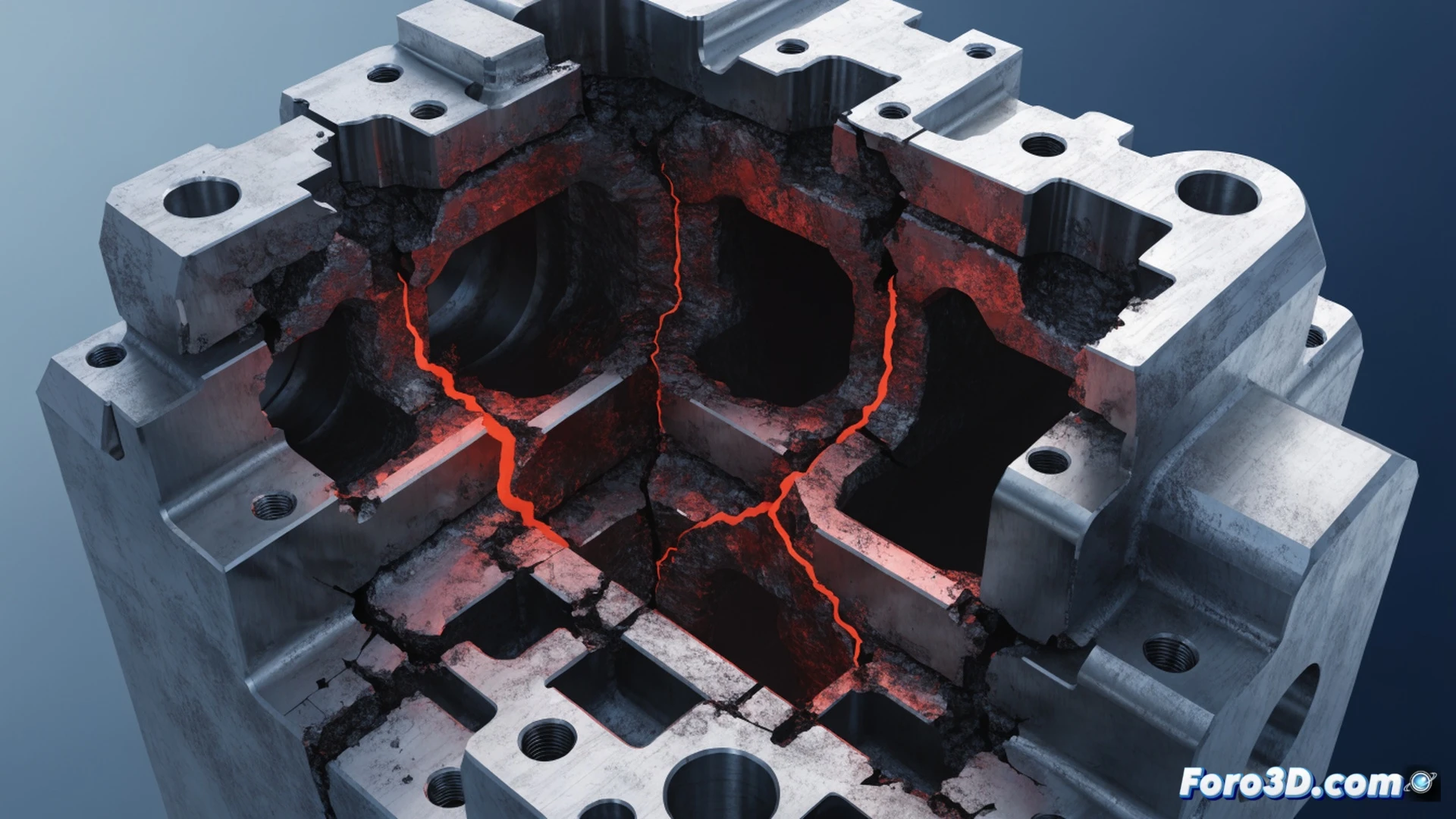
The catastrophic failure of a hot runner plastic injection mold revealed a fracture in the manifold block. The origin was not an impact, but metal fatigue from poorly dissipated cyclic thermal stresses. This case shows how a design without proper heat transfer can lead to the structural collapse of the tool.
3D Pipeline for Forensic Fracture Analysis 🔍
The team used SolidWorks to model the manifold block and recreate the original geometry of the cracks. With Autodesk ReCap, they digitized the fragments using photogrammetry, obtaining a precise point cloud. The analysis revealed that areas without cooling channels generated extreme thermal gradients. The repeated expansion and contraction of the steel exceeded its yield strength, propagating cracks from the thinnest points.
The Block That Said Enough and Split in Two 💥
The manifold block decided to take a forced vacation right in the middle of a night shift. It didn't warn, it didn't ask for permission. It simply said enough and fractured with a sharp sound that woke up the operator. Now it rests in pieces on the inspection table, while engineers debate whether to add more thermocouples or change its last name to self-destruct block.