Clavicular osteosynthesis presents a subtle mechanical challenge: fatigue fracture of the implant due to micromechancial stress. The origin is often at the screw notch, where stress concentration exceeds the material's strength. This phenomenon, analyzed with 3D Slicer for segmentation and Abaqus for simulation, reveals how small geometric details cause structural failures under cyclic loads.
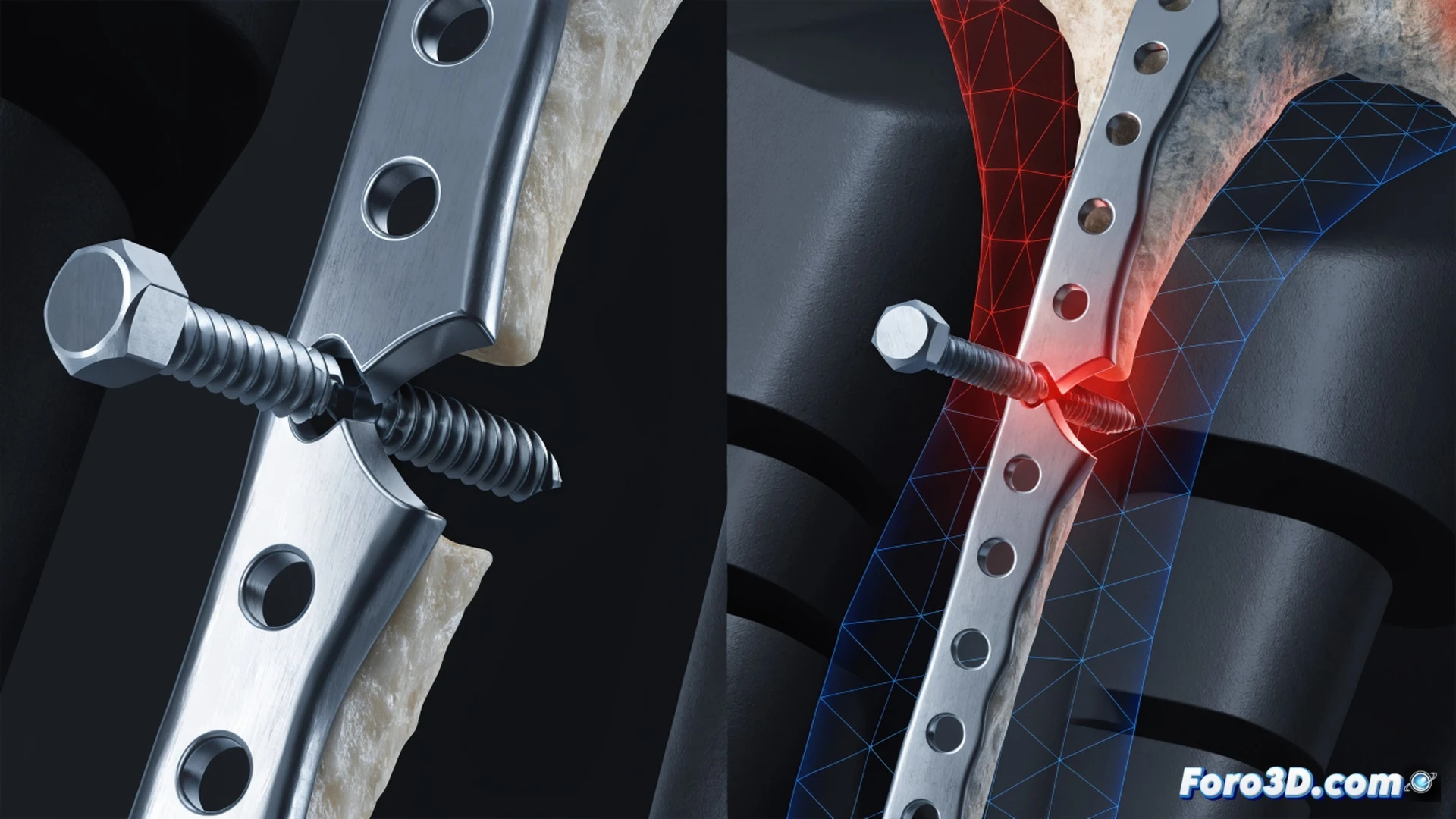
3D Pipeline: segmentation with Slicer and simulation with Abaqus 🔧
The workflow begins in 3D Slicer, where the geometry of the plate and bone is reconstructed from CT scans. The model is exported to Abaqus for finite element analysis. There, physiological loads are applied and the stress at the screw notch is evaluated. The results show localized stress peaks that, after thousands of cycles, initiate the fatigue crack. The precision of the mesh in the critical area is key to detecting the failure.
The screw that wanted to be a hero and ended up in fracture 💥
The screw, that small cylinder with titanium pretensions, cannot handle the pressure of being the center of attention. While the plate gets the credit for holding the bone together, it accumulates stress at its notch, like an office worker who never takes a vacation. The result: a fatigue crack that, instead of a medal, grants it an early retirement in the drawer of failed implants.