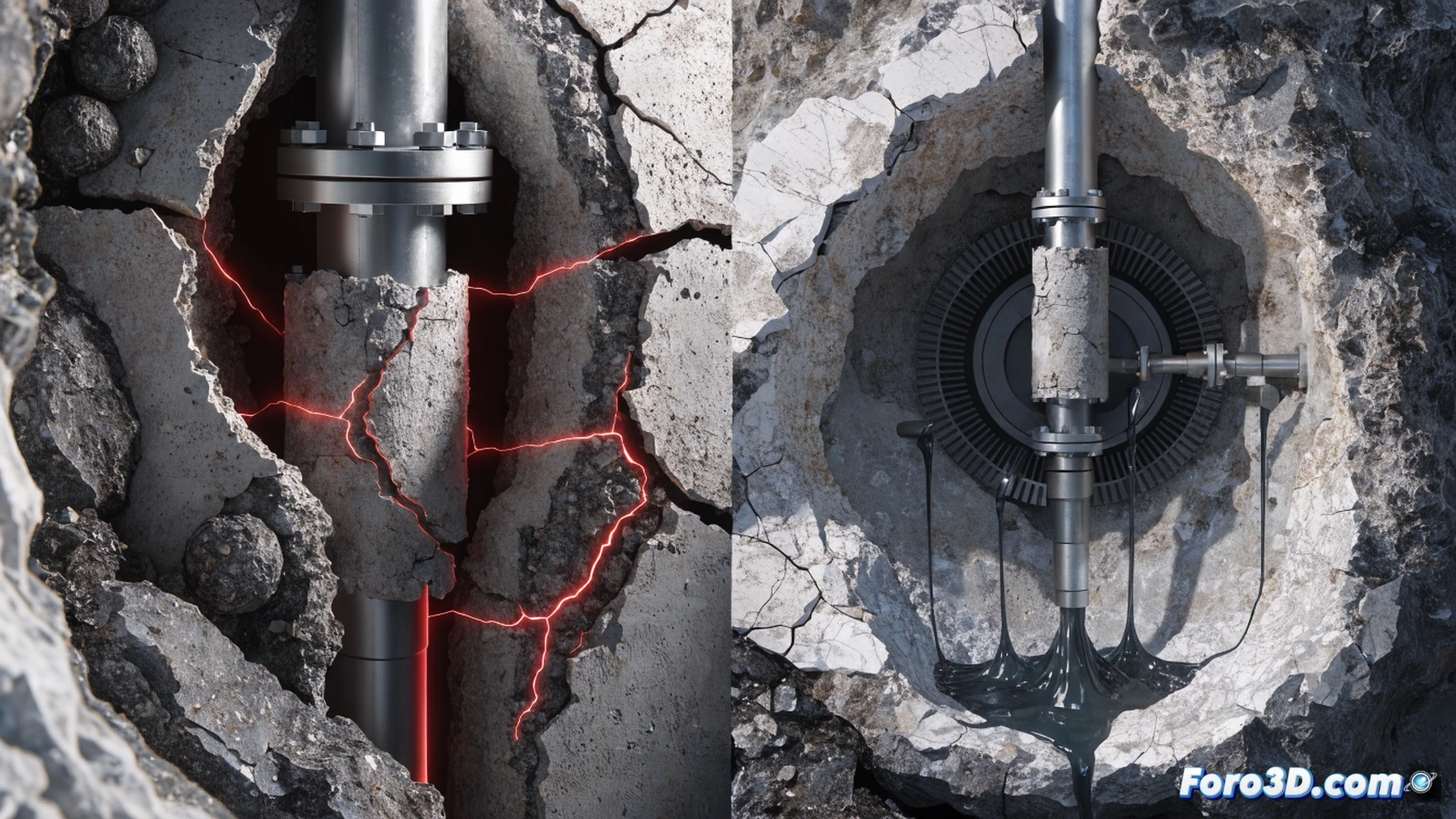
The underground gas storage well disaster revealed a critical failure: the sealing cement cracked after continuous injection and purge cycles. Fluctuating pressure caused material fatigue, opening leakage pathways. This problem, common in poorly designed facilities, can lead to leaks and environmental risks. Post-event analysis requires reviewing sealing protocols and the materials used.
3D Modeling with CloudCompare and FLAC3D for Failure Analysis 🛠️
To study the cracking, CloudCompare was used in processing point clouds of the 3D pipe, enabling detection of millimeter-scale deformations at the cement-rock interface. Then, FLAC3D simulated the mechanical behavior of the seal under cyclic loads. The results showed that accumulated fatigue from injection and purge cycles generates tensile stresses that exceed the cement's strength, initiating cracks that grow with each cycle. The model allows predicting the seal's service life.
The cement wasn't as eternal as the brochure promised 😅
Apparently, the sealing cement forgot to read the fatigue resistance manual. While engineers celebrated the injection cycles as if they were spinning records, the material was quietly cracking. Now, it's time to glue the pieces back together with more cement and hope it doesn't get bored before its time this go-around. Of course, the next well will come with anti-stress yoga included for the concrete.