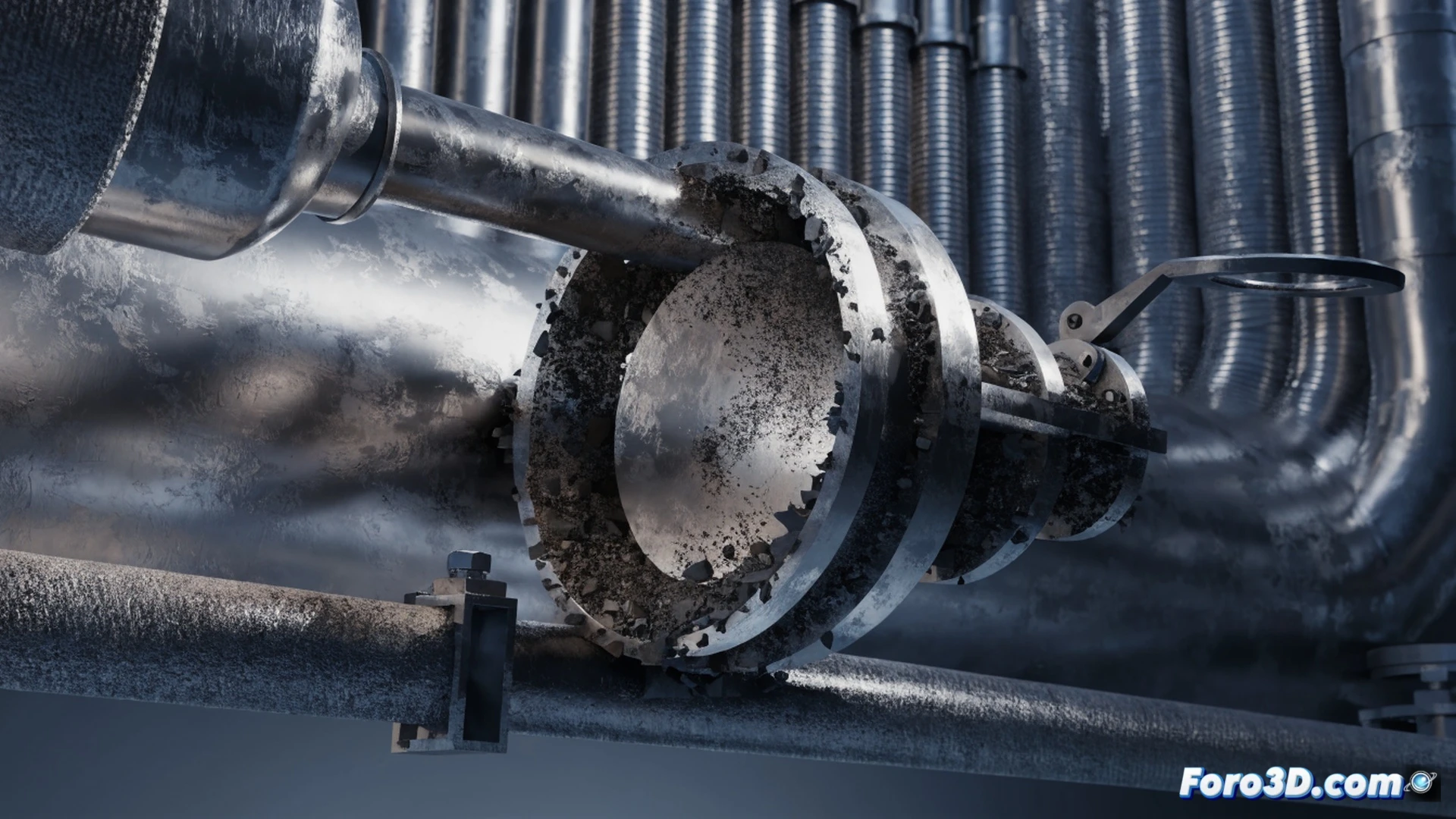
In a continuous process chemical plant, a check valve failed after only 200 hours of operation. The analysis revealed accelerated erosion on the seat and disc, caused by the impact of solid particles suspended in the fluid. This case, documented with SolidWorks Simulation and Blender, shows how particle dynamics can destroy critical components without warning.
Impact Simulation: SolidWorks and Blender in the 3D Pipeline 🛠️
The engineering team replicated the two-phase flow using SolidWorks Simulation to model the fluid mechanics and particle trajectory. The results indicated that silica particles, with a hardness of 7 on the Mohs scale, impacted the seat at 12 m/s. To visualize the progressive erosion, the geometry was exported to Blender, where surface wear was animated using displacement maps and particle simulations. The model confirmed that the valve geometry created recirculation zones that concentrated the impact.
The valve that couldn't say no to particles ⚙️
The check valve had one mission: let the fluid pass and block backflow. But no one told it that solid particles also wanted to get through. The result was a seat that looked like a lunar crater and a disc that seemed chewed by a hydraulic rodent. Engineers are now considering installing a filter, but in the meantime, the valve remains a reminder that in chemistry, solids matter too.