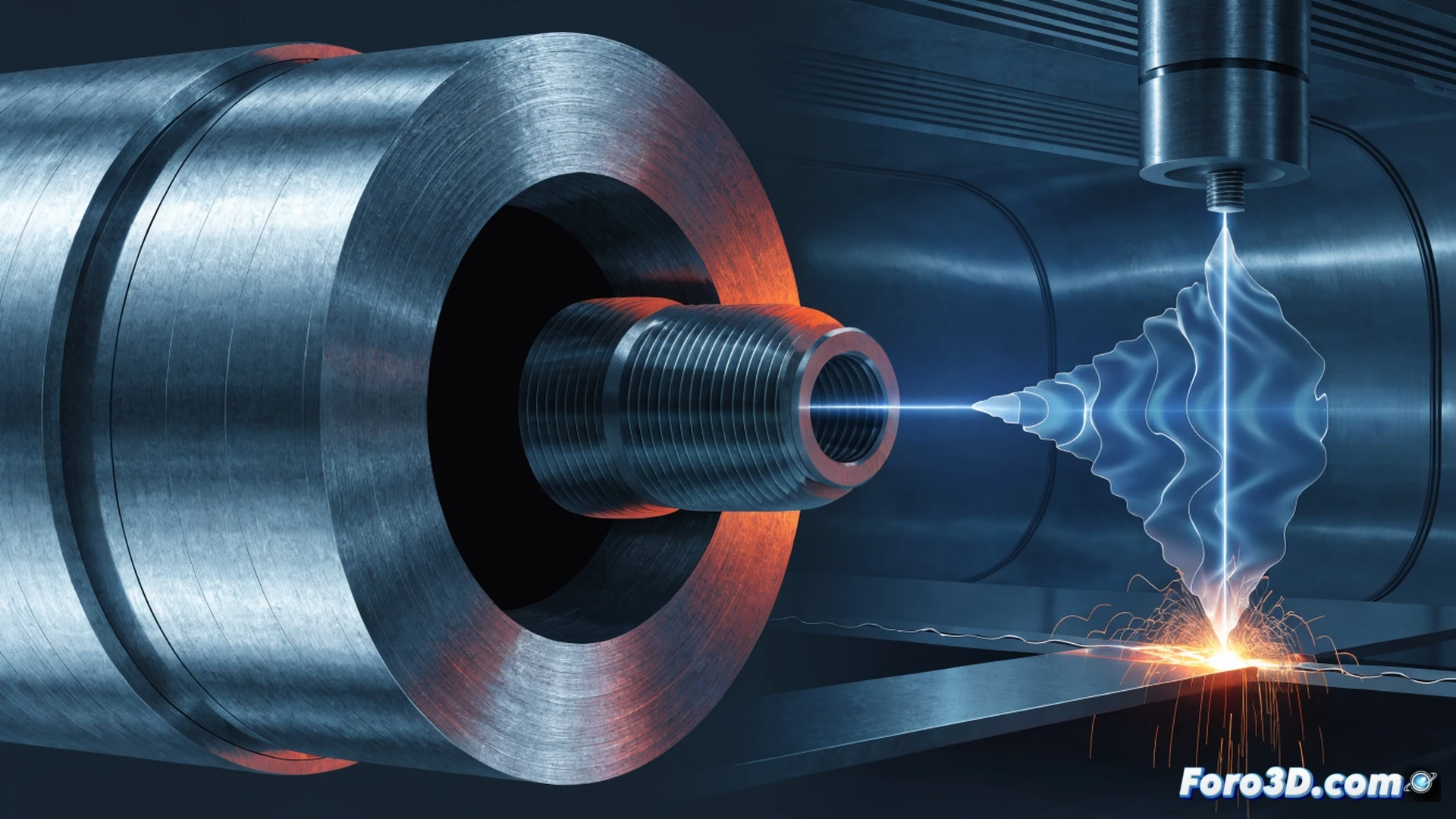
In the world of sheet metal welding, a recurring phenomenon baffles technicians: laser beam distortion caused by residual mechanical stresses. The origin of the problem is not in the optics, but in the threaded support. To unravel this mystery, a 3D pipeline has been employed with GOM Inspect for metrology and COMSOL Multiphysics to simulate deformations.
3D Pipeline Analysis with GOM Inspect and COMSOL 🔧
The process begins with GOM Inspect, scanning the support geometry to detect microscopic deviations in the threads. The data is exported to COMSOL Multiphysics, where the residual stress field is modeled. The simulation reveals how the threading pressure induces micro-deformations in the support, altering the optical axis of the lens. The result is an off-center focus that generates irregular weld beads.
The Day the Sheet Metal Laughed at Our Calibration 😅
After weeks of adjusting screws and staring at the lens, we discovered that the real culprit was the operator's hand torque. It turns out the sheet metal has no sense of humor, but it does have a memory: it remembers every turn of the torque wrench. Now, before welding, we make an offering to the gods of tightening torque and recite a COMSOL mantra. At least the distortion now has a proper name.