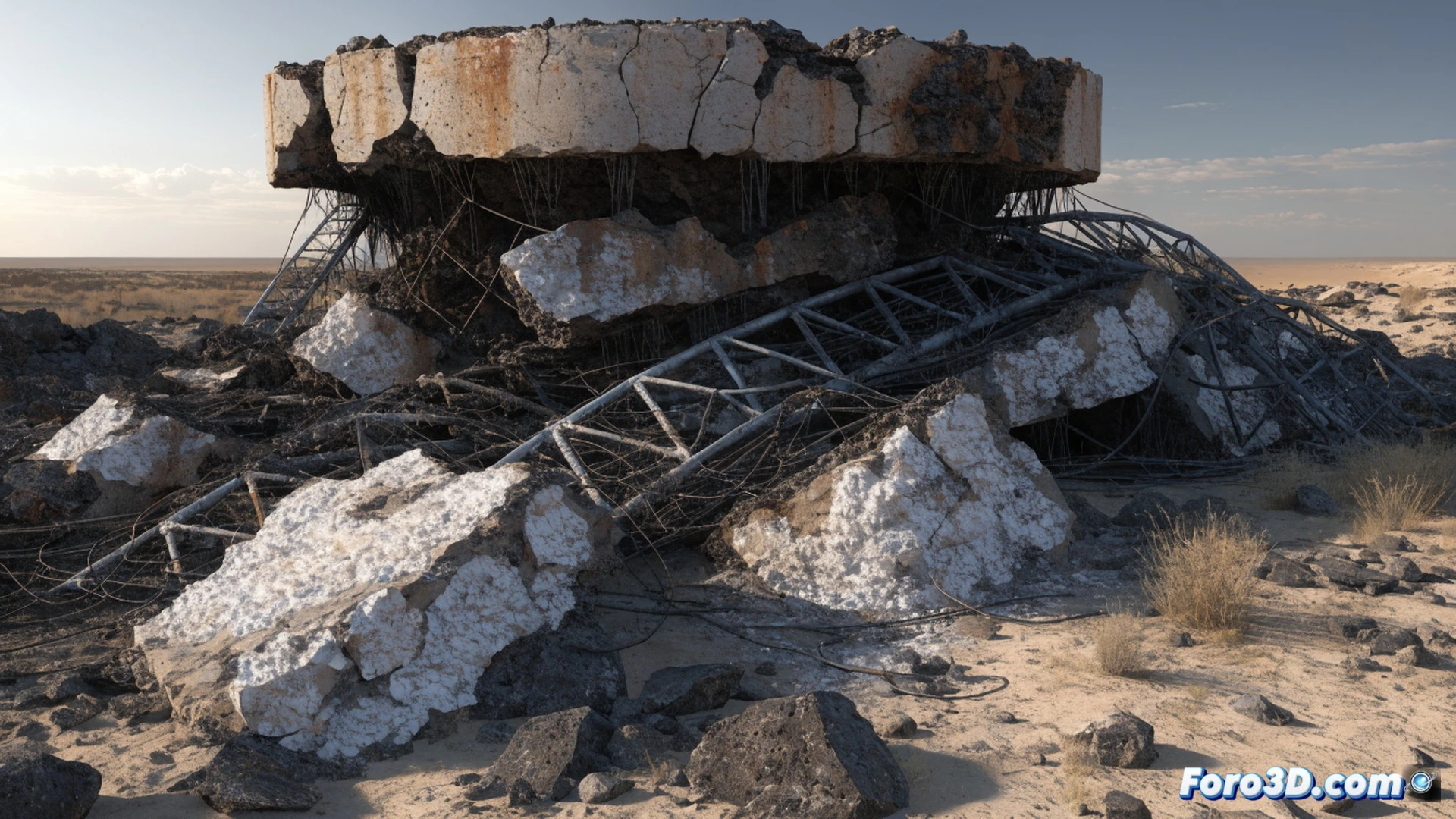
A telecommunications antenna in an arid area collapsed due to the failure of its concrete base. Forensic analysis points to two culprits: wind erosion, which wore down the surface, and sulfate salt expansion, which fractured the interior of the foundation. The collapse occurred without warning, leaving a lesson on material fatigue in hostile environments.
3D Pipeline: from laser scanning to geotechnical model 🛰️
The engineering team used Leica Cyclone to capture the terrain geometry and antenna debris with point clouds. This data was imported into Plaxis 3D, where the soil-structure interaction was modeled. The software allowed simulating the loss of concrete section due to erosion and differential swelling from salts. The results confirmed that the foundation lost its load-bearing capacity when the material's tensile limit was exceeded.
Concrete didn't ask for a vacation in the desert 🏜️
The antenna thought it was safe from traffic and pollution, but it didn't count on sand and sulfate salts making its life impossible. Instead of resting, the concrete swelled and cracked as if it had been to a gypsum spa. Now it lies on the ground, providing shade for lizards and reminding us that even in the desert, maintenance is not optional.