An accident in a shipyard has brought to light a technical problem that many prefer to ignore: the breakage of the main pulley shaft of a crane. The failure, attributed to a defect in the steel's heat treatment, caused the structure to collapse. To understand what happened, a 3D pipeline was used, combining photogrammetry with Agisoft Metashape and finite element simulations in LS-DYNA. The case is not isolated and deserves attention.
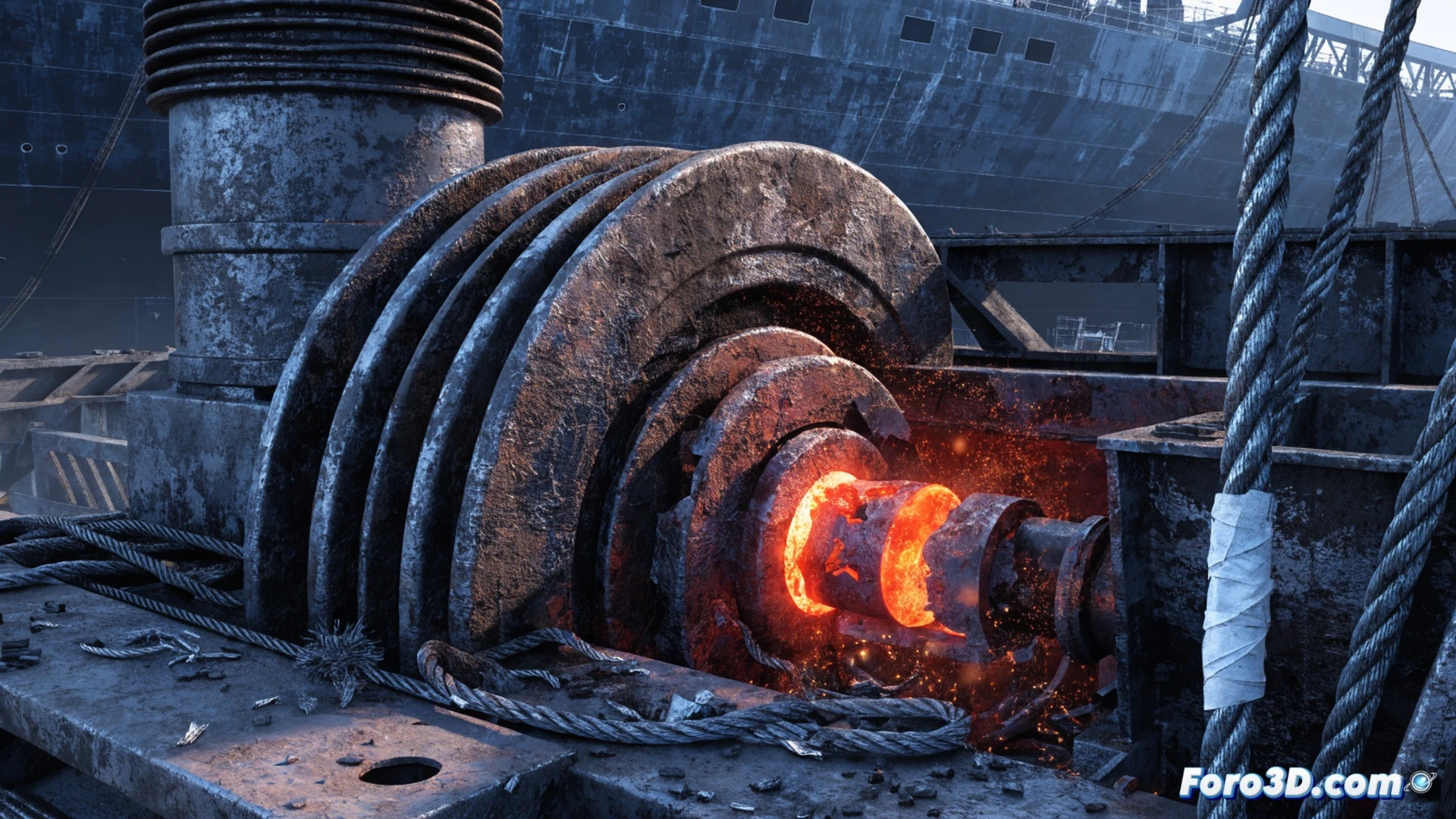
3D Reconstruction and Simulation of the Structural Failure 🏗️
The analysis process began with capturing the scene using Agisoft Metashape, generating a point cloud and a textured model of the crane and the accident area. This model served as the geometric basis for the simulation in LS-DYNA. Material properties were defined according to metallurgical reports, revealing irregular hardness in the shaft. The explicit finite element simulation reproduced the fracture sequence, showing that the stress concentration exceeded the fatigue limit of the poorly treated steel. The result is clear: the quenching process was not uniform.
The Shaft That Broke Because the Quenching Was Half-Hearted 🔧
It's not that the shaft was in a bad mood that day. It turns out the heat treatment was done with so little dedication that the steel decided to give up early. The LS-DYNA simulation confirms it: the critical area showed a microstructure softer than a freshly made churro. If the shipyard had invested in a decent furnace instead of the coffee machine, things would be different. But no, they preferred to save on quenching and now they have a crane turned into a modern sculpture.