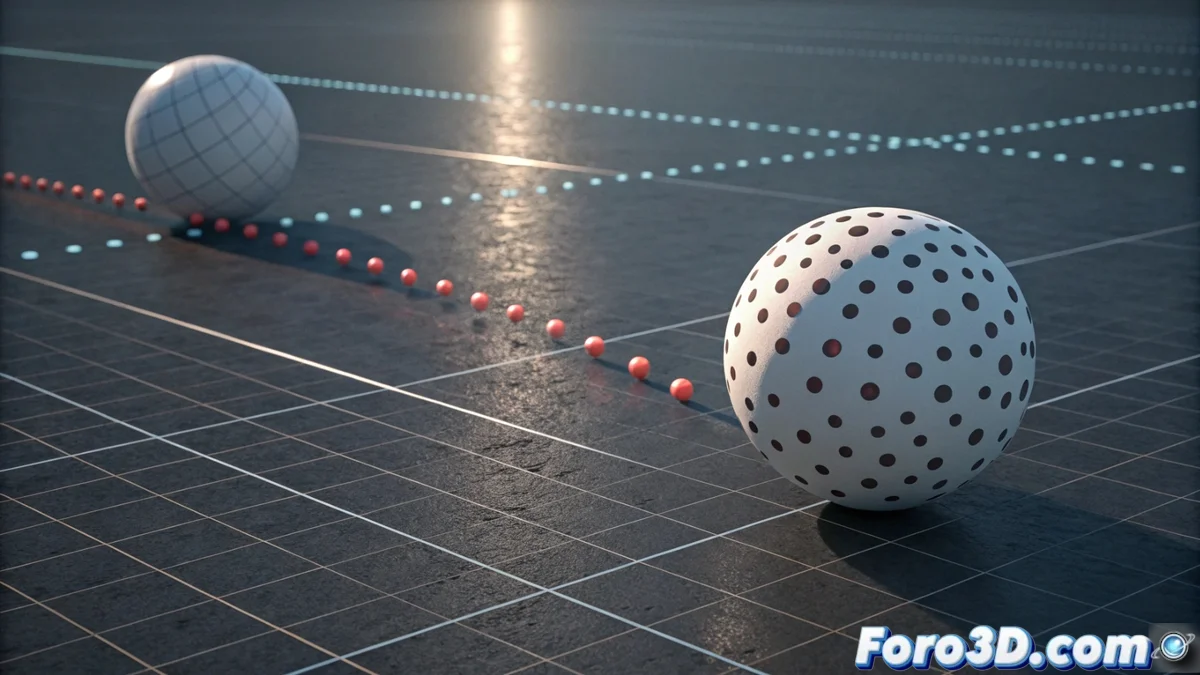
Why Avoid Linear Easing in 3D Animations
Using linear easing for animation means that an object moves at the same speed throughout its trajectory. This method completely lacks changes in acceleration, resulting in a rigid and artificial visual outcome. In contrast, movements in nature are almost never constant, as forces like gravity or friction modify them. For the audience to perceive an animation as believable, it is essential to imitate these physical properties. 🎬
The Visual Problem of Constant Speed
When an animated element neither accelerates nor decelerates, it appears to slide weightlessly, like a ghost or a cheap robot. This effect breaks the illusion of reality that is sought to be created in 3D environments. The technical solution is to replace the straight line with Bézier curves or mathematical functions that manage speed dynamically.
Basic Types of Easing for Realism:- Ease-in: The movement starts slow and then accelerates progressively toward the end.
- Ease-out: It starts fast and decelerates smoothly upon reaching the destination.
- Ease-in-out: Combines both, with an initial acceleration and a final deceleration. It is the most organic and common option, as it simulates the inertia of a real object.
A character moving with linear easing seems to glide over invisible ice, an effect that might only work for ghosts or robots in a low-budget movie.
Implementing Speed Curves is Simple
Almost all modern animation libraries and engines already include these predefined functions. The technical process does not involve calculating different displacements, but rather transforming the linear progress of time using one of these curves. Thus, the interpolated value between point A and B is distributed non-linearly, varying the speed in each frame.
Key Advantages of Adopting Non-Linear Easing:- The total displacement is the same, but the visual perception gains naturalness.
- It communicates the weight and materiality of animated objects.
- The movement becomes more appealing and dynamic to the human eye.
Conclusion for Animators
Abandoning linear easing is one of the most effective adjustments to improve the quality of an animation instantly. By opting for curves like ease-in-out, basic physical laws are simulated, making viewers believe in what they are seeing. Prioritizing this detail makes the difference between mechanical movement and animation with life and character. 🚀