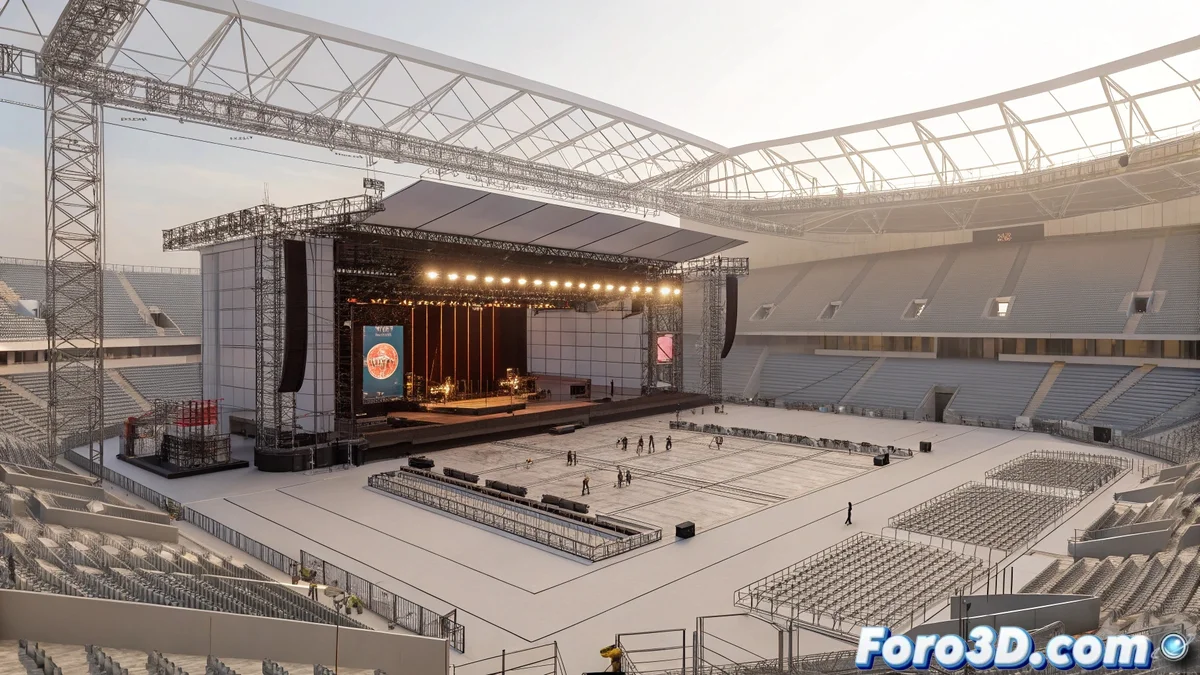
Building the Digital Stage for the 30th Anniversary of Achtung Baby 🎪
Following the announcement of U2's return with their world tour to celebrate the thirtieth anniversary of Achtung Baby, the perfect opportunity arises to recreate this experience in Unreal Engine. This tutorial focuses on the meticulous construction of the stage and its atmosphere, allowing visual artists to design a virtual concert that captures all the energy and spectacle of the Irish band. From the basic structure to the final effects, each step brings us closer to total immersion.
Initial Project Setup
The first step is to open Unreal Engine and select an empty project oriented towards architecture or real-time scenes. This choice provides a clean canvas, free of predefined assets, ideal for setting up a virtual stadium from scratch. Correctly configuring the space dimensions and units of measurement from the start will prevent scaling issues later, especially when incorporating elements like stands and stages. 🛠️
Modeling the Stadium and Stage Structure
Using basic primitives like cubes, cylinders, and planes, we begin generating the stands, the central field, and the main stage structure. In this phase, the focus should be on proportions and overall composition, leaving fine details for later. Simple blockouts allow for quick adjustments to visibility from different angles and the spatial distribution of key elements.
Dynamic Lighting System
In the Lights tab, several moving spotlights are placed to simulate traditional concert lighting. Configuring their trajectories using animation curves and varying their colors through programmed sequences is essential to create a visual spectacle synchronized with the music. Unreal Engine's Lumen lighting system allows these elements to interact with the environment in real-time, generating dynamic reflections and shadows that enrich the scene. 💡
Dynamic lighting not only guides the audience's attention but defines the visual rhythm of the entire concert experience.
Incorporation of Screens and Visual Elements
Planes with emissive materials are added to represent the characteristic LED screens of U2's shows. These surfaces can be animated using imported video sequences or dynamic textures controlled by material parameters. Achieving the right balance between brightness and visual content is key to emulating the impact of live projections, especially during climactic moments in the songs.
Workflow in Wireframe Mode
Before proceeding with the final rendered version, activating Wireframe mode in the viewport allows for a thorough review of the geometry. This technical view helps identify issues with polygon density, unwanted overlaps, and the overall organization of the scene. Critical aspects such as:
- Mesh optimization for real-time performance
- Light distribution and their influences
- Object hierarchy in the outliner
become clearly visible and adjustable, ensuring the scene is not only visually impressive but also technically solid.
While U2 invests millions in lights, screens, and pyrotechnic effects for their tour, you can achieve equally spectacular results with a few clicks and a good sense of digital timing. In the end, the only smoke you need is the one rendered by the engine. 😉