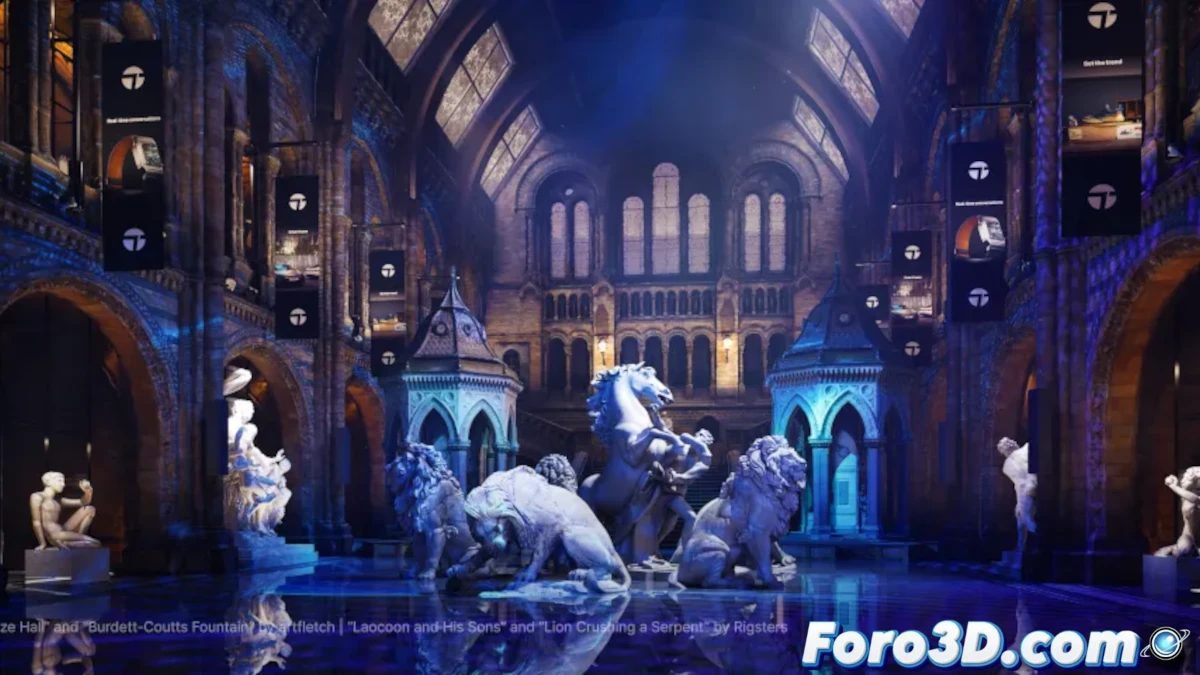
Twinmotion has released its 2025.1 version with a series of significant updates, integrating new technologies thanks to its update to the Unreal Engine 5.5 engine. Among the new features stand out the animated volumetric clouds, the virtual shadow maps, and an automated levels of detail (LOD) system, which improves both visual quality and real-time performance.
Dynamic volumetric clouds for a more realistic sky
The new version incorporates a volumetric clouds system that allows adding realistic skies with dynamic shadows in the scene. This technology enhances atmospheric lighting and enables greater integration with the environment, although its use with the Path Tracer is still in an experimental phase.
Benefits of volumetric clouds
- Simulation of moving clouds with realistic effects.
- Dynamic shadows that improve global lighting.
- Greater sense of depth and realism in outdoor environments.
Virtual shadow maps for greater precision
One of the most important advances in Twinmotion 2025.1 is the implementation of Virtual Shadow Maps from Unreal Engine. This technology improves the quality of real-time shadows, offering greater precision and smoothness in shadow projection on environmental objects.
“Virtual Shadow Maps allow for better integration of lighting in the scene, achieving sharper and more natural shadows.” – Twinmotion Team.
New automatic levels of detail (LOD) system
To improve performance without sacrificing visual quality, Twinmotion has implemented an automatic LOD system, which dynamically adjusts the number of polygons in models depending on the distance to the camera. This allows optimizing project fluidity, especially on devices with more limited hardware.
Advantages of the LOD system
- Reduction of resource consumption without loss of visual quality.
- Optimization in loading complex models.
- Better experience on devices with lower processing capacity.
Advances in materials, lights, and rendering
In addition to improvements in lighting and shadows, Twinmotion has incorporated new features in material and light management, highlighting:
- Greater control over fog density and its height in the scene.
- Adjustments to sky turbidity for more realistic lighting.
- New base material for tires with automatic UV generation.
- Advanced options in car painting, including surface imperfections.
- Incorporation of a particle system for dynamic effects like confetti.
Improvements in sequence editing and animation
To optimize the creation of cinematic sequences, Twinmotion has added a new orbital camera and the option to define a target for the Action Cam. This facilitates capturing movements in architectural visualization and product design projects.
Optimization in model integration
The environment panel has been redesigned to better differentiate sky and HDRI-based lighting, in addition to including a new modeling panel with basic adjustments for imported geometries.
New import formats
- Support for .wire models from Alias, improving workflow in automotive design.
- Option to import double-sided geometries in real time.
Conclusion
With the 2025.1 update, Twinmotion introduces important improvements in realism and performance, incorporating new technologies for volumetric clouds, virtual shadows, and levels of detail management. With advanced adjustments in lighting, materials, and editing tools, this version offers a smoother and more optimized experience for architects, designers, and 3D content creators.