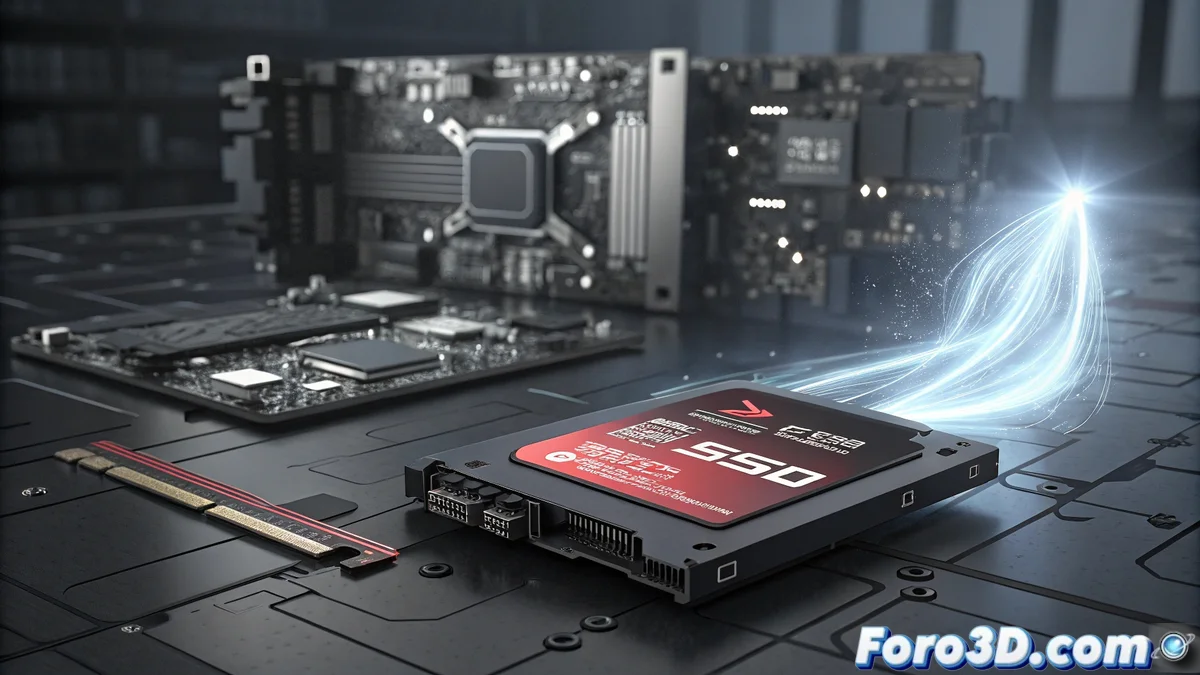
Farewell to an Old Friend in Storage
There was a time when installing a SATA SSD in a computer was the best possible upgrade. The leap from a mechanical hard drive was so abysmal that you felt like you had a supercomputer. 💾 But technology advances, and what was revolutionary yesterday has become a bottleneck today. SATA SSDs, with their theoretical limit of 600 MB/s, simply cannot keep up with the current demands of software, especially in professional content creation environments.
The Present: PCIe 4.0 for Most
The standard that has taken over massively is PCIe 4.0. These units, which connect directly to the M.2 slot on the motherboard, offer read and write speeds exceeding 7,000 MB/s. 🚀 For a gamer, this means almost instant loading times. For a 3D artist or video editor, it means the ability to work with high-resolution textures and 4K sequences without the system freezing. It's the sweet spot between performance and price.
PCIe 4.0 is the new de facto standard for any modern mid-to-high-end PC.
The Future Is Already Here: PCIe 5.0 for Professionals
For those who work with hundreds-of-gigabyte files, like VFX projects or extremely complex 3D models, PCIe 5.0 is the answer. With speeds that can exceed 12,000 MB/s, these SSDs can move data at a speed that seemed like science fiction a few years ago. 💻 The downside is that they generate more heat and require effective heatsinks, plus a motherboard and processor that support this standard.
- Sustained Performance: NVMe drives don't slow down drastically when filled, unlike SATA.
- Direct Integration: Connecting to the motherboard simplifies the PC's internal wiring.
- Future-Proof Investment: Buying a PCIe 4.0 or 5.0 today ensures the system won't be obsolete for years.
Is the Switch Worth It?
If your work depends on data transfer speed, the answer is a resounding yes. 🕒 The time saved loading projects, rendering, or moving large files translates directly into greater productivity. For general use or office work, a SATA may be sufficient, but it's like driving an old car on an empty highway: it works, but you're not taking full advantage of the road's potential.
So, if you still have a SATA SSD, you can look at it fondly, like someone keeping a compact disc. It served its purpose in its time, but the world now moves in high-speed data streaming. 📀 A nice memory of a simpler era.