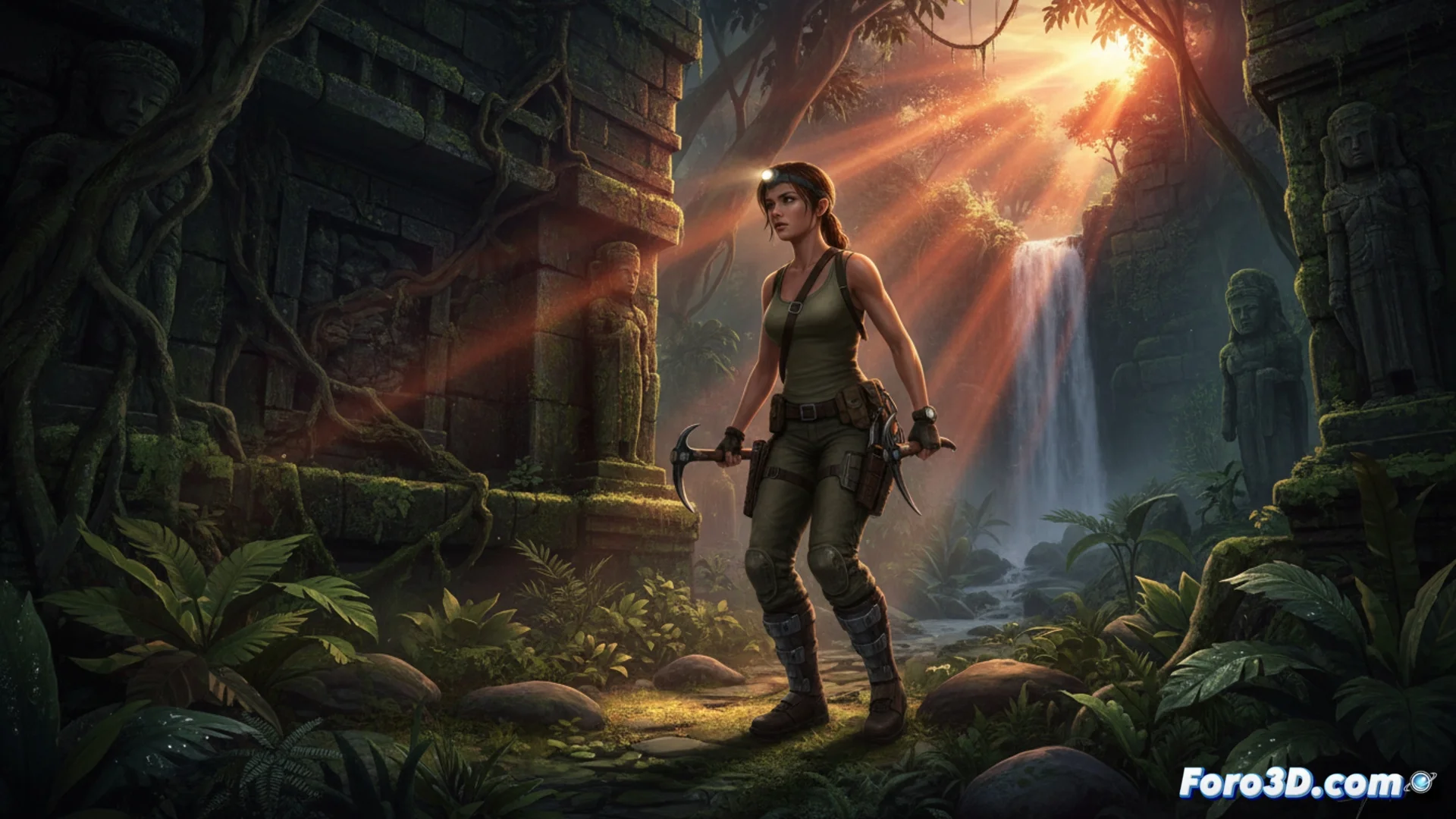
Shadow of the Tomb Raider Remaster Renews Its Graphics Engine
The definitive edition of Shadow of the Tomb Raider runs on a modern revision of Crystal Dynamics' Foundation engine. This adaptation leverages next-generation console hardware to integrate advanced visual effects and ensure smoother performance. The team has worked to make the base code operate more efficiently on these platforms, enabling the inclusion of contemporary graphics technologies without losing the essence of the original game 🎮.
The Foundation Engine Incorporates Ray Tracing and 4K Resolution
The most significant technical improvement is the inclusion of ray tracing to calculate shadows and ambient occlusion. This brings superior realism to the environments, especially the lush jungles and dark crypts where light behaves in more complex ways. Additionally, all textures have been upscaled to native 4K resolution using artificial intelligence tools, defining details with exceptional sharpness. Players can choose between a fidelity mode, which prioritizes these graphical advancements, and a performance mode, which aims to achieve 120 fps.
Main Visual Advancements:- Implementation of ray tracing for more realistic shadows and ambient occlusion.
- Remastered textures in native 4K using AI techniques.
- Two configurable graphics modes: Fidelity for maximum quality and Performance for high fluidity.
The studio has managed to improve visual assets without recreating all resources from scratch, optimizing development time and costs.
The Development Process Uses Maya and AI Software
To produce this remaster, the team maintained the original development pipeline, which is based on Autodesk Maya for modeling and animating characters and environments. The key step was employing specialized artificial intelligence software to increase the resolution of existing textures and also to remaster pre-rendered cinematics. This approach allowed improving graphical resources without needing to generate all assets from the beginning, thus saving valuable time and resources.
Key Elements of the Pipeline:- Continued use of Autodesk Maya for modeling and animation.
- Application of AI tools to upscale textures and remaster videos.
- Development strategy that reuses and improves assets, accelerating the process.
A Visual Leap with Playable Limits
Although Lara Croft now benefits from shadows calculated with greater precision thanks to ray tracing, this technology does not help her find the exit from the intricate tombs that populate her adventure. The remastering focuses on enriching the visual and performance experience, keeping the gameplay and challenges that defined the original work intact. This project demonstrates how optimizing an established graphics engine can breathe new life into a title without altering its core 🔦.