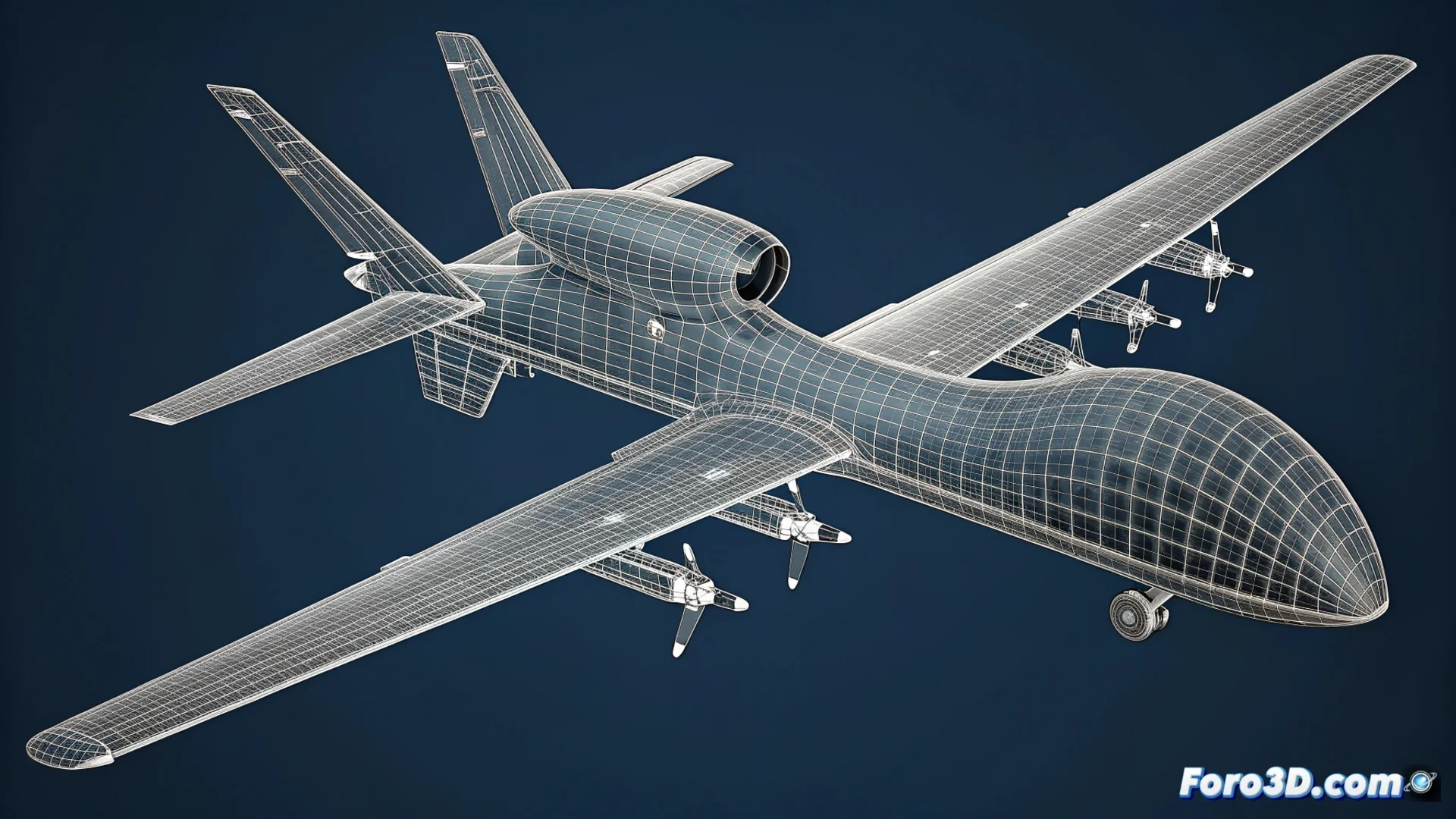
The RQ-4 Global Hawk: a Strategic Surveillance Drone
In the field of aerospace surveillance, the RQ-4 Global Hawk stands out as a key system. This unmanned aerial vehicle operates at high altitude and is designed to carry out reconnaissance missions that require exceptionally long endurance. Its primary function is to gather intelligence, so it is not armed. 🛰️
Anatomy of a Silent Watcher
Its aerodynamic design is fundamental to its performance. It features long and thin wings that optimize efficiency in flights exceeding thirty hours. The fuselage incorporates a distinctive front bulb that houses the sensor systems, while a V-tail and an engine mounted on the upper rear complete its profile, reducing its radar and thermal signature.
Dimensions and Operational Presence:- Wingspan: Nearly forty meters, giving it an imposing presence on the ground.
- Length: Fourteen and a half meters.
- Height: 4.7 meters from the ground.
From the ground, its silhouette is just a silent silver dot that processes entire landscapes as data on a screen.
Observation Capabilities and Sensors
The most outstanding operational capability is to fly above eighteen thousand meters, giving it a very wide field of view. The sensor platform integrated into its ventral canoe can carry various payloads to monitor with great detail.
Main Sensor Systems:- Synthetic Aperture Radar (SAR): For obtaining images in any weather conditions.
- Electro-Optical Systems (EO): For capturing images in the visible spectrum.
- Infrared Systems (IR): For detecting heat and operating at night.
Function and Operation in Airspace
This drone is used to obtain persistent information over large territories, being a key asset for situational awareness. It flies autonomously following a preprogrammed route, although ground operators can modify the mission and monitor data in real time. Its design prioritizes endurance to operate in various atmospheric conditions, being suitable for maritime and land missions. Its value lies in